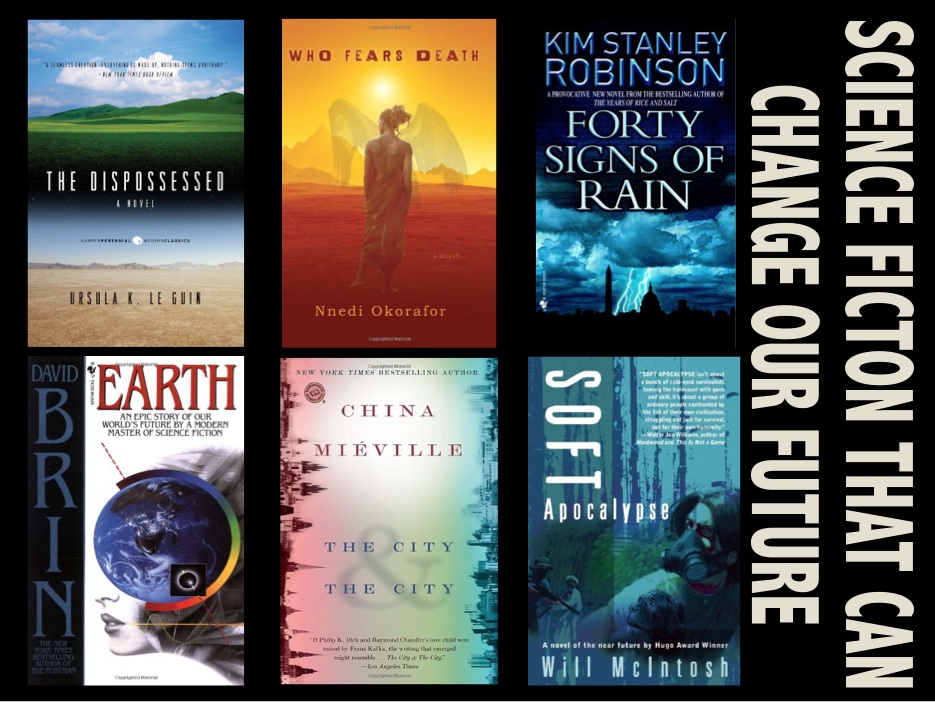
Let's take a pause to envision how science fiction makes a difference. First by pointing at the rocks that lie in wait, downstream, that might yet be avoided. Second, by shining light upon the possible -- on things that we might want, or the people we choose to become. And finally...
... the category of I told you so. Rubbing our Cassandra warnings in the faces of those who just didn't listen! Very soon, I will post about how Robert Heinlein is suddenly oh, so pertinent again, in all three categories. But for now, let us romp through the lesser but still fascinating tulips all around us.
== Appreciation from the mighty ==
We have fans in unexpected places. For example, the (then) President of the United States - in his final interview in office - touted The Three Body Problem, by Liu Cixin and conversed tangentially about the Hugo Award. Yes, he has long been – tangentially – a sci fi reader. Great stuff! But. Um hey, sir? Did you notice my name, in small letters, on the back cover of that book? ;-)

What a terrific interview about books and reading with a truly amazing American who isn't done helping the world.
Even more powerful... Google has shown its appreciation often. For example, I spoke last week at the blue-sky and far-out research group "X" -- with thanks to our host, Rapid Evaluation leader Rich DuVaul and his fine colleagues. And in this article how another group, Google Creative Lab, is currently taking applications for The Five, a one-year paid program for five lucky innovators, drawn from a pool of artists, designers, filmmakers, developers, and other talented, multi-dextrous makers. And yes, SF authors.
In fact, open mindedness has always been present, at least among geniuses. Winston Churchill wrote an extensive essay about… alien life. How amazing! We will fight them on the beaches and the landing grounds...
== Cool links ==
 Tune in
to Episode 5: "Limits of Understanding: cosmology, imagination, and the role of theology", with Paul Steinhardt (author of Endless Universe: Beyond the Big Bang) and David Brin, part of the
"Into the Impossible" podcast series by UCSD’s Arthur C. Clarke Center for Human Imagination.
Tune in
to Episode 5: "Limits of Understanding: cosmology, imagination, and the role of theology", with Paul Steinhardt (author of Endless Universe: Beyond the Big Bang) and David Brin, part of the
"Into the Impossible" podcast series by UCSD’s Arthur C. Clarke Center for Human Imagination.Also check out the extensive archives of Starship Sofa for more audio science fiction stories.
Yea for time sinks! Dust offers a great collection of entertaining and provocative Sci Fi short films.
Good Omens, Neil Gaiman’s first novel, done with the late Terry Pratchett, will be televised by the BBC. And Robert A. Heinlein's Stranger in a Strange Land is coming to television as well.
On the international front... Looks like a really interesting contribution to the African SF Renaissance. Nigerians in Space by Deji Bryce Olukotun, tells the tale of a Nigerian geologist who has been asked by his nation... to steal a piece of the moon.
And this from the New Scientist: In China, this is Science Fiction's Golden Age, by Lavie Tidhar.
And this from the New Scientist: In China, this is Science Fiction's Golden Age, by Lavie Tidhar.
Did SF predict the iPad, Skype... or Trump? Business Insider lists: The seven most freakishly accurate ways science fiction predicted he future.
Larry Niven’s classic story Inconstant Moon asks the question, “What would you do if it were your last night on Earth?” and takes place over one catastrophic night in Los Angeles. It’s been picked up for a film by the producers of The Arrival. Terrific!

In other Niven News, Larry’s terrific novel Protector is assigned reading for the Special and General Relativity course at West Point! The tale’s vivid depiction of interstellar spaceflight at relativistic speeds culminates in a relativistic space “dogfight” past a neutron star. Though of course the tactics shown at the end of Startide Rising ain’t shabby, neither, ahem.
Jeez, what’ll it take to get some royalties, around here? Have a look at an Interesting spin on dittos in a video game… that actually looks kinda cool.
And then there’s this: “Terminator and Avatar director James Cameron has signed a deal with AMC to produce a six-episode documentary series, titled James Cameron’s Story of Science Fiction. The series will explore how science fiction has tried to answer humanity’s “big questions” throughout history.” I’ve been on a lot of these shows, e.g. Masters of Science Fiction and Sci Fi legends, but I expect Cameron to bring a big budget sensibility and a strong sense of why we are all different from our ancestors. Largely because of a new habit of looking ahead.
 Oh, here's another interesting novel, this one by Norman Spinrad (author of Bug Jack Barron and The Iron Dream). HIs latest, The People's Police tells of New Orleans in a near future when Category 6 hurricanes are the norm, when deflation is getting millions tossed from their homes, when voodoo comes alive... and when the police tire of serving the money-masters, devoting their loyalty instead to the common people.
Norman can get a bit polemical... then he makes you laugh out loud with something outrageously unexpected, like a vodoun spirit talker elected governor of Louisiana. I think he gets wrong how our public servants will rise up to protect and defend and serve us. But it is a near-certainty that they will.
 Just released: a graphic novel adaptation of Octavia E. Butler's powerful novel, Kindred.
And Margaret Atwood has created a graphic novel, Angel Catbird -- a tale of genetic engineering.. and a superhero who emerges after the accidental merging of human DNA with that of a cat and an owl. Volume 2, To Castle Catula has just been released.
Following up on his classic American Gods, Neil Gaiman's latest novel, Norse Mythology was released in February -- with his own colorful re-telling of the legends of the ancient Norse pantheon of gods.
Oh, here's another interesting novel, this one by Norman Spinrad (author of Bug Jack Barron and The Iron Dream). HIs latest, The People's Police tells of New Orleans in a near future when Category 6 hurricanes are the norm, when deflation is getting millions tossed from their homes, when voodoo comes alive... and when the police tire of serving the money-masters, devoting their loyalty instead to the common people. Just released: a graphic novel adaptation of Octavia E. Butler's powerful novel, Kindred. And Margaret Atwood has created a graphic novel, Angel Catbird -- a tale of genetic engineering.. and a superhero who emerges after the accidental merging of human DNA with that of a cat and an owl. Volume 2, To Castle Catula has just been released.
Following up on his classic American Gods, Neil Gaiman's latest novel, Norse Mythology was released in February -- with his own colorful re-telling of the legends of the ancient Norse pantheon of gods.
== Science Fiction & Politics ==

Slate has invited ten writers to envision the possible (dystopic?) future of Trump's America. You can read compelling selections by Lauren Beukes, Jeff Vandemeer, Elizabeth Bear, Saladin Ahmed, Nisi Shawl, Ben Winters and others in The Trump Story Project.
Our metaphors fill society. This one was posted with zero commentary needed.