Slate asked science fiction authors to name what books they would recommend to the 2016 presidential candidates.
 Their list offers up Science Fiction That Can Change Our Future -- serious novels that explore changes in our world or civilization and ponder either opportunities or mistakes to avoid. Included are authors like Usula LeGuin, Kim Stanley Robinson, Margaret Atwood, Bruce Sterling, China Mieville, Nnedi Okorafor… oh and yours truly. And no, we aren't all identical, politically. The authors on that list want readers who argue and who are willing to entertain a fresh idea, even when the author is 80% wrong.
How might the future of Earth -- and humanity -- be impacted by climate change? Enter ASU’s Climate Fiction Short Story Contest (deadline January 2016) to be judged by the great Kim Stanley Robinson!
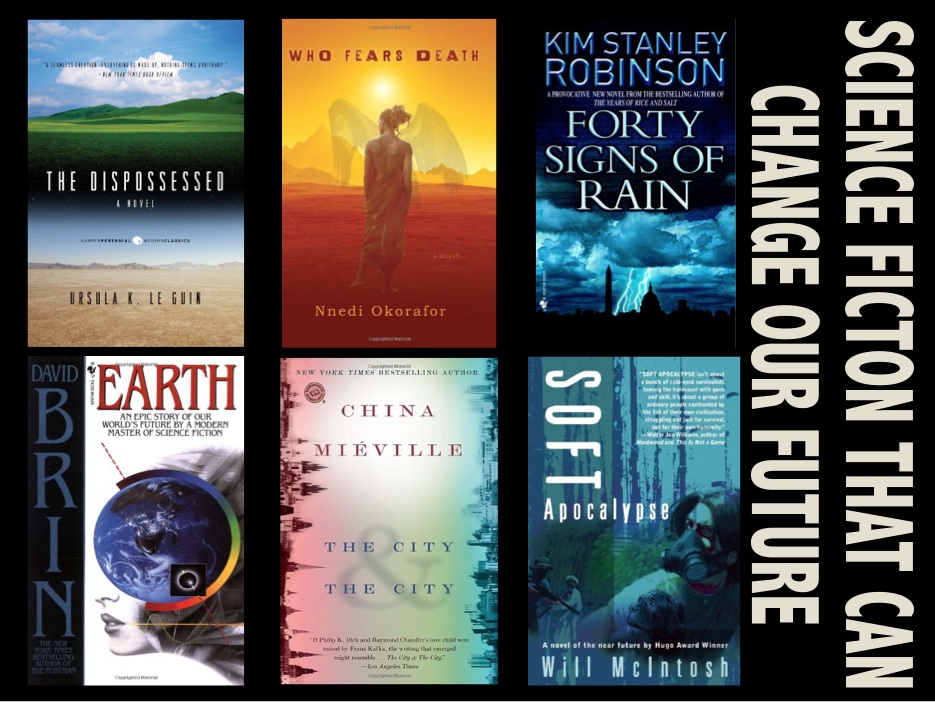 Their list offers up Science Fiction That Can Change Our Future -- serious novels that explore changes in our world or civilization and ponder either opportunities or mistakes to avoid. Included are authors like Usula LeGuin, Kim Stanley Robinson, Margaret Atwood, Bruce Sterling, China Mieville, Nnedi Okorafor… oh and yours truly. And no, we aren't all identical, politically. The authors on that list want readers who argue and who are willing to entertain a fresh idea, even when the author is 80% wrong.
How might the future of Earth -- and humanity -- be impacted by climate change? Enter ASU’s Climate Fiction Short Story Contest (deadline January 2016) to be judged by the great Kim Stanley Robinson!

Want to send your name to Mars? On four successive spacecraft?
NASA can arrange it via the InSight program! Only beware. My short story
“Mars Opposition” suggests a (highly unlikely but vivid) way that there could
be a price to pay. Heh. But what are, you, chicken?
This list of the 120 most helpful websites for writers in 2015 features Contrary Brin as one of those sites. Probably of
more value to writers than my blog would be this popular page of advice - A Long, Lonely Road - that I have long put up. It has my best practical suggestions... and the
sidebar contains other links. See also this entire Scoopit of advice compilations!
== Recent Books ==
See this cool, brief update on the state of Science Fiction in Africa.

Follow that up with this NPR review of of a new novel, Lagoon, by Nnedi Okorafor, a leader in the African SF
renaissance. “Lagos (Nigeria) is
introduced to aliens who can shift their shape, heal wounds, resist death and
change the bodies of the things around them — and claim to want to change human
lives for the better.”
Ring of Fire IV, due for release in May 2016. This will be another major anthology in Eric Flint's 1632 alternate history series. The lead story in that volume will be a novelette... by David Brin. Okay, okay. I couldn't help myself. It's just so much fun.
A look back at a Sci Fi Classic: The Last Question by Isaac Asimov is now in webcomic format. Some of the plot premises (if there is a plot) are silly… but the ultimate question is still… ultimate.

Why haven’t we been visited by tourists
from the future? One possibility is that time travelers keep a low profile in
order to avoid changing the past. But if they can’t change history, why would
they even want to come here? Well, maybe they’re stealing our stuff. It’s an idea Wesley Chu explores in his new
novel Time Salvager — currently
being adapted into a film by Michael Bay — about time
travelers who visit the scenes of famous disasters and salvage materials that
are destined to be destroyed anyway.
This is a blatant homage -- to John Varley's story "Air Raid" which became the 1989 movie
Millennium, where time agents pop into airliners that are about to crash, yank
out the passengers and replace them with crude clones, because they cannot
visibly change the past.
In fact, my very first attempt at a novel, during my freshman year at Caltech (pre 'Air Raid'), took an interesting variation on this theme! Someday, if I get that copy-yourself-to-get-more-done machine from Universal Kilns...
 How is the military envisioning the warship of the future? Lasers and railguns and microwave-spitters... and a tethered drone instead of a mast? Zowee.
See more in August Cole's well-researched techno thriller written with Peter Singer -- Ghost Fleet: A Novel of the Next World War -- where the United States, China and Russia face off in a chilling, frightening version of the Cold War... which rapidly turns dangerously hot. Conflict plays out across the high-tech battlefields of the near future -- over land and sea, cyberspace and outer space -- with all-too-believable complications involving robotic drones, cyberwarfare, artificial intelligence, skilled hackers and more...
 A brilliant debut from Jason M. Hough (pronounced Huff), The Darwin Elevator is a compelling read. The first of Hough's Dire Earth Cycle, the novel is set in a post-apocalyptic 23rd century Earth, which has been ravaged and almost completely depopulated (or turned into savage sub-humans) by a virulent plague. The epidemic is held at bay only in the isolated community at Darwin, Australia, where a mysterious 'gift', a high-tech space elevator was planted by aliens known as 'The Builders'. Only a few immune adventurers are able to leave Darwin to scavenge for valuables... and to seek answers when the alien technology begins to fail. If you like this, Hough's most recent sci fi thriller is Zero World.
 Have any of you read the post-apocalyptic novel One Second After by William R. Forstchen? The sequel, One Year After was recently released. My own "The Postman" received kind of an honorable mention in the first chapter: “I used to be an official employee of the United States Postal Service, and by heaven, I was proud of that. Remember that book some years back and the wretched movie made afterwards about how the postal service reunites America after a disaster like the one we had for real?”
Carl Gutiérrez-Jones, a professor of English at University of California, Santa Barbara, suggests that tales in which science fictional characters face existential or even suicidal choices may play a kind of therapeutic role as they help audiences imagine adaptation in times of terribly traumatic upheaval. See this analyzed in his recent book: Suicide and Contemporary Science Fiction.
In fact, my very first attempt at a novel, during my freshman year at Caltech (pre 'Air Raid'), took an interesting variation on this theme! Someday, if I get that copy-yourself-to-get-more-done machine from Universal Kilns...
How is the military envisioning the warship of the future? Lasers and railguns and microwave-spitters... and a tethered drone instead of a mast? Zowee. See more in August Cole's well-researched techno thriller written with Peter Singer -- Ghost Fleet: A Novel of the Next World War -- where the United States, China and Russia face off in a chilling, frightening version of the Cold War... which rapidly turns dangerously hot. Conflict plays out across the high-tech battlefields of the near future -- over land and sea, cyberspace and outer space -- with all-too-believable complications involving robotic drones, cyberwarfare, artificial intelligence, skilled hackers and more...
A brilliant debut from Jason M. Hough (pronounced Huff), The Darwin Elevator is a compelling read. The first of Hough's Dire Earth Cycle, the novel is set in a post-apocalyptic 23rd century Earth, which has been ravaged and almost completely depopulated (or turned into savage sub-humans) by a virulent plague. The epidemic is held at bay only in the isolated community at Darwin, Australia, where a mysterious 'gift', a high-tech space elevator was planted by aliens known as 'The Builders'. Only a few immune adventurers are able to leave Darwin to scavenge for valuables... and to seek answers when the alien technology begins to fail. If you like this, Hough's most recent sci fi thriller is Zero World.Have any of you read the post-apocalyptic novel One Second After by William R. Forstchen? The sequel, One Year After was recently released. My own "The Postman" received kind of an honorable mention in the first chapter: “I used to be an official employee of the United States Postal Service, and by heaven, I was proud of that. Remember that book some years back and the wretched movie made afterwards about how the postal service reunites America after a disaster like the one we had for real?”Carl Gutiérrez-Jones, a professor of English at University of California, Santa Barbara, suggests that tales in which science fictional characters face existential or even suicidal choices may play a kind of therapeutic role as they help audiences imagine adaptation in times of terribly traumatic upheaval. See this analyzed in his recent book: Suicide and Contemporary Science Fiction.
Take a look at this: A young smuggler raised on the star lanes must rescue his crew, and save the galaxy from demons... See this crowdfunding project aiming at good old fashioned space opera with some cool concept art already in hand: The Magnificient Raiders of Dimension War 1, by author Dante D'Anthony.


