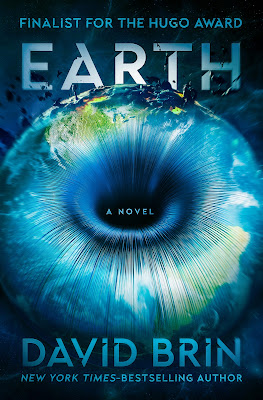
Why? Because EARTH is almost always on every list of Top Ten Novels That Predicted the Future. (It had web pages before there was a Web, or browsers, that I had to mock up myself in 1988. Other themes included: generational conflict over privacy. Floods of climate refugees. Melting glaciers and rising seas. Plus heat waves... and a mother planet that (some characters believe) is finally getting fed up. Plus many other predictive 'hits.'
Anyway, I decided that inserting updates that conform closer to the world of 2023 would be cheating. Hence, my big predictive mistakes are also there! You'll find several.
Anyway, while Open Road prepares for the novel's re-release - with a gorgeous new cover! -- in December or January -- I'll be posting some of those 'predictive hits' here... or just passages that I think you might enjoy. So, let's get started!
The first excerpt from Earth is copied in below... one of the semi-poetical extracts or views into the world of 2038. Much as John Brunner did in his wonderful, still totally relevant classic Stand on Zanzibar.
This passage also has a video reading I posted to Youtube. In fact, you could read along as I recite it!
====
A dust wafts through the hills and valleys of Iceland.
It was a noble and distinguished heritage. And yet, the founders’ principal legacy to their descendants was not that freedom, but the dust.
Whose fault was it? Would it be fair to blame ninth century settlers, who knew nothing of science or ecological management? In the press of daily life, with a family to feed, what man of such times could have foreseen that his beloved sheep were gradually destroying the very land he planned leaving to his children? Deterioration was so gradual that it went unnoticed, except in the inevitable tales of oldsters, who could be counted on to claim the hillsides had been much greener in their day.
Was there ever a time when grandparents didn’t speak so?
It took a breakthrough ... a new way of thinking ... for a much later generation to step back at last and see what had happened year after year, century after century, to the denuded land ... a slow but steady rape by degrees.
But by then it appeared already too late.
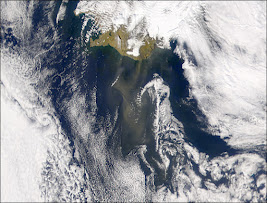 |
| Dust over Iceland (SeaWiFS Project) |
Families adopt an acre here, a hectare there. Some have been tending the same patch since early in the twentieth century, devoting weekends to watering and shoring up some stretch of heath or gorse or scrub pine.
Pilots on commuter flights routinely open their windows and toss grass seeds over the rocky landscape, in hopes a few will find purchase.
Towns and cities reclaim the produce of their toilets, collecting sewage as if it were a precious resource. As it is. For after treatment, the soil of the night goes straight to the barren slopes, to succor surviving trees against the bitter wind.
A dust colors the clouds above the seas of Iceland.
At the island’s southern fringe, a cluster of new volcanoes spills fresh lava into the sea, sending steam spirals curling upward. Tourists gawp at the spectacle and speak in envy of the Icelanders’ “growing” land. But when natives look to the sky, they see a haze of diminishment that could not be replaced by anything as simple or vulgar as mere magma.
A dusty wind blows away the hills of Iceland. At sea, a few plankton benefit, temporarily, from the unexpected nurturance. Then, as they are wont to do, they die and their carcasses rain as sediment upon the patient ocean bottom. In time the layers will creep underground, to melt and glow and eventually burst forth again, to bring another island to life.
Short-term calamities are nothing to the master recycling system. In the end, it reuses even dust.
====
Oh heck, here's another... a snippet extract by one of the characters - in New Zealand - when he learns that a micro black hole might swallow the planet in a couple of years...
====
"You know,” George Hutton said slowly, still contemplating the peaceful view outside, “back when the American and Russian empires used to face each other at the brink of nuclear war, this was where people in the Northern Hemisphere dreamed about fleeing to. Were you aware of that, Lustig? Every time there was a crisis, airlines suddenly overbooked with “vacation” trips to New Zealand. People must have thought this the ideal spot to ride out a holocaust.
“And that didn’t change with the Rio Treaties, did it? Big War went away, but then came the cancer plague, greenhouse heat, spreading deserts ... and lots of little wars of course, over an oasis here, a river there.
“All the time though, we Kiwis still felt lucky. Our rains didn’t abandon us. Our fisheries didn’t die.
"Only now..."
====
I set aside a bunch of these to share with you all, across the next few weeks.
Here's hoping the best of the predictions will still come true... and not the worst ones.