Showing posts with label james webb space telescope. Show all posts

Monday, October 21, 2024

Supernovas, Mars, and solar sails!

We just returned from Pasadena, where Caltech - my alma mater - installed me as Distinguished Alumnus. An honor that I sincerely never expected, given the many brilliant minds I knew when I was there. Reflecting on that is humbling - even 'imposter syndroming' - though people kindly urged me to think otherwise.

In today's delayed posting, I'll be mostly taking a pause from politics... though the topic of my previous blog - about the likelihood of blackmail poisoning top levels of the U.S. republic - remains horrifically plausible... 

...especially now that prominent members of one party are openly admitting that their party is suborned in this way, by foreign powers.

Only now, let's move on to news from out there!


== Space News! ==

I've already posted elsewhere about the incredible "chopstix" landing-grab of a returning heavy-lift SpaceX booster stage. The concept is now proved, even though a whole lot more incremental steps are needed. 

Don't let any polemical jibber-distractions take away from the wonder that was achieved by Gwynne Shotwell and her SpaceX team.

Anyway, as for that distracting blather... well... I recall when there was a similar problem with Frank Zappa -- vast accomplishments that he seemed bent on contiuously spoiling with audience-insulting rants -- until (at last) Zappa listened to the fans shouting he should "Shut up and play your Guitar!" 

The ratio of ravings to accomplishments seems similar, this time. And what will be remembered (whether or not that wise example is followed) is the 'guitar.'**


 == The next steps in space exploration? ==

On this Future in Review (FiRe) podcast, I'm interviewed by the brilliant Berit Anderson - focusing on the near and mid-future of human spaceflight, especially Artemis and other planned missions to the Moon. (Incidentally, the annual FiRe Conference - one of the most visionary gatherings on the planet - has been postponed due to landslides.)

Also.... Just released: a newly-updated version of  Project Solar Sail: 21st Century Edition: A collection of stories and essays exploring the future of lightships and solar sails in propelling interplanetary... and then interstellar... exploration!

This volume (which I edited with Stephen W. Potts) offers classic contributions by Arthur C. Clarke, Isaac Asimov, Larry Niven, Poul Anderson, Jack Vance, and others... plus new material, including by JPL scientists exploring the latest technologies and vast potential for sails in the future of space exploration. 

== A Red/WET Planet? ==

Geophysical/seismic data from the old Mars InSight lander indicates a lot of water – frozen or even liquid – sloshing deep, deep under the surface of Mars. If the water-rich layer now detected deeper below the surface were consistent around the entire globe of Mars, there would be enough water to fill ancient oceans, and then some. 


And while we’re there…


NASA's Innovative & Advanced Concepts program - (NIAC) - is pleased to announce the 2024 NIAC Phase III award to the mighty pioneer of applications of spaceflight to future biology, and vice versa, Lynn Rothschild: “Mycotecture Off Planet: En Route to the Moon and Mars.”  

In other words, growing space habitats with the help of fungi and mushrooms! A house that protects you from vacuum and radiation... and that you can eat!  For a list of all early stage NIAC research, please visit the Funded Studies page. 


The Curiosity Mars rover rolled over a rock, accidentally crushing it open to reveal yellow crystals of elemental sulfur! - the first time sulfur has been found in its elemental form on Mars.


A fine article about my friend & colleague (and half of a mighty fencing team) Geoff Landis, epic scifi author and incidentally superstar NASA scientist, proposing ways to explore Venus. See also Land-Sailing: Venus Rover, where Landis introduces younger readers to methods of exploring - and traveling across - the surface of Venus.


Speaking of Venus…. re-analysis of data from the 1990s Magellan probe appears to show that volcanoes there are still active!


== Gettin’ a little galactic wit it ==


Many of you are familiar with Lagrange points – L1 through L5 – where gravity balance between two objects (the smaller orbiting the larger) creates ‘tidepools’ where even-smaller things can gather. Temporarily or (in the case of Jupiter’s Trojan asteroid clusters) permanently. Here Anton Petrov talks about a (slim) possibility that there might be such a point between our sun and the galactic center.  It would not be able to collect much, with other stars whipping by over millions of years. But still… I do talk about galactic tidepools in Infinity’s Shore!


Mysterious brightening of a distant galaxy: Did this galaxy suddenly brighten, doubling in infrared frequencies, a 10 fold increase in X-rays)… because its central black hole ate a star?


Getting cosmic. Has the James Webb Space Telescope allowed researchers to resolve the “Hubble Tension” or discrepancy in the rate of expansion of the universe?  It may have just been exaggerated… or possible we simply needed a better tool. 


Two huge galactic clusters were colliding at 1% of light speed, billions of years away/ago, heating their gas clouds prodigiously as drag slowed them down… "These cluster collisions are the most energetic phenomena since the Big Bang…"  But while drag slowed the gas and stars, the galaxies’ dark matter apparently kept rolling on ahead at the original velocities, separating dark from regular matter clumps. This is pretty good reporting on how much detailed sleuthing is involved in figuring all this out.

== Truly mind-stretching! ==


Incredible. About 20 seconds into this video by Anton Petrov (one of the best ‘casts about new discoveries in space) you’ll see an amazing image from the Webb Space Telescope. A very deep field photo that dives into the faint past, beyond redshift-3, this one image captures eighty(!) supernovae taking place ‘simultaneously’ (as seen from Earth today) in a single, narrow frame. Each in a different galaxy. 


There are so many things this tells us.


1. Since any one supernova only remains stand-out visible for a few weeks (maybe a bit longer in infrared, the Webb specialty), this means there ‘are’ absolute gobs of them happening out there…

2. …or there used to be gobs of them, since we are in this case peering way back in time, making it a wee bit less surprising, since early star formation must have led to a great many giant, 1st generation stars, of the kind the burn bright and then blow themselves up with core-collapse supernovas… seeding later generations with heavier elements. Certainly, nothing like this rate is occurring “today”… (our redshift <1 era.) Though Betelgeuse is simmering...

3. Since each of the circled supernovae happened in a different galaxy… and it had to be happening a lot, in order for these brief bursts to be so common in one patch of deep sky... it gives you a truly boggling idea how many galaxies there are. A mind stretch that I can only perform for a few seconds at a time. Read more: NASA's Webb opens new window on supernova science..

That we are a civilization capable of building such a wonder as the Webb… and perceiving and marveling at such wonders… fills me with joy! And also fear that we might throw it all away, in a fit of anti-modernity angst, Pushed by powerful fools bent on restoring us to feudalism’s darkness.


More impact news...


Recent chemical and isotopic analyses from samples obtained by coring into the Chicxulub, Mexico's crater site in the Yucatan peninsula, indicate that the 66-million year old mass-extinction event was likely caused by the impact of a carbonaceous asteroid, originating from the outer solar system, rather than a comet.


As for the moon... Bombardment and impact vaporization of meteorites hitting the lunar surface appear to replenish and maintain the moon's extremely thin atmosphere.


Watch this simulation of a black hole tearing apart a star. 


And...You can help find black holes: a new app, Black Hole Finder - enables citizen scientists to help identify singularities in astronomical images collected by BlackGEM telescopes in Chile. 


And yeah. Again. ALL of this is under threat by ingrates with a lunatic grudge against not only scientists, but every fact-using profession. A too-seldom-mentioned aspect of this dire fight for the only civilization that ever brought us all these wonders... and that now stands poised to venture the stars.


If we decide not to blow it.


====


====


** Patrick Farley's Electric Sheep Comix appears to no longer support the beautiful series DON'T LOOK BACK, which featured Guitar spaceships!  You could nag him to repost it?  


Or else enjoy... and be terrified by... APOCAMON, revealing what fate some of our neighbors believe and fervently salivate for, from from the Book of Revelation. OMG read that one and know what they want and plan for us! People who want this are not nice and they are openly telling you what they want for you.


Friday, January 26, 2024

Yet more Space News! And reasons for us to have some confidence.

There are so many reasons why we ought to refuse and reject the propaganda-against-confidence, out there. A better-than-expected economy?  Dropping crime rates? A working vaccine against malaria and looming extinction for both the Guinea worm and polio? Uneven but steady, incremental steps toward justice... and even progress toward saving the planet!  

Please look at these! https://www.abundance360.com/ and https://futurecrunch.com/goodnews2023/

But above all, incredible science!  So today let's deal with the science that's actually above it all. In space!

== Let's live up to Ingenuity ==

The little Mars helicopter that could. It's mission is now officially over, due to damaged blades. This may not be the very last hurrah. But still... hurrah little guy.

Meanwhile Japan's SLIM lunar lander bots - a mostly successful ensemble! Though one little pike on top coulda prevented the showoff headstand.... Some of the design concepts emerged from studies funded by NASA's Innovative & Advanced Concepts program - (NIAC).

== Looking out there ==

The Webb Telescope took spectra as a sub-Neptune planet passed in front of its star, letting Webb detect the presence of methane and carbon dioxide in the exoplanet atmosphere, which supported the theory that K2-18 b could indeed be a Hycean (highly oceanic) world… plus evidence of the rare molecule dimethyl sulfide, which might be a strong indicator for the presence of life. On Earth, dimethyl sulfide is created solely as a byproduct of life, most commonly by marine bacteria and phytoplankton.

An infant star! A new image from NASA's James Webb Space Telescope has captured what Earth's sun may have looked like when it was only a few tens of thousands of years old. Enhanced images of this newborns are gorgeous!

Also from Webb: carbon, an essential component of life on Earth, is also present within Europa, Jupiter's ice-covered moon that's believed to hold huge oceans of liquid salt water beneath its icy surface.


The riches pouring from the Webb are amazing: a cornucopia!  For example, Tellurium, an element rarer than platinum on Earth, was just found in the aftermath of a violent cosmic kilonova 1 billion light-years away, thanks to Webb.  


See the James Webb Space Telescopes's views of galaxy M51. And again wow. YOU are a member of a civilization that does this sort of thing. Yet you dare to wallow in gloom and killed confidence? Look at this! You helped pay for the wonder, the competence, the wisdom. Do more.


LIGO my ego! Humanity’s new gravity wave detectors, led by LIGO, are so spectacularly precise that they could parse the tiny difference of arrival time between the g-waves emitted by a neutron star collision 130 million light years away and the subsequent (by just a 2.7 second delay!) arrival of gamma rays then visible light from the same event. Truly wonderful stuff. And humbling that I cannot operate at that plane! 


== Space travel & colonization ==


Just getting big rockets to push more stuff out of the Earth’s grip will not be enough for Mars colonization. Other absolutely necessary ingredients will include ISRU facilities robotically utilizing local water to make fuel and air and drinkables, with full tanks before any human departs Earth-Luna space. Also vastly better recycling. And solutions to zero-g and radiation health dangers. And – above all – nuclear interplanetary rockets for shorter transit times.


Speaking of which… this Fission Fragment Rocket Design is one of our projects at NASA's Innovative & Advanced Concepts program - (NIAC).


The one – and only one – verified-likely “lunar resource’ – other than the hot air of Artemis-booster blowhards – is a few somewhat-verified deposits of water-ice in some permanently shaded polar crater areas. Alas, even that attractive bonanza seems to be downgraded. “Deposits of nearly pure ice tens to hundreds of meters thick are no longer expected” according to  new research in Physics World.  “The outlook for would-be lunar water prospectors isn’t entirely negative, though. “We now have more accurate maps for where the largest concentrations of ice can be expected on the Moon.”


There might also (maybe) be debris fields of collectable iron bits from past meteorites. And if someone develops a very efficient solar smelter, maybe a couple other metals. Someday. But if you want water out there in space… and just about anything else… lift your gaze!  


NASA and Japan and the EU should explore the riches of asteroids and leave that  dusty plain of poison lunar dust – to the kiddies, tourists and Apollo-wannabes.


Okay… time to cue the insipid Helium Three cult! Over to you guys.


== Look up! But with judgement & skepticism? ==


This BigThink photo-essay by Ethan Siegel does a terrific job illustrating the 'distance ladder' method for measuring the 'Hubble Constant' rate of expansion of the universe, now double checked by the Webb Telescope. This method's metric differs from one got from the microwave background, a conundrum! one you'll understand much better from this excellent piece of sci-journalism.


Failure to find a giant ‘planet X' way out there, perturbing into the inner solar system, has led to models suggesting a smaller one, orbiting closer in. This world, frozen and dark, would be no greater than 3 times the mass of Earth, and orbiting at high inclination no farther than 500 astronomical units from the Sun. Which happens also to be the boundary of the Sun’s gravity-lens zone described in Existence. Hence such a world might (maybe) become an incredible base for making a myriad super telescopes.


Speaking of the outer system… the New Horizons Science Team hopes to use the spacecraft to precisely measure the darkness of space itself. Since it's so dark where New Horizons is – billions of miles beyond the sunlit dust of the inner solar system.


A new study reports ‘conclusive evidence’ for the breakdown of standard gravity in the low acceleration limit from analysis of the orbital motions of long-period, widely separated, binary stars. If verified, this might – maybe – confirm a conjecture of  the late physicist Jacob Bekenstein.  


A new paper explores a concept closely related to my novel Existence. “Capture of Interstellar Objects in Near Earth Orbit.” Are many near Earth Objects (e.g. close passing asteroids) actually interstellar arrivals (Like ‘Oumuamua) that Jupiter captured into the solar system?  I show such a trajectory-event happening (with a little assist from the object itself!) in that epic tale!


== Black Hole ‘Eaters’ inside the sun? Or the Earth? ==


My friend and colleague John Cramer was working on the latest of his wonderful “Alternate View” columns for ANALOG, this time regarding a new paper out there… “Is there a black hole in the center of the Sun?”  


Here’s an excerpt from that article’s abstract: “There is probably not a black hole in the center of the sun. Despite this detail, our goal in this work to convince the reader that this question is interesting and that work studying stars with central black holes is well motivated. If primordial black holes exist then they may exist in sufficiently large numbers to explain the dark matter in the universe. While primordial black holes may form at almost any mass, the asteroid-mass window between 10−16−10−10 M⊙ remains a viable dark matter candidate and these black holes could be captured by stars upon formation. Such a star, partially powered by accretion luminosity from a microscopic black hole in its core, has been called a `Hawking star.'”


Phew!  John wrote for my opinion, given that my novel Earth is pertinent.  Here’s some of my response:  


John, your Analog columns are a principal reason to stay subscribed! And this is a fascinating topic! And yes, in Earth the very diverse and eclectic plot is centrally propelled by one protagonist having accidentally dropped his lab-made singularity into the planet. Nearly all physicists are sure it will dissipate... he's not so sure and leads a secret effort to build gravity resonators to 'ping' the planetary interior… and he does find it... and realizes it IS dissipating... but there's another one down there. A more deadly variety of singularity that's been growing since 1908. 


Moreover, his ping triggers something unexpected. His surface resonator and the mystery singularity serve as 'mirrors' that excite stimulated, coherent radiation from the energy-rich core and mantle in between. In other words… a gravity laser! Or gazer.  The potential range of beneficial uses - like spaceflight or saving the world from getting eaten from within - fall aside as it is used by various groups as a weapon.  Till someone notices that all these beams are also doing very strange things to the Earth's mantle... So sure, Earth is relevant to the topic. (It also came in 2nd for a Hugo.)


As for one inside the sun - an intriguing idea that demands compatibility with fundamental observations. 


Amid billions of observed stars, we are witnessing no effects of runaway eating of dense stellar interiors, which ought to cause a rather peculiar kind of supernova in its final stages.  (This is also an answer to the question of whether super-high-energy cosmic rays - vastly more powerful than any produced by the LHC - could make dangerous black holes.) Hence, if a solar core primordial BH does not do runaway eating, not even when an elderly star shrinks to a super-dense white dwarf or neutron star, then what prevents that?And if growth doesn't happen, they why won't it shrink?


Of course, using asteroid size BH to explain Dark Matter is a version of the MACHO theory. If there's that many of them, it certainly could help explain the Fermi Paradox!  Making interstellar travel pretty damn hard because of the Minefield Problem.  The problem with this is that they oughta interact with Jupiter pretty often. And wouldn't some get captured into solar orbit?  They'd have to all be below a certain mass not to be noticed.


Okay, you can see why I saved that part of my conversation with John Cramer to share with you last.


Keep looking up... and continue fighting those who would sabotage your can-do spirit and confidence!


Sunday, July 24, 2022

Space news: from supermassive black holes to asteroids

Okay, let's gat back to spaaaace!  So many reasons to be enthusiastic and to see our shared accomplishments out there as signs of real civilization, down here on Earth... a civilization worth saving.  Plus a few causes for cynicism, alas.

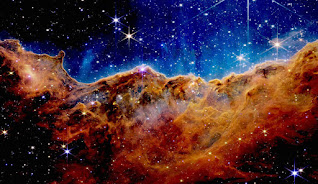
The biggest news: we've received the first vivid images from the James Webb Space Telescope. (The Carina Nebula in spectacular detail shown to the right.) The Webb has produced phenomenal high-resolution images of deep space: galaxies, star clusters, and nebulae - with a promise of more spectacular images  to come!

== Dealing (or not) With Dangers! ==

Breakthrough methods pioneered by the B612 Foundation are finding hundreds of asteroids - some of them dangerous - by mining past data sets. A great way for a small foundation to amplify the more expensive projects funded by governments. Small enough and effective enough to perhaps merit your support. (I am on the B612 advisory board.) 

A Very Long Baseline radio telescope array (I worked for one of the first VLBI systems one summer, in 1969) spanning the entire Earth - the Event Horizon Telescope - has imaged the supermassive black hole - Sagittarius A* - at the center of the Milky Way galaxy. 


Taking the Sagittarius A* image (shown to the left) was like capturing a photo of a grain of salt in New York City using a camera in Los Angeles, according to California Institute of Technology researchers. 


Somewhat smaller… Astronomers believe that 100 million free-floating black holes – largely left over from supernovas - roam our galaxy. Now, after dedicating six years to observations, astronomers apparently found one about  5,000 light years away, located in another spiral arm of the Milky Way.  And with gravitational lensing, they made a precise mass measurement of the extreme cosmic object, which might possibly be ‘only’ a neutron star. 


Meanwhile, Europe’s legendary GAIA space telescope has been an absolute treasure for science, concentrating first on measuring parallax and proper motions of millions of stars near us, then gathering color/spectral data on billions more - – about 1% of the total number in the galaxy – and are allowing astronomers to reconstruct our home galaxy’s structure and find out how it has evolved over billions of years.


You are a member of a civilization that does this kind of thing.


== Back in your SSR backyard – Your Solar System Region! ==


Meanwhile, we keep being inspired by the great Perseverance/Ingenuity mission. The little 'copter snapped these closeups of the now-standard and reliable sky-crane landing system, whose components seem to have crashed more durably than expected.


It makes one wonder: Would it really be that hard to enable these other bits to land softly enough to serve some purpose? Say as a weather station? The rocket+crane bit, especially. It must fly away from the main cargo/rover, sure. But how hard would it be to throttle the remaining fuel-seconds to set down with a simple weather sensors + transmitter? Use up the safety margin!


Anyway, Perseverance and Ingenuity keep surprising us! Like this ballyhooed “doorway” in the face of a cliff. Oh, I totally believe it is a natural fissure... but still, they really need to drive up and get a closer look. One Earth, clean vertical cleavages, like railroad cuts - were key to the sudden emergence of both geology and paleontology.


Phobos could possibly be among the most valuable pieces of real estate in the solar system, if there are volatiles under the surface that can be turned into water and fuel.  See the gorgeous images of Phobos eclipsing the sun, taken by the Perseverance rover!


We know that the magnetic poles of our planet sometimes drift (as today the North Magnetic Pole  is rapidly moving to Siberia) and occasionally quell or even flip.  Now comes speculation that such flips can happen on a massive scale, even to the monster black hole at the center of a galaxy 250 million light years away.


Farther out: The Decadal Survey of NASA advisors has recommended priority be given to… Uranus!


And emerging from some of our old grants at NIAC… the Da Vinci+ probe will try to repeat what Cassini-Huygens did for Titan, only for Venus! I wish the descender-probe had a slow-down balloon, but this will still be… well, not cool. Hot!  At the end of the decade.


And Truly far-out… if within reach… You’ve seen me tout NASA's Innovative & Advanced Concepts program - (NIAC) – on whose advisory council I serve. Look at their tiny seed grants to research concepts JUST this side of science fiction. These are fun, engaging, STEM books for grades 4-8 about the science and researchers behind the NIAC program. It includes information about their lives as young children and their inspiration. Produced in partnership with World Book, Inc., they recently won an award from the American Library Association (ALA). A third series is in early development. The two series help to support a big part of what we do as an early stage technology program- to inspire the next generation of scientists and innovators, children who may eventually be running NASA missions 20 years from now. You are welcome to view the sixteen Out of This World books online here:

Series 1 Out of This World includes titles such as Asteroid: Harpooning Hitcher, Land-Sailing Venus Rover and Laser-Sailing Starships. All available online!

and Series 2 Out of this World includes Fusion-Powered Spacecraft, Martian Cave Colonies, Solar-Surfing Space Probes and many more, also available online.


Read some of these then look around... and have some confidence.

Wednesday, March 23, 2022

Space: wonders from within our solar system - and beyond!

Soon I will be flying to DC for the annual orientation meeting of NASA's Innovative & Advanced Concepts program - (NIAC). Have a look at some of this year's seed grant award-fellowships to study possible technologies just this side of science fiction!

Of course last month's most exciting news was NASA's successful launch and deployment of the James Webb Space Telescope - the largest space telescope, which will help illuminate the mysteries of the cosmos! Here's amazing video of the observatory's separation from the Ariana 5 rocket in space. We are already getting the first images. 

This was the step that had me tense: the latching of the secondary mirror - and the unfurling of its tennis-court sized sunshield. The telescope has now reached its final destination at L2, a million miles from Earth. First public light - last week - was fabulous!

One thing I learned: in order to zero in on a target, the whole spacecraft rotates, but must keep the shield blocking any sunlight or Earthlight. That means Webb will not have much freedom to choose targets at-will, but rather will study distant vistas on an opportunity basis, during its yearly solar orbit. Unlike Hubble, it won't normally be available to swing around toward just any transient phenomena. In a given week, it will have a pretty narrow, ring-like array of possible targets to sample-study. Inside those rings, it will likely be magnificent! So next time there's some transient event out there, like an 'Oumuamua, don't go shouting 'give us the Webb view!' A good reason to keep Hubble.

And more.... NASA will further extend our vision of the cosmos with the Imaging X-ray Polarimetry Explorer, which will provide data on magnetars, supernovae and black holes. And NASA has an ambitious launch schedule for 2022.

LISA- Laser Interferometer Space Antenna - will be an ESA-led and NASA supported mission to deploy laser interferometer arrays into an orbit that follows Earth’s, bouncing beams across distances much larger than our planet. The Europeans have been working on the concept and testing it for decades. Now we may be ready soon to study gravity ripples vastly more sensitively than the already magnificent (and Kip Thorne-led) LIGO array.

Meanwhile, we have fantastic results from our Juno probe orbiting Jupiter and probing the storms down below even 500 km. Helping to illuminate our own weather patterns, these discoveries are simply amazing… almost as amazing as the spectacular competence of an enlightenment civilization that does such things… and the cosmic unlikeliness that citizens of this civilization simply shrug off or ignore such wonders.

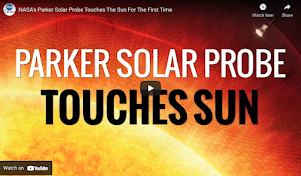
And for the first time, a NASA spacecraft has 'touched the sun.' The Parker Space Probe, launched in 2018, first reached the sun's corona a few months back. The probe will approach the sun 24 times over its lifetime, sending back data about our sun... A good reason to revisit my first novel, Sundiver!

== Wonders beyond our solar system ==

We've long known that the planets of our own Solar System emit powerful radio waves as their magnetic fields interact with the solar wind, but radio signals from planets outside our solar system had yet to be picked up. Till now. “This discovery is an important step for radio astronomy and could potentially lead to the discovery of planets throughout the galaxy." Red Dwarf stars have much more powerful magnetic fields than the Sun's, and the exoplanets we've found orbiting them can be much closer than anything in the solar system; hence interaction might generate powerful radio emissions. This promises a powerful method added to the quiver of planet hunters.


Astronomers caught a 2020 supernova in the act way earlier than ever and the data will be powerfully revelatory. “This is a different situation, because we really know what’s going on and we actually see the death in real time.”


Observations of circumstellar material in close proximity to the star were made by Hubble just hours after the explosion, which, wow. The star shed this material during the past year, offering a unique perspective of the various stages that occur just prior to a supernova explosion.


A bright red dwarf system just 150 light years away has planets orbiting perpendicular to each other. Creepy. 


Intriguing... Scientists find dark matter “bridges” that may reveal the future of our galaxy. A new AI-generated map of dark matter shows previously undiscovered filamentary structures connecting galaxies.


Black hole star destroyers: When a star gets so close to a black hole that the tidal force results in material being stripped from the star… simulated eight ways vividly (!) in this video.


== And finally ==


The BBC did a 5 part history of Earth’s evolution and I am in this final episode: The Anthropocene. It’s very entertaining and lively and informative. Very well-edited! Glad to participate.


One of my colleagues is offering an onliner primer on black holes and how a small one might have… well… See “Tunguska Seminar 05” by Bill DeSmedt, author of Singularity and Dualism.


From the Portalist: a worthy collection of science fiction novels, old and new, that explore deep space... including tales by Poul Anderson, Samuel Delaney, Ursula K. Le Guin, Nnedi Ororafor, Christopher Paolini... and my own Startide Rising.