Showing posts with label education. Show all posts

Wednesday, November 04, 2015

Promising... and worrisome news

Don't let the gloom industry get you down.  The news isn't all bad. Progress happens. For example...

The global extreme poverty rate fell below 10 percent for the first time, according to the World Bank in 2015. Extreme poverty has long been defined as subsisting below $1.25 a day, but the World Bank's adjustment now sets the line at $1.90 a day.  That leaves 702 million people in extreme poverty (or 9.6 percent of the world's population) vs 2012's 902 million people or 12.8 percent. 

Let's step further back: in 1990, 1.9 billion people lived under $1.25 a day. Twenty-five years have brought a substantial decline. Especially if the rise to 1.90 is factored in.

Okay, here's the question. Does this news encourage or enrage you? 

Pause and ponder how both the right and the left have a vested interest in gloom and destruction of our confidence. Sure fight complacency! Redouble our efforts! But that does not excuse reflexively rejecting good news.

Indeed, good news should make us confident we can earn more.

== Chipping away at problems ==

Diseases linked to open-fire cooking kill more people worldwide than HIV and malaria combined. And wood gathering destroys the land and often takes young people away from education or other opportunities. For decades innovators have been offering up "perfect" stoves for the world's poor. Now the latest move is promising. BURN manufacturing is producing clean, efficient cookstoves (made in Kenya) with low emissions that may save lives... and forests across Africa.

Polio may be eradicated worldwide by 2018 -- thanks to vaccines!

Google has launched its Person Finder tool -- which aids users in locating surviving friends and family members in the wake of natural disasters and catastrophes.

A revolution in transportation? Work is 'weeks away' from starting on a $150 million Hyperloop 5-mile test track. The first passenger tests will operate at 160 mph, with an eventual goal aiming toward 760 mph! And yet... this will be long under development.

Self-repairing infrastructure? Researchers are developing drones to autonomously monitor and -- possibly -- even repair the cities of the future.

China is pursuing a high-speed rail project that could connect Los Angeles to Las Vegas -- which would take 80 minutes in high-tech trains traveling 150 mph. And Russia has proposed constructing the world's greatest superhighway, a trans-Siberian route that would cross the Bering Sea, linking London to New York!  So why is America's crazy half reflexively opposed to building such a basic capability that always delivers huge economic benefits?  Oh, yeah.  The "crazy" part.

The future of energy: In Time Magazine's Inside the Quest for Fusion, Clean Energy's Holy Grail, Lev Grossman (author of The Magicians) takes a look at new start-ups investing in innovative approaches to fusion, including Tri Alpha Energy's prototype plasma reactors. They've raised hundreds of millions of dollars to push the frontiers of clean energy. Other companies, such as Helium Energy, are trying new approaches, fusing deuterium and Helium-3.  Meanwhile, German researchers are developing a novel, alternate approach to fusion tokamaks, the Wendelstein W7-X, an immense, supercomputer-designed 'optimized stellerator,' -- the largest ever built. This engineering marvel, under construction for 19 years, can withstand huge temperature ranges and enormous forces. It's due for a plasma trial run in November.

Heading out there... Planetary Resources received $12 million in new funding to further its hunt for resources and rare metals from mining asteroids. 

In the deserts of Nevada, a tower of molten salt will collect solar energy from a million square meters of mirrors in -- in order to store and deliver solar thermal energy after sunset. 

Japan is pushing hard, offering government subsidies,  to transform into a 'hydrogen society.' The hydrogen-fueled Mirai went on sale last year. And yet, Tesla CEO Elon Musk has called hydrogen-powered fuel cells "extremely silly' predicting that they will lose out against next-generation electric vehicles. Me? I totally agree with Elon. The needed infrastructure alone would be loony.  No wonder hydrogen power was a top R&D priority of the Bush Administration, over the objections of every top advisory board.

== The Future of Education ==

AI in the classroom: Meet the artificially intelligent software that is replacing the textbook... and reshaping teaching methods in the classroom. In addition, Google has invested in micro-learning -- short bursts of information on mobile devices -- to allow educational content to reach a wider audience.

Currently college students may spend as much as $4800 for textbooks during their four year education. A recent study indicates that grades did not suffer when open source free textbooks were used instead. It’s not just about money; textbook content can be upgraded, improved and customized by professors.

And yet, 27% of U.S. adults didn't read a single book last year (with a slightly smaller 20% for twenty-something year olds). Even more worrisome, eleven million Americans still lack basic literacy skills -- and are unable to read and comprehend a newspaper article or even a medical prescription. That number rises to 800 million worldwide. 

Environmental concerns and solutions: Climate scientists ponder spraying diamond or alumina nanoparticle dust high in the atmosphere as one method to cool the planet, by reflecting and scattering the sun's energy. Diamonds in the sky? Oh, but geo-engineering should be done in gradual experiments, including the one I think makes the most sense -- fast ocean current fertilization.

Switching back to gloom... Over the next twenty years, lion populations are likely to decline by half across Africa. There were probably a million lions at the beginning of the 20th century; today there may be as few as 20,000, as humans encroach on sensitive ecosystems.

Immigration and citizenship: Okay this is actually a biggie: A federal judge recently ruled that the state of Texas can continue to deny birth certificates to the U.S.-born children of undocumented immigrants. Of course I am outraged at the blatant racism. It may start us down a slippery slope. And yet… it is simple minded and dogmatic not to at least acknowledge an underlying issue that merits adult conversation, not reflex.

It is a matter we might discuss, sensibly and negotiate... once this phase of the American Civil War is over.  Till then, I can only urge you all buy blue kepi hats for next Halloween.  It will send a message to the risen confederacy.  Calm down, rediscover citizenship and join us at the adult table.

Tuesday, May 12, 2015

Preparing for the Future

Sailing into the future...

How stunningly weird is it, that we’ve been in space for almost 60 years… and our first real-genuine experiment deploying a solar sail is about to be launched (by the Planetary Society), later this month? A human lifespan… to get around to trying something to simple, obvious and inexpensive?   The delay is so strange and unlikely, it almost makes one conjure up sci-fi/thriller/paranoid explanations. 

Support the solar sail on Kickstarter.  Something worthwhile.

Other interesting things, in the offing...

Innovating for the future: an interesting article about the history of and the death… and rebirth(?) of corporate research labs, reports that "innovation may no longer be in corporate-affiliated research parks, but is cropping up in unexpected places... which goes hand in hand with rapid shifts and expansions in the information landscape." 

Ah, but as you'll hear me repeat, those who have sabotaged investment in U.S. research are traitors and enemies of our children.  No less.

Financing the future...will we see...an attack of the algorithms? In a disturbing trend, monetary funds run by robots now account for $400 billion of the worldwide economy.

Mining for the future...Last summer the UN's International Seabed Authority issued the first deep sea exploration permits, allowing companies to start actively looking for places to mine Manganese nodules and other sources of rare earth elements from the ocean floor. As I forecast in EARTH (1989). Might this be a way around the current Chinese near-monopoly on rare earths production?

In the short term. Maybe.  But till we're mining asteroids (including "davidbrin") we won't yet be rich enough.

== Powering the Future ==

Speaking of solar... Bike lanes covered with solar panels follow the median of highways in South Korea: “...for 20 miles between the cities of Daejeon and Sejong, they can be running down the median of a six-lane highway. And what's really special about this one is that it is covered with solar panels, generating electricity and shading the cyclists as they ride,” reports this article in TreeHugger. Sounds nice -- till you factor in noise, danger and exhaust fumes.  Reboot idea source.  Try again.

My own passion is to see solar panels running along the west’s great aqueducts, shading the water and reducing evaporative losses. The energy that’s generated would benefit from a clear right-of-way for cheap power lines.  Add a bike-path? Sure!

Better yet, the aqueducts are (not-quite but sort-of) perfect for Elon Musk’s Hyperloop transport system! The main California Aqueduct runs roughly along the I-5 interstate freeway – with, admittedly, a few more twists. The point is that Elon might be able to flexibly hop from one to the other, with the aqueduct portions being much, much cheaper to acquire and build upon than portions running down an interstate median. Now, to power with that water-and-electricity-saving roof of solar cells.

Been musing this idea more and more…

One of you did some of the math: “Just the California aqueduct is 1129 km long and 10 meters wide.  That figures to a surface area = 1.129E7 m^2.  Now, assuming solar energy 1.2 KW per M^2, with 20% conversion efficiency: then this surface area would generate 0.27E7 KW… or 2.7 GigaWatts. Out of California’s current electrical demand ~50GW, that’d be a whopping 6%. Compare this to existing California solar = 6GW, so a complete solar roof over the CA Aqueduct (and that is only the largest of California’s many water channels) would provide half again the existing solar power base in California alone.”

It's been done in India: a canal in Gujarat topped with solar panels. See the picture to the right.

Hm, well, the numbers can be quibbled in either direction.  But not by enough to refute the notion. Now factor in all benefits:

1) No appreciable environmental tradeoffs. Very little additional land need be set aside for this power plant, unlike the vast solar arrays now being erected in sensitive desert areas.

2) Access is simple and secure. The roads and infrastructure needed for construction are already in place.  Indeed, the accompanying power lines can simply follow existing aqueduct rights-of-way, saving time and expense.

3) Excess power has an immediate use, pumping water over the Tehachapis to holding reservoirs that can then be swiftly tapped for hydro power, when clouds come in.

4) Prevention of evaporative loss from the aqueducts themselves.  This is, of course, the biggest win-win benefit, in times of drought. And this is where a call to the smart mob comes in.  Can anyone find estimates of what this saving would amount to?  

Indeed, one must wonder about unintended consequences, as some evaporation would then condense on the solar roof’s support structures. Anti-corrosion will have to be part of basic planning.  Still, here's the capstone that makes all of this sound plausible --

Elon Musk tweeted, "Have asked SolarCity if we can do something philanthropic with the CA aqueducts to help the water crisis. Investigating…"

And...what about the All American Canal as well?

== Preparing for worst cast scenarios ==

Battling infectious diseases: There have been missteps. As this article notes, empty Ebola clinics have been reported: “After spending hundreds of millions of dollars and deploying nearly 3,000 troops to create Ebola remedy centers, the United States ended up creating facilities that have largely sat empty: Only 28 Ebola sufferers have been treated at the 11 remedy units built by the United States military…”

Before getting all outraged at this “waste,” perhaps some perspective? All right, the help arrived a bit late and our civil servants learned a lot, so that they’ll do better next time. Which is… um… kinda the point, yes? For all of its tragedy, this Ebola outbreak was on the medium-small scale, compared with the nightmare scenarios we all might face, next year or next decade.

On that broader perspective, this exercise was, in fact, worth every penny! We’ll be quicker off the mark, next time, better skilled and equipped.

 == Educating for the Future ==

Along the same lines as my posting -- How the American Education System Doesn't Fail -- this article - We don't need more STEM majors, We need STEM majors with liberal arts training --  shows both true wisdom and obdurately silliness.  

Yes, we need to double down on America's investment in "breadth" during college.   All around the world, the normative baccalaureate degree is three years, with 17-year olds diving into narrow fields with utter specialization. 

In sharp contrast, the American (and Canadian) Bachelor's Degree takes four years because all STEM majors are required to take a year's worth of humanities/history/Lit etc... and vice versa for humanities majors needing science survey classes. This article's author is only expressing the value system under which she was raised.  One with which I wholly agree! (As a "scientist/novelist" who earns his living across the entire spectrum.) You want MORE breadth?  Fine. I am down with that.

But to not even acknowledge that's already what we do?  Vastly more than any other nation on Earth?  Did you see her mention that? Even remotely?  Nope, just finger-wagging chiding -- the coin of our era -- instead of constructively pondering how to improve the miracle we already have. Pure silliness.

 == Predicting the Future ==

A reminder to you nit-pickers out there that I am willing to live by the principles that I preach! I have talked a lot about how we need “accountability for those who claim to predict. Actually, my fans have noticed the unusual number of "hits" or predictive successes that seem to have been scored in EARTH. These  accurate foretellings... and some that were embarrassingly off-target(!) are now being tracked at this site.

Feel free to suggest ways in which I have been wrong or right!  Not just in that one novel.

Here’s my essay -- Predictions Registries -- on why we should be doing this for everyone!  Especially politicians and cable news pundits and merchants of fear. 

 = And Finally =

What if...Ayn Rand reviewed children's movies? Hilarious!  

I really like the deep and original song by Big Data - “Dangerous.”  Their video is complex, layered and entertaining, demanding full attention: "How could they know, how could they know.. what I been thinking? Like they're right inside my head because they know, Because they know, what I been hiding..."

Then there’s this more shallow and yet deeply disturbing alternate version. Yeouch! 

Monday, March 30, 2015

How the American education system doesn’t fail

Fareed Zakaria makes a number of excellent points in this article -- Why America's obsession with STEM is dangerous -- about the U.S. education system, whose faults are regularly exposed by those infamous international math tests – but whose huge advantages are almost never discussed, including a culture that seems to engender a major portion of the world’s creativity. 

Zakaria is spot on in many ways… yet he betrays the topic by buying into zero sum thinking. He argues, for example, that calls for increased emphasis on STEM education (Science-Technology-Engineering-Math) must necessarily undermine these creative advantages, by robbing American students of exposure to English, the arts, humanities and other tools of a broad and generally adaptable, modern mind.

Sorry, but that part -- like most zero-sum reasoning -- is pure hokum. 

Oh, Zakaria’s premise is on-target; we need to double down on  our investment in creative generalist education. But his fretfulness distracts from a key point here – that the “well-roundedness” trait is embedded far too deeply in the North American system to be threatened so easily. Its bulwark is fundamental and potent – in the four-year U.S. Baccalaureate degree. 

Most Americans are astonished to learn what a “bachelor’s” degree consists of, across most of Europe and Asia. Taking just three years (nominally), it calls for a 17 year old to dive into a single specialization, almost as narrowly as someone in law or medical or grad school, with only token requirements to lift her or his head and look beyond.

That is a fine way to make science “boffins” (the contemptuous British term for STEM specialists)… or upper-crust history majors who are destined for roles in government or boardrooms, without a clue how the world really works.  But it seems a wretched thing to do to teenagers whose prefrontal lobes haven’t even kicked-in yet, and who should taste from many pots, before deciding which one to cook. Yanks and Canadians rightfully recoil from such a dismal life sentence for any poor teenager who is caught in that premature-specialization machine.

Breadth requirements University of Michigan
The North American university pattern is inherently different in its program, but also in its expectations for what it takes to be a well-rounded citizen. The fourth year of a U.S. Baccalaureate degree consists entirely of breadth requirements. 

A young person who enrolls in a science or math curriculum, at almost 99% of accredited U.S. colleges, may not graduate without taking six or more courses in the arts, humanities, history and literature. Precisely the prescription demanded by Fareed Zakaria, only without the fragility that he implies.

As one side effect, our nascent boffins not only learn much about the color and texture of human experience. They also discover how easy those subjects can be! And hence, an inventor who wants to start a company might decide to get a law degree, or MBA, “on the side.”  Indeed, many do. And this helps to explain Silicon Valley, where boffins rule.

Likewise, North American students in arts or humanities are required to take half a dozen light-but-fascinating science and math survey classes. I taught “Astronomy for Poets,” one year, and saw how happy the guys and gals were, to lose their fear of nerdy things. They left with at least a general awareness of the universe, its scope and rules, and how quickly this adventurous civilization is learning more. See: The Surprising Effectiveness of College Literacy Classes, by Art Hobson.

(Always, every year, one science survey class was more popular than our introductory astronomy course. It was “the Biology Of Human Sexuality.” Curse you, bio nerds!”)

This, too, has had a major outcome. The United States may do badly in international tests of memorized facts and rote skills. But we always score in the top three, at “Adult Science Literacy.”  Last year, U.S. citizens scored in second place. I believe another year we were first!  

Is this an unadulterated success?  Of course not. In order to rank number one or two, the U.S. had only to score twenty-eight percent in adult Science Literacy Rate (SLR) -- a shamefully low bar, that helps to explain why forty percent of our population actually credits blithering nonsense, like climate change denialism and anti-vaccine mania.  What the ASL scores actually show is how bloody awful the rest of the world is, at graduating well-rounded citizens.  Yes, even worse than America.

(Homeopathy? Oh, my.)

Clearly there is just one reason why U.S. "adult" "science" "literacy" would be so much higher than our other scores, measuring the memorized/rote skills of children.  That difference is college breadth requirements. Indeed, during the last decade, reformers in both the EU and Japan have been hand-wringing about this very point, promoting changes in primary, secondary and university education, demanding that they be taught “in a more American manner."

Is everything rosy?  Of course not! Part of the 4-years in the U.S. is making up for the fact that American high school students memorize almost no facts (but learn argumentation skills that are unmatched, anywhere) and must relearn many basics.  Moreover, the skyrocketing cost of a U.S. bachelor's degree is a travesty, in a country that should be investing more in this peerless infrastructure of human development.  There are also increasing concerns that corporations and even rich donors are using their economic power to sway the focus of university education away from the "wide stance" method that engenders so many competitive startups, and more to the old model of providing "boffins" to serve and never ask "why?"

But the main bone that I have to pick with Fareed Zakaria (author of the new book, In Defense of a Liberal Education) is that a balanced view tends to be more accurate.  Most of what he says is right! But he buys into zero sum thinking and jeremiads of doom, when the real news is actually quite mixed. 

Evidence suggests that North Americans have backed the right horse – aiming to teach well-rounded generalists who then, at age 21 or 22, can choose to specialize with a broad grounding and a wide stance. We do this at a cost – doing more poorly than other nations at tests measuring rote skills and memorized facts. This fact, in turn, has hurt those U.S. students who need basic or vocational proficiencies, more than they need exposure to stars and art. We have abandoned vocational education, and betrayed those kids.

But for the 50%+ who do go to college of some sort, there is as much good news, as bad. The pattern is the right one for developing agile, creative citizens. It is a pattern that engendered eighty of the one hundred best universities on the planet. 

Moreover, we can work with that pattern, making it ever better at preparing students for this ever-changing world.


Saturday, September 15, 2012

The New Modernism: Blending Science, Engineering, Art, and Human Imagination

INTRO:  On September 14, 2012, I served as the guest speaker at the grand opening and dedication of the new Structural/ Materials Engineering Building at UC San Diego (UCSD).  Present also and offering remarks were Frieder Seible, Dean of the Jacobs School of Engineering; Pradeep Khosla, the new Chancellor of UCSD; Nathan Fletcher, State Assemblyman; Seth Lerer, dean of UCSD's Division of Arts and Humanities; and Karl Beucke, President of Weimar's famed Bauhaus University. Also present: Irwin Jacobs, founder of Qualcomm and benefactor of the Jacobs School, Bob Akins, my old office mate in graduate school and a founder of Cymer Corp. A video of my talk is available.

The new building is a marvel. Many afterward asked if I would publish my speech.  I hadn't intended to!  But fortunately, my notes were easy to transcribe. So here it is.


The New Modernism: Blending science, engineering, art, and human imagination

Deans Seible and Lerer ... Chancellor Khosla... Assemblyman  Fletcher.. distinguished guests from the Bauhaus,  faculty, students and friends. It's a great honor to speak at the dedication of the latest wonder here at UC San Diego.  The mammoth and magnificent Structural & Materials Engineering Building whose every trait and design feature should help unleash the creativity of those who work within.

Built by the people of this state, with help from generous donors, it represents a major investment in the future of the University of California system, a system which I deem to be one of the diadems in the crown of human civilization.

Here you'll find the new home for endeavors ranging from the ultra-small up to macro and even mega scales.  Problem-solvers within these walls will send robots into the bloodstream and mysterious, non-linear realms within the cell. New work in fluidics, materials and battery storage systems will help us tackle vexing energy problems, extending efficient sufficiency to many of the world's rising poor and helping sustain a planet-wide middle class.

Here, researchers will test the stability of the Earth and strengthen the structures that we plant upon it. They'll innovate and improve the vehicles that carry us across and under the seas, or into the sky and space.

The composites  that make up our vehicles, aircraft and sporting equipment will grow stronger and lighter, and save vast amounts of energy while making us safer. Some will be capable of activity, flexing like muscle or re-shaping themselves, on command. They might also serve as substrates for embedded computational elements, so that the phrase "smart materials" will take on new meaning.

It will be an amazing world when your shoes, your shirt and your dinner plate all actively compute according to your stated desires, responding to your will, learning to serve you with the same graceful assurance that you now expect, when you command the fingers of your hand.

And yet another group will operate within these fascinating walls.  The Medical Devices department will continue UCSD's tradition of finding ways to overcome illness, debilitating handicaps and even some of the limitations placed on us by evolution.

But I want to remark on another milestone.  It is fifty years since the great philosopher C.P. Snow gave his famous address lamenting how the academic world had divided into "two cultures" - one scientific and the other consisting of the arts, the humanities and so on.

Both realms attract great minds! Yet, Snow appraised how these worlds of discourse appeared to speak different languages, parse different logics and view reality in fundamentally incompatible ways.

Academic "scholarship" in the humanities and arts seemed to view Truth with a rear-view mirror of citation, reputation and precedence, in a tradition going back millennia.

Science took a very different approach, in which fame or reputation could be trumped or overcome by fresh facts. In this new culture, every assertion was viewed as contingent, requiring perpetual re-evaluation through criticism and scrutiny by the next experiment.  Then the next.

And yet, this contingency did not led to murky chaos, but to ever-rising confidence in an ever-growing model of the world.

Science distrusted the squishiness of subjective intuition or reasoning.  In return, those who dwelled across campus saw scientists as "boffins" obsessed with merely solid things, bereft of vision or soul.

Underlying this divide was the noxious notion that limited so many of our ancestors... the Zero Sum Game... the assumption that you cannot achieve new powers without abandoning or losing something else. Perhaps something precious. And make no mistake, this way of thinking dominated nearly all human cultures, leading to the banal and stifling logic of feudalism.

One might even envision the great Enlightenment Project -- with its creative markets, science, democracy and so on -- as boiling down to one thing, a rebellion against Zero Sum thinking. A two century campaign to become more than just the sum of our small victories and individual defeats.

Snow despaired over these two cultures ever crossing their divide, though he hoped that it would happen somehow... someday...

...and behold! Look around you now.  It is here, at UCSD... situated in the "bottom left corner of the continent," where anything loose can roll into a wondrous pile... that the dream is coming true, at last.  Where members of both academic cultures want it to come true.

For here, in this marvelous new SME building, fiercely pragmatic researchers and dissectors of objective reality will share floors with the Department of Visual Arts, in spaces that are deliberately intermingled so that engineers will constantly find themselves engaged in conversations with right-brain creators.

And our friends from the Bauhaus know what emerges when that happens.
Something called design.

The joyful blending of breakthrough technology with artistic sensibility... extravagant imagination merging with utilitarian vision, leading, it is hoped, to spaces and tools and devices and projects and inventions... as well as wonderful frivolities...  that people not only find useful but love to use, amid a growing prosperity that's perfectly compatible with a sustainable Earth.

Attention to design becomes clear as you wander this new building.  Observe the way that open space is used, taking advantage of views and the spectacular San Diego environment.  A paradise, indeed! Though one that is also a desert, with little water or energy to spare, And so the design strives hard to compensate with breakthrough efforts at efficiency.

Within, you'll find the groups and departments arranged in clusters that gather professors near their students around common collaborative areas... then other commons areas attract interactions between departments and groups.

And as Dean Lerer alluded in his remarks about building bridges, SME is well situated to stimulate the rest of the campus, encouraging ideas to infiltrate outward, and within.
This building will thrive because its "cells" are leaky. Its structure is malleable and adaptable to changing needs, deliberately almost biological.

Not a rigid expression of one architect's ego, but a willing servant to many more generations of pioneers, who will work within these walls. And who will want to move some of the walls, to make this structure truly theirs.

That is they way design will have to be in the future.

And speaking of the future, the SME has not left out foresight, the gift that springs, as if from the prefrontal lamps of our brows shining light on the perils and opportunities ahead.

Two institutions dedicated to foresight will have their homes here:

and

It happens that I had a humble role in helping Professors Sheldon Brown and David Kirsh plan this bold venture with the Clarke Foundation and every single dean at UCSD, along with the heads of the Salk and Neuroscience Institutes and many other partners, aiming to bring to bear all the tools of science and the arts toward plumbing a great mystery -- where does the fantastic gift of imagination come from?

How can it be taught and nurtured? Can we simultaneously unleash imagination with greater freedom, yet better harness it to individual and human needs?

This cross fertilizing goal of the Arthur Clarke Center is a fitting tribute to Arthur's life, as both a scientist and vividly prescient storyteller... and one who was my personal role model.  I'm proud that my alma mater is honoring him with this bold endeavor.

May I mention a pertinent point? More successful science fiction authors have emerged from UCSD than any other campus on Earth, prompting one of your predecessors, Chancellor Khosla, to ask "Is there something in the water?"

No, it is in the air.  In the ambiance. In the attitude of a civilization, a state, a county, a campus... a building... that views prim scholarly categories as mere suggestions.

A place where the core emphasis remains on our scientific projects... using new structures and new materials to augment our tools, aircraft, buildings, and even our lives...

... but where that process benefits and derives much from openmindedness, curiosity, even humor and art.
A place where collaboration, innovation, and flow between cultures is not only allowed, but encouraged.

Even better, it is taken for granted. A palace for the Positive Sum Game... the notion that we are not bound by limiting assumptions. Where students and faculty and regular folks feel empowered to say: "I can always be a little more than I am."

It is the theme of a new culture that some find frightening in its hubris. One that is so brash and confident that it takes up the challenge we were thrown long ago, wandering in confusion amid the rubble of that Tower in Babel...

...a challenge to grow mature, to overcome the barriers of misunderstanding that separate us, combining both science and art with wisdom to re-gather in a polyglot world. To decipher the universe. To love and understand it and become its co-creators.

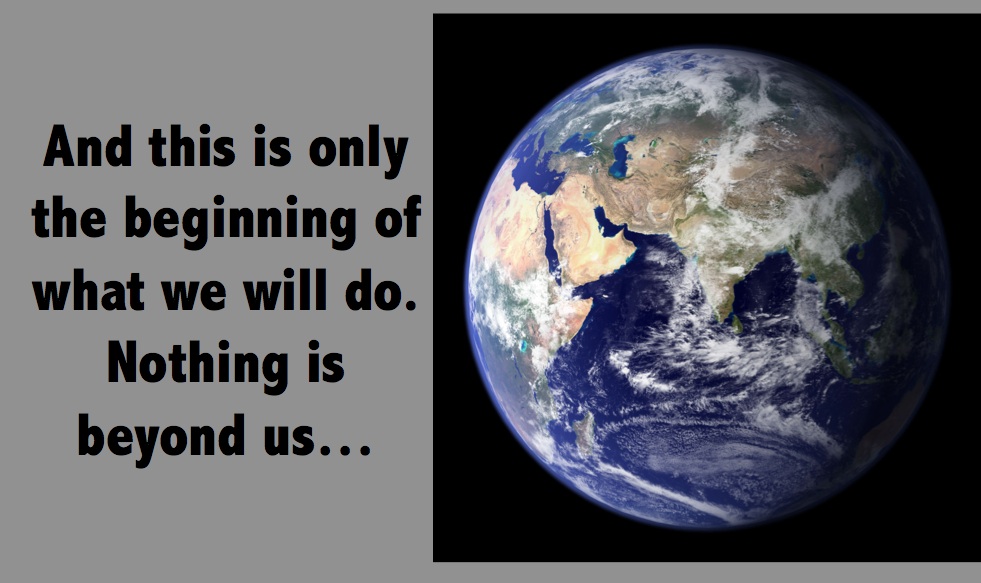
And this is only the beginning of what we will do. Until, truly, as was once promised, we find that nothing is beyond us.