Showing posts with label augmented reality. Show all posts

Monday, July 06, 2020

A Thin Blue Line? What to do about bad cops. Light is our best friend.

The "thin blue line" is a monicker used to stand for police, asserting they are the slender bulwark which keeps society from descending into violent chaos. A more extreme, adversarial emblem of cop solidarity in the face of oppression by an ingrate citizenry - often appearing on tattoos -  is the skull symbol from the Punisher comic series. These memes have spread avidly, now in counter-beat to “Defund the Police” and both of them elicit hand-rubbing glee in Kremlin basement troll farms. (And so - to an extent - does the ill-chosen phrase "defund the police.")


This time I plan to discuss Police Unions, focusing on how to continue protecting ‘good cops’ while finally delivering at long last on 50 years of solemn promises to ‘eliminate the bad apples.’  Indeed, in the short term we need a slogan like: “Protect both citizens AND good cops from the calamity of bad cops.”

Over the long term, though, we’ll see below that that entire point may be moot. Police forces will professionalize and gain accountability, just as they will get much smaller. 
It will happen for many of the same reasons that are playing out  now, in our streets, and that I predicted in The Transparent Society.

== The debacle of Police Unions - a practical reform ==

The New York Times published an investigation explaining how police unions have amassed political power and blocked change. Ever more it’s become clear that the unions are central to the entire mess and their members need to be told: “You can either continue to reflexively protect all your bad apples, using procedural and contractual and legal maneuvers… OR protect the vast majority of your members who are good cops from the deterioration that those bad apples bring to their working lives. You cannot do both.”

Yes, some of those procedural protections had reasons. If a chief or mayor can fire police officers at-will, that power will often be misused politically, or for graft, or blame-deflection. Moreover let’s be clear that eliminating such protections for civil servants, in general, is the top priority – often stated openly – of the Republican Party, bringing back the spoils system and ending the autonomy that has made the 4th branch of government the biggest obstacle to oligarch feudalism.

So, while we aim to bring the cop unions around, turning them into forces for good, that does not mean elimination of procedural safeguards!

Is there a way to get a win-win? There is… and this method can apply to Teachers Unions, too!  Here’s how.

== Simple, direct and practical ==

Set up FIVE STAKEHOLDERS. City officials, senior cop management, neighborhood citizen oversight commissions… and an annual confidential poll of all officers in the precinct.  All are asked to “name cops you know are rotten, or loose cannons, or threats to public safety or professionalism, or who just scare you.”

The fifth input is automatic… from complaints filed against officers.

Now the rule is simple. If an officer is in the bottom 5% according to ALL FIVE stakeholder groups, ejection for cause is automatic. No appeal. No buyout. No nothing. Get lost.

If it’s four out of five, an appeal is allowed, but the presumption favors firing and the appealing cop bears burden of proof it should be otherwise,

If it’s three out of five stakeholders who denounce him, all of today’s processes play out before an impartial board, with firing entirely up to the board. But even if the officer is retained, she or he is publicly named and warned and given retraining.

If the officer is denounced by just two out of five stakeholders, or just one, the board inquires confidentially into causes and determines if a full hearing is called for, and remedial training is needed, but presumption is made in the officer’s favor the first or second time.

This approach allows the union to stand up for members against capricious bias or political interference, or else a public smear campaign. But if the public in a precinct and the cop’s secretly-polled peers AND a citizen oversight panel all agree, shouldn’t the bad apple get to speak… but then (default) go away?

(Note that this entire process is a matter personnel management and not for dealing with specific complaints of particular crimes or wrongdoing, which are handled separately, though they can initiate this process. Here we are talking about simply saying: "Whether or not your misdeeds are proved: we don't want to work with you anymore!")

The same should hold for teachers. We recall one awful fellow who all the parents and students and fellow teachers hated, who was protected by tenure. With those three stakeholders, plus administration and outcome test scores in play, shouldn’t the same sort of arrangement give us a win-win? A way to protect teachers from any one kind of bias campaign or unfair railroading… but also to eliminate the worst, when diverse and competing stakeholders agree?

It’s called NON-ZERO SUM thinking and one of our goals, after winning this year’s life-or-death fight for civilization, should be to reinstate it as something that we normally try to do. You’ll find lots of other examples in POLEMICAL JUDO.

Of course for now, all of the above is just blather. Sure, it would work and all that, finding a win-win overlap of interests. But with black folks being outright murdered before our very eyes, the time for subtle solutions lies ahead of us by months, not days.

For now, we march. We shout. We must.


== A simpler alternative ==

Discussed on NPR - a much more basic solution using market forces to eliminate bad cops …requiring them to individually have (along with their respective police forces) liability insurance, as we require doctors, lawyers, barbers, and hairdressers to do. Sure, the department subsidizes premiums on a matching basis. Still, cops with bad records will be viewed, properly, as bad risks who raise everyone else’s premiums.

Yes I talk about insurance as the libertarian alternative - never mentioned by libertarians - all the time. Including in POLEMICAL JUDO.


== Did I say it’s about light? ==
        
Will you forgive me if I say that much of this ‘cop problem’ ought to go away organically? And for a reason I discussed in The Transparent Society (see especially page 160!) 

The reason is simple, but you may have to pause and step back a minute.

It's long been proved that criminals are not deterred so much by envisioning punishment, as they are by the relative certainty of getting caught.  It matters far less what penalty awaits than knowing “I’ll be seen and identified, so I better not do it.”

And yes, we are seeing it today, on our streets, as the prevalence of phone-cameras has made it harder to conceal misdeeds performed out of doors. Even back in the 1960s, Martin Luther King credited the presence of primitive newsreel and TV cameras with saving his life, multiple times, and verifying the testimony of civil rights workers before the eyes of an appalled public. As Will Smith recently said: “It’s not that things are as bad as the 1860s, they aren’t. It’s not that things are as bad as the 1960s, they aren’t. It’s that they are filmed.”

What I find strange is that no one seems willing to put all this together and extrapolate what happens when citizens become ever-more omniscient, with their pan spectral Augmented Reality goggles supplemented by tiny drones you can order to peek down that dark alley over there. Do you honestly think one top outcome won’t be less violent crime? 


And if there’s a lot less crime, then won’t there be fewer police, allowing us to hyper-professionalize those who remain?

Oh, once, just for once will you curb the cynical reflex and not just leap to assume the worst Orwellian outcomes? Actually work with me, here.

 Let’s suppose citizens calmly do as recommended in The Transparent Society and elsewhere, aiming light of sousveillance at all elites, preventing Big Brother.

Further let's all strive to ensure that we evade the trap of “social credit” homogenization that is being erected in some countries right now, as a means of conformity enforcement and social control. I go on elsewhere about how we can achieve that.

But no, for now let's stick to the street crime that the Thin Blue Line is set up to protect us from. Now squint and consider a future in which you are safe on any street at night, not because every streetcorner has a cop, but because your own augmented senses guarantee it. Most crime is deterred by us, not by armed agents of the state. 

Is that the ultimate overlap of liberal and libertarian goals? That the thin blue line grows thinner as the need diminishes?

And don’t you think the good cops of today – the best ones who remain – would rather practice their calling like doctors, both skilled and relatively rare?

Yes, we have battles in the here and now. I am as hip deep in those as any of you! 


But we are supposed to be the ones who also lift our gaze farther ahead. And the very trends that make us vexed today may also be the ones offering a path to sunlight.

Thursday, August 11, 2016

How will Augmented Reality change us?

Ferocious arguments rage between those who think the Internet and augmented reality powers will liberate humanity, in a virtuous cycle of evolving creativity, vs. gloomy critics who see a kind of devolution taking hold, as millions are sucked into spirals of distraction, shallowness and homogeneity. The pessimists fear we are gradually surrendering what little claim we had to the term “civilization.”
Call it cyber-transcendentalists versus techno-grouches. But is this argument anything new? Certainly science fiction has tended to side with the grouches! Cyberpunk romances portrayed lavish, tech-enhanced realms in which citizens were clueless and the e-wonders were mostly tools for undercurrent battles between oppressive elites and demigod guerrilla hackers. 
Vernor Vinge broke with cynicism in his rather hopeful depiction of augmented reality, in RAINBOWS END. In my own EARTH (1989) kids and citizens wore Tru-Vu Goggles” that empowered them with overlays of useful information. Later, in EXISTENCE (2012), AR gets some updates and surprising uses.
But let’s step back in time. There is nothing unique about today’s quandary. Ever since the arrival of glass lenses and movable type, the amount that each person can see and know has multiplied, with new tools ranging from newspapers and lithographs to steamships and telegraphs, to radio and so on. And every time, conservative nostalgists claimed that normal people could not adapt, that such godlike powers should be reserved to an elite, or perhaps renounced.
Meanwhile, enthusiasts zealously greeted every memory and vision prosthetic — from the printing press to lending libraries to television — with hosannas, forecasting an apotheosis of reason and light. 
Specifically, augmented reality overlays will be tools for instantly validating or questioning the input of our natural senses. Potential environmental hazards will flare at us as we walk. Your “peripheral vision” will include alerts sent to you by a gel lens, floating on a stalk over your head, giving you those proverbial “eyes in back.” Or images from that micro-drone you send ahead of you, down a street or alley.
And you will be tempted into addictions. Just as today’s youths must overcome the allure of endless hours of lavish video games, finely tuned to prevent anyone leaving to pick up a book or go outside…
In reality, the vision and memory prosthetics - ever since glass lenses and movable type - brought on consequences that were always far more complicated than either pessimists or optimists expected. Out of all this ruction, just one thing made it possible for us to advance, ensuring that the net effects would be positive. That one thing was the pragmatically generous mind set of the Enlightenment. 

Yes, for sure, some millions, perhaps billions, will become couch or Net potatoes. Unimaginative, fad-following and imitative. But there is a simple answer.
So what? Those people will matter as little tomorrow as couch potatoes who stayed glued to television mattered yesterday.
Meanwhile, however, a large minority — the “creative minority” that Toynbee called essential for any civilization’s success — will continue to feel repelled by homogeneity and sameness. They will wander away from the opinion echo chambers and the Nuremberg rallies of self-righteously reinforced rage. They’ll seek out the unusual and surprising. Centrifugally driven by a need to be different, they’ll nurture hobbies that turn into avocations that transform into niches of profound expertise.
Already we are in an era when no worthwhile skill is ever lost, if it can draw the eye of some small corps of amateurs. Today there are more expert flint-knappers than at any single point in the Paleolithic. More sword makers than during the Middle Ages. Vastly more surface area of hobbyist telescopes than instruments owned by all governments and universities, put together. Following the DIY banner of Make magazine, networks of neighbors have - among countless projects - started setting up chemical sensors that will weave into hyper-environmental webs.
Imagine how this explosion of hobbies and skills will accelerate when your AR glasses will offer you live tutorials, guiding your hands so that every step comes quickly and clearly? From home repair to lens-grinding all the way to “I know kung fu!” -- won’t this be the start of Neo’s downloaded abilities from the Matrix? Only in a good way?
Addictions? Or a tsunami of skill? It will (as always) be up to us.
(This appeared on Quora, as an answer to: What will be the most important social change that augmented reality will bring?)

== Bio tech insights ==

Using genes (instead of voltages), synthetic biologists design genetic circuits (arrangements of DNA components) that can perform new functions, like AND or OR logic gates, taking an analog input (say the amount of a particular chemical present) and make a binary decision. Note that all this can happen inside a living cell.  In other words Intracellular Computing, which many of us have suspected for decades. If Nature herself uses this approach, it means that there may be hundreds or thousands of “calculations” inside cells for every synapse flash we see on the outside.  Implications for (actually against) AI are huge.

Curious... having three genetic parents appears to make mice age better. 

Each cell in our body contains around 2 meters of DNA. But since our cells are so tiny, DNA strands have to be tightly wrapped into bundles called nucleosomes in order to fit. Now some physicists suggest that the way these lengths are folded also contains information which helps to control which genes get expressed, and when.

New research suggests why the human brain and other biological networks exhibit a hierarchical structure, and the study may improve attempts to create artificial intelligence.  The research findings suggest that hierarchy evolves not because it produces more efficient networks, but instead because hierarchically wired networks have fewer connections. That’s because connections in biological networks are expensive.  

Friday, June 26, 2015

Tech, Skepticism, Transparency and Vision

Our Augmented Future: My talk on Augmented Reality and Transparency given last month to the Augmented World Expo has been posted on YouTube.  How will we use technology to solve the problems of the future...and prevent Big Brother?

Elections Matter in shaping the issues of the future. So does science! So... sign the national call for a presidential debate on science at ScienceDebate.org.

Ignore the Tech Skeptics: This essay by David Auerbach is exceptional and merits attention – on how technology may disappoint us and fall short of utopian fantasies… but that it is still the core of problem-solving ability that could save us in coming years: "If we hope to save ourselves from disaster, technology - real technology - remains our only hope."

And then there are the tech-visionaries: Here's a fascinatingly detailed biography-look at Elon Musk, the cover story in Bloomberg Magazine. Our Edison. 

== Journalism & Science ==

This article by Rhys Taylor - on how journalism treats science – is pretty interesting.  A couple of quotables:  “Furthermore, reading most articles, one gets the impression that "scientists" are some sort of huge homogeneous group, and whenever a mystery is "solved" everyone is instantly content and moves on to something else (apart, presumably, from those unfortunate enough to be perpetually baffled). Of course outside this media fantasy land, proof almost never turns up, and trying to convince everyone that any one idea is better than another is a bit like trying to teach cats synchronised swimming.”

The same argument is made more concisely when I point out that no human activity is more competitive than science and no humans, in the history of our species, are more competitive than scientists.  Diametrically opposite to the image portrayed in media of both the mad far-left and today's entire, jibbering-insane right.

More from Rhys Taylor: “One final point: there seems to be a tremendous lack of interest in the journalistic world into actually bothering to check the press releases and get more details. While the sandwich-eating abilities of politicians are microscopically scrutinised by every news agency in existence, most science articles are little more than carbon copies of the press release. Which doesn't make a lot of sense because whenever anyone bothers to ask, it's very hard indeed to get most scientists to shut up about their research.”

== Tech, Transparency and Vision ==

Like it or not...

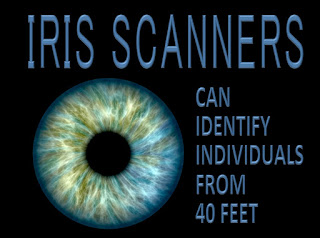
Biometrics are advancing so fast that technology now allows the scanning of irises from a distance of up to 40feet (12 metres) away… exactly as we saw in Steven Spielberg’s film Minority Report.  In fact, “Researchers from Carnegie Mellon University in the US demonstrated they were able to use their iris recognition technology to identify drivers from an image of their eye captured from their vehicle’s side mirror.”


The good news… portrayed in both EARTH (1989) and EXISTENCE… is that: “By using measurements of physiological characteristics, people no longer need security tokens or cumbersome passwords to identify themselves.”  The harsh news is that every measure that you thought would conceal you is probably moot.

Nothing could be more stupid than trying to protect your freedom and safety by hiding and secrecy.  Only one endeavor will prevent this stuff from empowering Big Brother.  Sousveillance.  Looking back.

Will we see public shaming based on the DNA in that gum you spat on the sidewalk? "By analyzing saliva or blood, a company is able to make an educated prediction of what you might look like." Hong Kong uses the method to take cigarette butts from the street, back analyze DNA and post billboard images of what the litterer might look like. Your take-home from this? The village is returning. We can still choose which village, though.

Brain implants are on their way... A lot of people accept “cyborg” enhancements that are either removable (augmented eyeware) or permanently helpful below the neckline (heart valves and joint replacements.) Cochlear implants to give hearing to the deaf?  That’s controversial only among the willfully indignant. Indeed, a fraction of blind folks may soon get rudimentary vision, this way.  Still, the notion gets creepy when you start shoving machinery into “our second favorite organ,” (as Woody Allen called the brain). Concerns stretch back to James Coburn’s wonderful 1960s film “The President’s Analyst.”  


“When we had him come to Crown College at UCSC we watched as his wife "turned him off" with the remote. 300 students and faculty gasped. He woke up laughing when she adjusted the stimulation level.  The future of brain implants promises even more powerful interventions, especially optogenetics. As current potentially deadly or disabling remote implants already are known to have poor security protocols as far as can be found out behind the veil of corporate security, we can expect this to become a bigger issue as time goes on. More people with more interactive and powerful implants is more motivation for people to hack their way into the remotes that control them. Security will improve, of course. But what nontrivial system is every truly safe from compromise?”  (Via Chris Gray.)

Well well… here’s an alternative.  Do it organically! “Toronto scientists and engineers have made a breakthrough in cell transplantation using a gel-like biomaterial that keeps cells alive and helps them integrate better into tissue. In two early lab trials, this has already shown to partially reverse blindness and help the brain recover from stroke.” 

== Tech Advances where we need transparency ==

A new set of algorithms enable robots to learn motor tasks through trial and error using a process that more closely approximates the way humans learn, marking a major milestone in the field of artificial intelligence. “Most robotic applications are in controlled environments where objects are in predictable positions,” said Darrell. “The challenge of putting robots into real-life settings, like homes or offices, is that those environments are constantly changing. The robot must be able to perceive and adapt to its surroundings.” 

This, by the way, correlates with what I believe is likely the way we'll finally get true AI… the only way that - to the best of our knowledge - intelligence has ever arisen in the cosmos, via extended physical interaction with the physical world through a little process called "childhood."  (As discussed in Existence.)

Electrical healing? harmless wounds were created on each upper arm of volunteers.  One wound was left to heal normally, while the other was treated with electrical pulses* over a period of two weeks -- resulting in wounds healing significantly faster.

On the other hand, in a double-blinded, randomized study, UNC researchers found that the IQ scores of people who underwent tDCS brain stimulation improved markedly less than did the IQ scores of people in the placebo group.

Using a weak electric current in an attempt to boost brainpower or treat conditions has become popular among scientists and do-it-yourselfers, but a new UNC School of Medicine study shows that using the most common form of electric brain stimulation had a statistically significant detrimental effect on IQ scores.  So let's step ahead carefully, here.

== Tech Snippets ==

Randall Munroe, the XKCD comix guy, has created a book called the Thing Explainer: Complicated Stuff in Simple Words whose diagrams "cover all kinds of neat stuff—including computer buildings (datacenters), the flat rocks we live on (tectonic plates), the stuff you use to steer a plane (airliner cockpit controls), and the little bags of water you’re made of (cells)" with all the parts described using only the thousand most common English words. Support this guy and share the thing.

Just like some sci fi stories I could name… “The Void is a new start-up based in Salt Lake City, Utah which claims to have gone some way in bridging the gap between physical and virtual worlds by building physical stages which match the virtual environment, then putting players inside.” Visitors immerse themselves in custom-built arenas (Gaming Pods), wearing untethered virtual reality headsets.  Included… haptic feedback to let you know when you’ve been “shot” and other innovations.


Researchers have created an optical lens that can be placed on an inexpensive smartphone to magnify images by a magnitude of 120, all for just 3 cents a lens.  "Our lens can transform a smartphone camera into a microscope by simply attaching the lens without any supporting attachments or mechanism." 


A graphene, lovely miracle graphene!  Now at last someone seems to have figured out how to make it in continuous batches, rolling up long ribbons!  
   

Monday, June 08, 2015

Augmented Reality in the Year 2040

 In honor of AWE  -- the Augmented World Expo at the Santa Clara (CA) Convention Center – where I will speak Wednesday morning – I’ve decided to post this excerpt-chapter from my novel Existence.  It is set at a transhumanist convention in the year 2040. And the point-of-view character is using a LOT of augmented reality (AR) gear as she strolls the aisles, sampling hot new tech trends.  Not the most action-packed scene in the book… but still, I think you geeks, especially, will be amused.  Added Note: You can view my talk to AWE here. 

=====
        

As Tor Povlov entered the vast conference hall, she realized, right away, that she had entered Awz.
        A real-cloth banner, just inside the entrance, proclaimed --
        TOMORROW WELCOMES THE BOLD!
        To which, a tagger had attached, in lurid vrafitti, visible to anyone wearing specs --
        And Next Tuesday Greets the Gullible!
        Beyond, for aisle after aisle, eager companies, foundations and selforg clubs touted “transforming breakthroughs” from smartly decorated booths, augmented by garish VR. Even more than while s-trolling back in Sandego, Tor found her specs bombarded by eager pitches, offering everything from health enhancements to lifespan folding. From guaranteed rejuvenation supplements to home marrow repair kits. 
         From “cyborg” prosthetics to remote controlled nanoflits.
        From fully-implanted brainlink shunts to servant robots.
        Yes, robots. The quaint term was back again, as memory of the Yokohama Yankheand slowly faded, along with a promise that this generation of humanoid automatons would actually prove useful, rather than cantankerous, too-cute, or dangerous. Or all three at once.
        “Every year, they solve some problem or obstacle, in machine-walking, talking, vision, navigation, or common sense,” she subvocalized for her report, letting the specs absorb it all, watching as one aindroid from a Korean chaebol showed off eastasian dance moves and a winning smile. The demonstration was impressive. But demonstrations always were.
        “Then, they always wind up bollixed by some simple task. An uneven flight of stairs. A muddled foreground or background. A semantic paradox. Something that wouldn’t bother a five-year old kid. And every year, the lesson is the same.
        “We are already marvels. A three kilo human brain still combines more amazing things than any computer model can yet emulate.
        “It’s been seventy years that ai-builders have promised to surge beyond human ken. Their list of tricks keeps growing. AI can sift and correlate across all of human knowledge, in seconds. Yet, each decade reveals more layers of unexpected subtlety, that lay hidden in our own packed neuron-clusters all along. Skills we simply took for granted.”  
         There it was, again. A theme, planted in her mind by Sato. The notion that something strangely spectacular had been wrought -- by God or evolution or both -- inside the Homo sapiens brain. About the same time as that chert core in her bag was the technological acme.
        “If anything, today’s Tower of Babel is flat but incredibly wide. This generation of godmakers isn’t thwarted by language -- that barrier is gone forever -- but the bewildering complexity of the thing they hope to copy. Our minds.”
        Of course, some of the products and services here had more modest goals. One body-sculpting booth offered the latest fat-dissolving technology, using targeted microwaves to melt lipids exactly where-u-want. Their slogan -- from Nietzsche -- Tor found ironic on about five different levels.
         “The abdomen is the reason why man does not easily take himself for a deity.”
        She wondered what Sato would make of that. Well, one more humility-reminder bites the dust. When everyone can look good in spandex, will conceit know any bounds?
        Not everyone could wait patiently for all this progress.  Elderly believers in the Singularity grew worried, as it always seemed to glimmer twenty years away, the same horizon promised in the 1980s. And so, Tor passed by the usual booths offering cryonic suspension contracts. For a fee, teams would rush to your deathbed, whether due to accident or age. The moment after a doctor signed-off you were “dead,” skilled teams would swarm over your body -- or (for a lower price) just your detached head -- pumping special fluids to chill in liquid nitrogen, in relished confidence that some future generation would thaw and repair you. Decades ago, cryonics companies eked along with support from a few rich eccentrics. But the safe revival of Guillermo Borriceli changed all that, pushing the number of contracts past thirty million.  One of the offshore “seastead” tax-havens even allowed cryonic suspension before legal death, leading to a steady, one way stream of immigrants who were wealthy, infirm, and -- in Tor’s opinion -- certifiably crazy. 
        They never explain why future generations would choose to revive refugees from a more primitive time. Money alone won’t cut it. 
           Was that why many of today’s rich were converting to fervent environmentalism? Donating big sums toward eco-projects? To bribe their descendants and be recalled as karmic good-guys?  Or was it an expanded sense of self-interest? If you expect to live on a future Earth, that could make you less willing to treat today’s planet like disposable tissue.
        Meanwhile, some offered services aimed at the other end of life. Like new kinds of infant formula guaranteed to enhance early brain development. Or suture-spreaders to enlarge a fetus’s skull capacity, letting its brain expand in the womb – with a coupon for free caesarian section. The brochure showed a happy child with the smile of a Gerber Baby and the domed head of some movie alien… bearing a glint of unstoppable intelligence in big, blue eyes.
        Fifty-Genes Inc. offered a service that was legal at just three seastead colonies. Enhancing the few dozen patches of DNA thought to have been crucial in separating the hominid line from the other apes. Continuing along the evolutionary trail. All three of the people manning that booth wore dazzle makeup, hiding their identities from facial recog programs, making them painful to look at. As if the feds didn’t have ten thousand other ways to track a person.
           Farther along, she encountered yet another humanoid automaton, under a virt-blare that proclaimed Certified: Turing Level Three-Point-Three! in flashing letters. Proportioned like a body builder, it bowed to her, offering Tor a seat, some zatz-coffee and a game of chess -- or any pastime of her choosing. There was a flirtatious glint in the machine’s smile, either cleverly designed... or else...
        She was tempted to plunge a pin into that glossy flesh, to see if this one yelped. The old man-in-a-robot-suit trick.
        A subvocalized side note, for later: No cutsie animal or child-like bots, this year? All hunk-style males, so far. Why? A trend aimed at fem demographics?
        She couldn’t help but wonder. Men across the planet had been using robo-brothels for more than a decade, with hundreds of thousands of Luci, Nunci, Pari, Fruti and Hilti models purchased for home use. It didn’t exactly require artificial intelligence to mimic crude, servile passion, if that’s what some males wanted. Of course, the trend was bemoaned in the press. Women mostly stayed aloof, contemptuous of the unsubtle artificial lovers they were offered.
    
    Till now? While the hunk-bot flirted with her, Tor recalling Wesley’s onetime proposition -- to maintain a cross-continental relationship via dolls. Would it be more palatable to be touched by a machine, if it the thoughts propelling it came from someone she cared for? He was coming to DC in a few days, flying east to meet her final zeppelin, at this journey’s end. Did that mean he was giving such nonsense? Ready to talk, at last, about “getting real?” Or would he have a fist full of brochures to show her the latest enhancements? A modern way they both could have cake, and eat it too?
        Oh crap. The subvocal was on high-sensitivity. Her musings about sexbots and Wesley had gone straight into notes. She blink-navigated, deleted, and disciplined her mind to stay on-task. Spinning away from the enticingly handsome android, multi-tasking like a juggler, Tor kept reciting her draft report without breaking stride.
        “Oh, few doubt they’ll succeed eventually. With so many versions of AI cresting at once, it seems likely that we’ll finally enter that century-old sci fi scenario. Machines that help design their successors, and so on, able to converse with us, provide fresh perspectives, challenge us… then surge ahead.
        “At that point we’ll discover who was right, the zealots or the worriers. Can you blame some folks for getting nervous?”
        Of course, Tor’s aiwear had been tracking her word stream, highlighting for gisted meaning. And, because her filters were kept low on purpose, the Convention Center mainframe listened in, automatically making goorelations. Helpfully, the building offered, in her low-right peripheral, a list of conference panels and events to match her interests.

        My Neighbors Prefer Death: Easing the Public’s Fear of Immortality
        Yes. Out of five hundred program items, that one had good relevance to her “skepticism” phrase. The next one was also a good fit.    
    Risk Appraisal: Dangers on the Road to Transhumanity.
        But it got even better. Tor blinked in surprise at the next offering.
        Special invited-guest lecture by famed novelist Hamish Brookeman! “Reasons to doubt ‘progress’ -- and reasons to believe.”
        Tor stopped in her tracks. Hamish Brookeman? Here, of all places? The author of Tusk! and Cult of Science, coming to beard these extropians in their own den? Who had the courage -- or outright chutzpah -- to invite him?
        With a tooth click and scroll-command, Tor checked the conference schedule... and found the Brookeman talk was already underway!
        Oh my. This was going to be demanding. But she felt up to the challenge.
        Swiveling, she called up a guide ribbon -- a glowing path that snaked toward the lecture hall. Which, according to a flash-alert, was already full to capacity. So Tor sent a blip to MediaCorp, asking for a press intervention. It took a couple of minutes (after all, she was a newbie), during which Tor hurried past a publisher of biofeedback mind-training games and a booth selling ersatz holidays on realistic alien worlds.     
  
Smell Colors! Taste the Rainbow! See Music in the Air! -- hollered a booth offering synesthesia training. Next to another kiosk that proclaimed a kinky aim – to genetically engineer “furries,” cute-but-fuzzy humanoids. Tor shivered and hurried on.
        Abruptly, the guide ribbon shifted, aiming her instead down a different aisle, away from the back of the lecture hall, where standing room crowds waited. Now, it directed her toward the front entrance, closest to the stage. Wow, that was fast.
        I am so gonna love this job, she thought, not caring if that made it into the transcript. MediaCorp already knew. This was what she had been born to do.
        Along the way, Tor passed between stalls offering latest generation otto-dogs, lurker-peeps, and designer hallucinogens... the latter one was covered with vir-stickies on about a hundred levels, sneering “ignore these guys!” and “it’s a narc sting!”
        (As if anyone needed to actually buy drugs, anymore, instead of homebrewing them on a MolecuMac. Or using a meditation program to make them inside your own brain.  A dazer with a twin-lobectomy could hack the lame safeguards.)
        One booth offered a dietary supplement that seemed intriguing, but she didn’t slow down, merely click-noting it for further information, later:
        No More Lemons! blared the virt-banner. Bypassing Humanity's Broken Vitamin C Gene With New Gut Bacteria!
        
But, for the most part, Tor had little attention to spare for exhibits. Kicking her M-Tasking into overdrive, she called up a smart-condensed tivoscript of the Brookeman speech, from its start twelve minutes ago, delivered to her left ear in clipped, threex mode -- triple speed and gisted -- while preserving the speaker’s dry tone and trademark Appalachian drawl.
        “Thanks invitation speak you ‘godmakers.’ Surprised/pleased. Shows UR openminded.
        “Some misconstrue I’m anti-science. Anti-progress. But progress great! Legit sci -tech lift billions! Yes, I warn dangers, mistakes. Century’s seen many. Some mistakes not science fault.
        “Take the old Left-Right political axis. Stupid. From 18th Century France!  lumped aristos with fundies, libertarians, isolationists, imperialists, puritans, all on ‘right.’ Huh? ‘Left’ had intolerant tolerance fetishists! Socialist luddites! And all sides vs professionals. No wonder civil servant’s guild rebelled!
        “Result? Wasted decades. Climate/water crisis. Terror. Overreaction. National fracture. Paranoia. Blamecasting.
        “Shall we pour gasoline on fire?
        “Look. Studies show FEAR sets attitudes/tolerance 4 change. Fearful people reject foreign, alien, strange. Circle wagons. Pull in horizons. Horizons of time. Of tolerance. Of risk. Of Dreams.
        “You tech-hungry zealots answer this with contempt. Helpful?
        “New ‘axis’ isn’t left vs right.
        It’s out vs in!
        “You look outward. Ahead. You deride inward-driven folk.
        “But look history! All other civs were fearful-inward! R U so sure YOU are wise ones?”
        The front entrance to the lecture hall lay ahead, just beyond a final booth where several cleancut envoys in blue blazers passed out leaflets to educated and underemployed U.S. citizens, inviting them to apply for visas -- to the science-friendly EU. The brain-drainers’ placement was deliberate. They’d get plenty of customers, when Brookeman finished.

        Feeling a little eye-flick strain and attention fatigue, Tor clicked for a small jolt of adderall, along with a dash of provigil, injected straight into her temple by the leftside frame of her specs. Just a bit, to keep her edge.
        “Look at topics listed in this conference,” continued the ai-compressed voice of Hamish Brookeman, addressing the audience in the hall next door. “So much eager tinkering! And each forward plunge makes your fellow citizens more nervous.”
        The condensed tivoscript was slowing down and expanding, as it caught up with real time.
        “Ponder an irony. Your premise is that average folk can be trusted with complex/dangerous future. You say people = smart! People adapt. Can handle coming transformation into gods! How libertarian of you.
        “Yet, you sneer at the majority of human societies, who disagreed! Romans, persians, inca, han and others... who said fragile humanity can’t take much change.
        “And who shares this older opinion? A majority of your own countrymen!
        “So, which is it? Are people wise enough to handle accelerating change? But if they are wise... and want to slow down... then what does that imply?
        “It implies this. If you’re right about people, then the majority is right... and you’re wrong!
        “And if you’re wrong about the people... then how can you be right!”
        Even through the wall and closed doors, Tor heard laughter from the audience -- tense and reluctant. But she already knew Brookeman was good at working a crowd. Anyway, most of this bunch had grown up with his books, movies and virts. Celebrity status still counted for a lot.
        “All I ask is ... ponder with open minds. We’ve made so many mistakes, humanity, during just one lifetime. Many of them perpetrated not by evildoers, drenched in malice. But others by men and women filled with fine motives! People like you.”
        An aindroid stood by the door, smiling in recognition as Tor approached. This one featured a hole, penetrating straight though its chest, large enough to prove that the entity was no human in disguise. An impressive highlight. Till the automaton gave her a full-length, appreciative eye-flick “checkout” that stopped just short of a lustful leer. Exactly like some oversexed, undertacted nerd.
        Great, Tor thought, with a corner of her mind MT’d for such things Another realism goal accomplished. One more giant leap for geek-kind.
        The robot opened the door, just enough for Tor to slip through without disturbing speaker or audience. Her specs went into IR mode and a pale green ribbon guided her, without stumbling, the final few meters to a VIP seat that someone had just vacated, on her account. She could tell, because the upholstery was still warm. A wide imprint, and her spec-sensors gave a soft diagnosis of fumes from a recent meal, heavy in starches. If it need be, she could track down her benefactor, from those cues alone, and thank him.
        But no, here was Hamish Brookeman, in the flesh at last, tall and angular, elegant and expensively-coifed. In every way the un-nerd. Leaning casually against the lectern and pouring charm, even as he chastised. The tivoscript faded smoothly, as realtime took over.
        “Look, I’m not going to ask you to restrain yourselves for the sake of holiness and all that. Let others tell you that you’re trodding on the Creator’s toes, by carping and questioning His designs; that’s not my concern.
        “What troubles me is whether there will be a humanity, in twenty years, to continue pondering these things! Seriously, what’s your damned hurry? Must we rock every apple cart, while charging in all directions, simultaneously?”
        Brookeman glanced back down and ruffled some sheets of paper, though Tor’s zoom-appraisal showed that he wasn’t looking at them. Those blue irises held steady, far-focused and confident. Clearly, he already knew what he was about to say. In public speaking, as in music, a pause was sometimes just the right punctuation, before striking a solid phrase.
        “Take the most arrogant of your obsessions,” Brookeman resumed. “This quest for lifespan extension! You give it many names. Zero senescence. Non-morbidity. All of it boiling down to the same selfish hope, for personal immortality.”
        This goaded a reaction from the crowd -- hisses and muttered curses. Tor commanded her specs to deploy a slender stalk wafting upward with a tiny, omnidirectional lens at the end, surveying members of the audience, joining dozens of other gel-eyes floating, like dandelions, up to a meter above the sea of heads.
        “Did I strike a nerve with that one?” Hamish Brookeman chuckled. “Well, just wait. I’m getting warmed up!”
        Clearly, he enjoyed the role of iconoclast... in a hall filled with self-styled iconoclasts. A kindred spirit, then? Even while disagreeing with his hosts over every specific issue? That kind of ironic insight could make her report stand out.
        “For example, it’s easy to tell which of you, in the audience, believes in the magic elixir called caloric restriction. Sure, research studies show that a severely reduced, but wholesome diet can trigger longer lifespans in bacteria, in fruit flies, even mice. And yes, keeping lean and fit is good for you. It helps get your basic four-score and ten. But some of the fellows you see around here, walking about like near-skeletons, popping hunger-suppression pills and avoiding sex.... do these guys look healthy? Are they enjoying their extra years? Indeed, are they getting any? Extra years, I mean.
        “Alas, sorry to break this to you fellows, but the experiment was run! Across the last four millennia, there must have been thousands of monasteries, in hundreds of cultures, where ascetic monks lived on spare dietary regimens. Surely, some of them would have stumbled onto anything so simple and straightforward as low-calorie immortality! We’d have noticed two-hundred year old monks, capering around the countryside, don’tcha think?”
        This time, laughter was spontaneous. Still-nervous, but genuine. Through the stalk-cam, she saw even some of the bone-thin ones, taking the ribbing well. Brookeman really was good at this.
        “Anyway, remember that age and death are the great recyclers! In a world that’s both overpopulated and unbalanced in favor of the old, do you really think the next wave of young folks is going to want to follow in your shadows... forever?
        “Putting things philosophically for a minute, aren’t you simply offering false hope, and thereby denying today’s elderly the great solace that every other ageing generation clutched, when their turn came to shuffle off this mortal coil? The consolation that at least this happens to everyone?
     “During all past eras, this pure and universal fact -- that death makes no exceptions -- allowed a natural acceptance and letting-go. Painful and sad, but at least one thing about life seemed fair. Rich and poor, lucky or unlucky, all wound up in the same place, at roughly the same pace. At risk of quoting a fellow you transhumanists love to hate, Leon Kass claimed that our lives only become meaningful when we are aware of our mortality.
        “Only now, by loudly insisting that death isn’t necessary, aren’t you turning this normal rhythm into a bitter pill? Especially when the promise (all-too likely) turns into ashes, and people wind up having to swallow it anyway, despite all your fine promises?”
        Brookeman shook his head.
        “But let’s be generous and say you meet with some partial success. Suppose only the rich can afford the gift of extended life. Isn’t that what happens to most great new things? Don’t they get monopolized, at first, by the mighty? You godmakers say you want an egalitarian miracle, a new age for all. But aren’t you far more likely to create a new race of Olympians? Not only privileged and elite, but permanent and immortal?”
        Now the hall was hushed. And Tor wondered. Had Brookeman gone too far?
        “Face it,” the tall man told three thousand and twelve listeners present in the hall... plus nine hundred and sixteen thousand, four hundred and eight who were tuned in, around the planet. “You techno-transcendentalists are no different from all the millennial preachers and prophets who came before you. The same goggle-eyed, frenetic passion. The same personality type, yearning for something vastly better than the hand that you were dealt. And the same drive to believe! To believe that something else, much finer, is available to those who recite the right incantation. To those who achieve the right faith, or virtue. Or who concoct the secret formula.
        “Only, those earlier prophets were much smarter than you lot! Because the redemption they forecast was usually ambiguous, set in another vague time and place, or safely removed to another plane. And if their promises failed? The priest or shaman could always blame it all on unbelievers. Or on followers who were insufficiently righteous. Or who got the formula wrong. Or on God.
        “But you folks? Who will you duck behind, when disillusion sets in? Your faith in Homo technologicus -- the Tinkering Man -- has one fatal flaw. It offers you no escape clause.
        “When your grand and confident promises fail, or go wrong, who will all the disappointed people have to blame?
        “No one... but you.”


Want more?  Check out the amazing video preview-trailer for Existence, with incredible art by Patrick Farley!