Showing posts with label sousveillance. Show all posts

Saturday, March 04, 2023

Surveillance & technology

I was planning to publish today the final section (Part III) of "Aficionado" - a stand alone novella that's part of EXISTENCE. Alas, my website host has flaked on me and I want folks to be able to follow up to the book's page. (Suggested hosting alternatives are welcome, in comments.)

So, let me fill in with a little timely riff on surveillance tech.

First, many of you have already seen some of my postings about artificial Intelligence.  Here's my Newsweek op-ed on the Chat-art-AI revolution. TONS more on the topic. 

But let's zoom into...

== Light is coming... ==


UK enacts ownership registry for property held by foreign companies and to identify their true owners. It will seek to ensure criminals cannot hide behind secretive chains of shell companies. Oh, this move toward transparency will have a myriad holes that need to be patched under future scandals. But it is a huge step toward what I’ve demanded since late in the last century.  

Even more important, it will help corner the US into doing likewise… that is, if the GOP shills for criminal oligarchy are defeated, somehow.

Moreover, and I did not know this part! If you can’t prove who owns it, because you set up too many shell companies, the state will hold the property for you for five years, so that the proper owners can come forward and claim their property. After that set time, the state will sell it and take the proceeds to cancel public debt, much of it incurred because of the huge social costs of unaccountable shell corps.

Wow. It looks more and more like my "Declare Ownership!" treaty proposal! Which - (I assert) - could do more to save the world from a terminally stoopid world oligarchy AND zero-out the crippling public debt held by most nations - than any other action, almost overnight. Without inconveniencing honest citizens (even rich ones) even a little bit.


== More on the power of light ==


Is this evidence for the power of transparency? 50 US embassies have air quality monitors and tweet out the readings publicly. Including the embarrassing truth in capital cities whose regimes don't want citizens to know.


Was it a useless gesture? “Cities that had a US embassy that set up one of these monitors and tweeted out air-quality data saw a decrease of PM2.5 particulates to the tune of 2 to 4 micrograms per cubic meter—compared to their air quality before getting the monitor and to other similar cities that do not have a monitor.”  


Moving on. An interesting article proposes that in an ultra-transparent world, we (humanity) could finally ban weapons of mass destruction, like nukes, because even average citizens could thereupon catch cheaters. 


In extremum, this is, of course one of only two solutions to the Ultimate WMD Problem: “what-if a technology is found that lets very small groups cheaply make world-wrecking weapons?”  


Indeed, this is often posed as a compelling possible explanation for the absence-of-any-aliens Fermi Paradox!  A theory that all techno civilizations wipe themselves out, when even teensy mad minorities can access the means to accomplish it.


Up to a threshold, universal citizen transparency would be one answer (though it requires some courage and wisdom that might be rare across the galaxies.) Alas, the only other solution is a total-surveillance despotism.  


Fortunately, that doesn’t seem imminent. And anyway, I doubt that the citizen equi-veillance prescription can be implemented in the near-future.


What can happen is for up-ratcheting sousveillance and empowered citizenship to render ever-increasing numbers of nasty plots moot. And yes, many of our current problems are happening because world elites see those days of transparent accountability approaching - as in the "Helvetian War" I depicted, in Earth. They are making desperate power grabs, while there’s still time.


Where I demur is when this author conflates a mostly transparent world of equi-veillance with an “end to all privacy.” 


Yes, that is a common leap of misunderstanding, and horribly wrongheaded, alack.


I have despaired over how difficult it has been to convey a simple truth… that preserving a substantial amount of privacy will be a SOCIAL decision. One that transparency can help, rather than doom.


== We'll have some privacy, even in a Transparent Society... if we actually want it ==


If the vast majority of citizens deem privacy to be a core desideratum -- that privacy-invasion by snoops, gossips, voyeurs and bullies is a nastiness that merits denouncing -- then those behaviors will be the ones first caught and denounced! 


Please, please try to wrap your mind around that assertion.


If we all can see well, and denounce bad behavior, the common fear is that this will lead instantly to denunciation of eccentrics and mob enforcement of social homogeneity. Indeed that IS the goal and effect in some nations' growing 'social credit' systems! 


(See an interesting (if somewhat suspect) survey of Chinese public attitudes toward the government run “social credit” surveillance system.)


But what about a society whose top values include “leave each other alone” and “mind your own business” (MYOB)? Isn't that what YOU would want? Yet you assume only a select few share that wish, I'll bet. Can you consider a possibility, though? That millions of your neighbors share that value system? 


Yes, that social value system of using transparency to protect each other’s personal space seems a reach beyond our current, immature and sanctimoniously denunciatory society. But the elements are already there, in most Hollywood films wherein suspicion of authority (SoA) and appreciation of diverse eccentricity are among the most-preached values!  I show that in Vivid Tomorrows: Science Fiction and Hollywood.  


You can see that value system in the mirror... in your reaction, just now, wishing “if only my fellow citizens shared my valuing of tolerance and eccentricity and MYOB and SoA!” I agree! Only consider perhaps that goal is closer than you think.


(One of the top stupidities of books and films that warn against privacy loss (e.g. the execrable The Circle) is how they rely on that very value system already existing in their audience, while preaching it at them, while insulting those audience members by claiming that – except for a few hero protagonists - none of us sheep actually have that value. Think about it.) 


Consider what a world filled with light might be like, if we also completed our build toward that MYOB value system?  If the FIRST people judged to be behaving badly are those caught bullying and snooping and not leaving each other alone?


Indeed, then we might not only have no despots and no WMD-nukes. We might also have few voyeur, conformity-enforcing bullies… and a golden age of eccentric diversity.


Please, please... speak up in comments if you know another way to get that. 


== Other Tech news ==


Interested in “Futuristic Design”?  I am, of course! And I’ve consulted with a lot of groups looking for the Next Thing.  One of those consultations, a few years ago paid me to offer scenarios for Earth 2050an attempt to portray planetary changes – especially social/economic/political -- a few decades from now. And as you’ll see, the effort was led by the Kaspersky company, based in Moscow and at the time a leader in computer security software. (Now? Not quite so trusted for varied reasons, some in the news. Still, this is a separate matter.)


As it happened, I gave them a lot more material than anyone else did, for what aimed to be a vivid zoom-in to various parts of the globe, in 2050… a time frame close to my own near future novels Earth and Existence


I do think you might enjoy some of the speculations, and/or find them thought provoking. Like a dive into the great Phosphate Crisis of 2050, making Morocco the richest country in the world. Anyway, it’s good to see at last something come of this project, and it aims to be ongoing.  Though the timing is thought-provoking in its own right.  And now some in the media are actually talking about it!


== and lagniappes ==


QAnon – The Game that Plays People. – Lee Stein.


Amazon – after firing 110,000 employees in time for the holidays – may also be firing … Alexa.


Perpetual drone surveillance… or at least during public events… combined with advanced vision systems… is proposed to deal with mass shooters.


Looking toward the future: My 2015 speech at COFES (Congress on the Future of Engineering Software) covered a range of topics, including the context for a society that actually welcomes and invests in new things and progress. 


Saturday, May 21, 2022

Crypto is not a dog... or doge... or is it?

As this goes online, Bitcoin and other cryptocurrencies are in apparent price-freefall. This posting - prepared over a month ago - will not discuss the recent coin market meltdowns. Still, it seems a good moment to offer some light on one aspect.

First, I actually know a little about this topic. I've consulted with a number of companies, agencies, etc. about the blockchain era. More generally, about the conceptual underpinnings of "smart contracts" and the eerie, free-floating algorithms that were long-predicted by science fiction, but have become reality, as we speak. (Yes they are out there; some may be living right behind the screen you are looking at.)

One topic generating excitement - though the notion has been floating since the 1990s - is that of Decentralized Autonomous Organizations, or DAO, which are portrayed in many novels and utopian manifestos as a way for humans (and their helpers) to bypass sclerotic legacy nations and codger institutions with self-organizing action groups, using NFTs and Blockchain tokens to modernize and revitalize the concept of guilds -- global, quick, low-cost, boundaryless, open and inherently accountable. Bruce Sterling wrote about this notion in the last century (as in his novel, Heavy Weather) and other authors, like Neal Stephenson (Cryptonomicon), Karl Schroeder (Stealing Worlds), as well as Cory Doctorow (Down and Out in the Magic Kingdom), Annalee Newitz (Autonomous), and many others roam this conceptual landscape with agility! 

To a large extent, versions of DAO thinking underlie moves by nations like Estonia (or "E-stonia") to modernize democracy and public services. Also spreading widely is the related notion of Citizen Assemblies

But today I want to focus now on just one aspect of this brave new world: whether DAOs can find a middle ground between autonomy and accountability, by self-policing to reduce bad behavior by predators, while retaining their better, freedom enhancing traits.  

== Can blockchain-based DAOs - especially coin communities - self-police? ==

This is an important topic! Because major legacy nations like China are already stomping hard, using as justification the way cryptocurrencies do empower the very worst of parasitic human criminals. That justification might be reduced or eliminated if DAOs or blockchain communities could find a positive-sum sweet spot, cauterizing predators while preserving their role as gritty irritants, creating pearls of creative freedom.

Although there is no way to "ban" crypto currencies in general, there is an approach to making them much more accountable to real life law.

Let's start with an ironic fact. Blockchain-based token systems are not totally secret!  


Yes, they use crypto to mask the identity of token (coin) holders.  But those holders only "own" their tokens by general consent of all members in a communal 'shared ledger' that maintains the list of coins and which public keys stand ready to be turned by each owner's encrypted keys. In that sense it is the opposite of 'secret,' since the ledger is out there in tens of thousands of copies on just as many distributed computers. Attempts to invade or distort or corrupt the ledger are detected and canceled en masse. (The ecologically damaging "coin mining" operations out there are partly about maintaining the ledger.)


All of this means that - to the delight of libertarians - it will be hard to legislate or regulate blockchain token systems. Hard, but not impossible. For example, the value of Bitcoin rises and falls depending on how many real world entities will accept it in payment. And as stated above, and some governments have been hammering on that, lately.

There is another way to modify any given blockchain token system, and that is for the owners themselves to deliberate and decide on a change to their shared economy... to change the ledger and its support software.  No one member/owner can do that. Any effort to do so would be detected by the ledger's built in immune system and canceled. 


Only dig it, all such ledger-blockchain systems are ruled by a weird kind of consensus democracy. While there is no institutional or built in provision for democratic decision making in the commons - (Satoshi himself may have back doors: a separate topic) - there is nothing to stop a majority of bitcoin holders from simply making their own, new version of the shared ledger and inserting all their coins into it, with new software that's tuned to less eagerly reward polluters and extortionist gangs. 


Oh, sure, a large minority would refuse. Their rump or legacy Bitcoin ledger (Rumpcoin?) would continue to operate... with value plummeted as commercial and government and individual entities refuse to accept it and as large numbers of computer systems refuse to host rump-coin ledger operations. Because at that point, the holdouts will include a lot of characters who are doing unsavory things in the real world.


There are vernaculars for this. Indeed it has been done, occasionally, in what are called soft and hard 'forks.' 


== A forking solution? ==


A “fork,” in programming terms, is an open-source code modification. Usually, the forked code is similar to the original, but with important modifications, and the two “prongs” comfortably co-exist. Sometimes a fork is used to test a process, but with cryptocurrencies, it is more often used to implement a fundamental change or to create a new asset with similar (but not equal) characteristics as the original.


With a soft fork, only one blockchain will remain valid as users adopt the update. Whereas with a hard fork, both the old and new blockchains exist side by side, which means that the software must be updated to work by the new rules. But the aim is to render the old code so obsolete and so widely spurned that it ceases to have any use to anyone.


As an example: Etherium did a fork when about $100 million worth of coins (that would now be worth tens of billions) was tied up in a badly written smart contract that a hacker was stealing. The community decided to kill that smart contract showing that immutable blockchains can change if 50% +1 decides to change it.


If you squint at this, it's really not so radical.  (Don't even ask about the blockchain "spork!"). It is just an operating system upgrade that can only occur by majority consent of the owner-members of the commune.  As pioneered at the famous University of Fork... or...


And so the stage is set to 'regulate' in ways that leave the potential benefits of blockchain - self-correction, smart contracts and the like - alone while letting system users deliberate and decide to revise, a trait that should be possible in any democratic or accountable system.


Now, is there a way to use a Grand Fork to change the insane approach to coin "mining" so that ledger maintenance can be achieved without encouraging planet-killing pollution and waste?


== And finally... ==


The concept that I called equiveillance or look-back accountability, in The Transparent Society - and Steve Mann called sousveillance - is labeled "inverse surveillance" by members of the Asimov Institute, in Holland. “How can we use AI as a Panopticon to promote beneficial actions for citizens by organizations?” A proof of concept was explored in a 2021 hackathon


Well well. These are harder concepts to relate than they might think, I know from experience! Yet they are fundamental to the very basis of our kind of civilization.

Saturday, February 26, 2022

Best way to help Ukraine and peace and justice? Shine searing light on those wrecking the world!

While one hopes for good news from Ukraine, like verification of tales of Russian conscientious defectors, emulating Viktor Belenko... it's also important to remember that this is a worldwide oligarchic putsch that Putin has been ring-leading for a decade. The biggest and best thing the West can do, other than immediate support for Ukrainian resistance?

...would be to dismantle Kremlinite fifth column networks that the slightly-relabeled KGB vastly expanded during their hold on the White House. This would entail not only sanctions but housecleaning of a sort that could bring pain to many of our own elites. Especially those now being blackmailed. An example from a few days ago:

  “A massive leak from one of the world’s biggest private banks, Credit Suisse, has exposed the hidden wealth of clients involved in torture, drug trafficking, money laundering, corruption and other serious crimes.”  

These things keep happening as I predicted in Earth (1989) - that ever-more crimes and cheating would be revealed by whistle blowers… 

…and that it will never be enough to truly shred (with light) the worldwide networks of cheaters. Indeed, that danger to them is likely one reason the cheater-mafias all seem united now, in desperate moves to quash democracy and rule-of-law. And boy are they desperate, it seems! (See bottom re the "weak Biden" theme that's rampant on the right.)


For every spill like this one, there are likely ten that the oligarchs managed to quash just in time, “phew,” through murder, blackmail, bribery etc. Like the Epstein Files, or the Deutsche Bank records, or David Pecker’s safe… or a myriad other potentially lethal-to-aristocracy revelations that explain why the distilled chant every night on Fox amounts to: “Don’t look! No one should look at us!”

And yes, the one thing Joe Biden could do to smash the mafia putsch would be to appoint a truth commission to recommend clemency for blackmail victims who come forward.


== Demanding extreme transparency to save all our lives from 'black ball' dangers? ==


If I have been hammering Transparency since 1995, others have taken it up. The latest, dour Jonah-of-Doom Nick Bostrom, appeals for salvation-via-light in apocalyptic terms, via his latest missive about existential threats


How vulnerable is the world? - Sooner or later a technology capable of wiping out human civilisation might be invented. How far would we go to stop it?”   


(If I just now sounded critical, let me add that I agree with him about most things! Except the pessimism part… oh, and the incessant implication that “I invented all of these ideas!!”


Bostrom’s ruminations about a “black ball” existential threat is one that’s long been pondered both in science fiction and at fretful intelligence agencies. Let's say a harmful technology arrives that is easy for malignant forces to implement and amplify. Until today, many harmful threats like nuclear explosives were ‘hard’ to implement without large, national systems, and hence were controllable. But progress in all sorts of technologies like AI and miniaturization and genetics suggest a lone practitioner might someday wield vast power.


Bostrom pays less attention to the other thing that counters a ‘black ball’ scenario, the RATIO of sane vs. insane practitioners of the art. Take the anthrax attacks of late 2001, when hundreds of skilled and decent biologists acted quickly and in concert to help agencies thwart a mad scheme by one rarely skilled-but-indecent practitioner. So long as that ratio converges in an open and free society, 'black balls' may be staunched without imposing utter Orwellian surveillance or quashing the rapid advance of both freedom and progress.


But okay, let's go with the notion: what if there appears a tech so universally easy and devastating that those two saving graces aren’t enough? (And this possibility is often ranked high on any list of theories to explain the Fermi Paradox. Think about it. Or visit comments.) 


Bostrom posits that some kind of universal transparency/surveillance is the only conceivable palliative that might prevent catastrophe… and then proceeds to doubt that ornery humans would put up with such a state. 


(There is a Rising Power in the world whose court intellectuals are already raising exactly Bostrom’s point, in support of total control from the top by a Benevolent all-surveilling State.)


Alas, Nick seems incapable of perceiving the other way that light might usefully cancel out black balls. Not via top-down surveillance, but by lateral/reciprocal transparency and accountability, in which citizens themselves are the ones using omniveillance and sousveillance to spread general awareness, catching malevolent actions far quicker than any state protective caste.


Yes, sure, that sounds superficially a lot like the social credit systems for crowd-based mass enforcement of conformity being pushed in some parts of the globe. Only general transparency need not be oppressive if three conditions are met.


- Complete decoupling from state power.


- Sousveillance that pours light especially upon all elites.


- A social value system that highly prizes MYOB. Or Mind Your Own Business. And the rights of individual eccentricity. Stances preached relentlessly by Hollywood.


If we have all three of those conditions, then universal light will expose for opprobrium especially the voyeurs, gossips and bullies who would use transparency against people who are just minding their own business. (A logical flaw in that odious, drek-propaganda drivel, the book and flick The Circle.) 


Yes, this utopian alternative use of transparency sounds far more difficult to implement than Bostrom's state-centered Universal Surveillance. 


But yes, there really is only one path out of these messes - through the cleansing power of light. And the fact that so many elites reflexively oppose it means that they are far, far less-sapient than their hired sycophants flatter them into believing. 


It is vastly more likely to catch those black balls in time, while achieving that positive sum wonder... a society that's creatively rambunctious and moving forward at light speed.


And finally... something different to throw in...


== Damning State to State Differences ==


I’ve long held that the Union side in this phase of the 240 year American Civil War desperately needs better tactics… the reason I wrote Polemical Judo.  


Among the moves that we desperately need is to utterly smash a baseless canard that we’ve heard all our lives One that seemed valid and cute, when it came from Andy Griffith, then became increasingly toxic when spread aggressively by Jeff Foxworthy and the Blue Collar Comedy Tour guys… an assertion - both implicit and explicit - that “We may be less educated. But that’s a virtue! Since we down-home folks are more polite, down-Earthy, honest and moral than city/university people.”


Bull. A million times bull.


Oh, I’ll grant that slowness of speech and using “sir” and “ma’am” does make for a nicer sounding surface than city sidewalk gruffness. But New Yorkers are just as likely to be helpful, if they see a real need. And the rest is just a pure lie!


Regions that are best called ‘confederate’ have been net importers of tax dollars for more than a century, so griping about ‘taxation is theft’ becomes ironic. And as for morality? 


Name a turpitude that isn’t more prevalent in your average GOP run state (aside from Utah): from teen sex rates, pregnancy, abortion and STDs to domestic violence, crime, gambling, divorce and so many other metrics of poor self-control, like obesity. And yes, addiction. Not just to substances but mind-numbing drugs like Facebook and Fox News. 


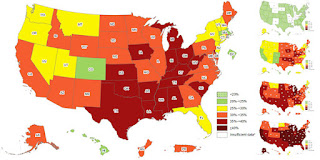
The risk of dying from Covid is 50% higher in red states. 


Obesity rates across states (CDC)
The U.S. distribution of the Seven Deadly Sins - portrayed in this set of graphics - is deeply damning

And yet, in fact, things are even more imbalanced than the graphics portray, because three of the ‘sins’ are weirdly defined in order to cut the Confederacy some slack! 

Gluttony ought to show obesity rates, not the number of fast food franchises, for example. The map of Greed is just absurd, since both the rich and the poor are attracted to states with vigorous economies, and at least the Northeast and far western states are trying to do something about disparities. Sloth is just weirdly defined. But the other four? They reflect pure statistical truth.

The worst hypocrisies have to do with divorce rates and gambling, which the parents of these folks deemed wretched sins. Now though? The divorce rate among just Republican office holders is FAR above that of Democrats, especially at the top, where demonstrable child predation and pedophilia occur at rates vastly higher than for top dems. (Please, oh please offer wager stakes on that?)

 And today’s GOP is owned by a consortium that includes almost every non-native casino owner, including those based in Moscow and Macao. Which brings us back full circle. The best way to defeat the worldwide mafia/oligarchy putsch against our grandchildren's future is to clean our own house. With light.


=====
* PS re the foxite narrative that the Ukraine war is all due to "Biden's weakness." 
Um, that isn't how this sort of thing works. 

During a regime of weakness - or one where the enemy controls the White House - that is when the enemy bides his time! Because time is on the tyrant's side. Hitler and his staff were planning war for 1947.  He only yanked the schedule forward when reports came in of rapid British re-arming at rates that would soon outstrip German production. This was all laid out in a senior thesis, later a best-seller, called While England Slept, by a Harvard student, John Fitzgerald Kennedy. 

Likewise, it is vastly more likely that Putin rushed his war of conquest because time was no longer his friend, not only because of Biden administration rampings up of Ukraine aid, but also (I posit) things that have very likely been done by our unleashed intel agencies during the last year that they have not been quisling-restrained.

Envision current staunch Ukrainian resistance enhanced by 6 more months of NATO aid. Then tell me which narrative makes more sense.

Thursday, December 16, 2021

Revisiting transparency, tracking, & resilience

Although Facebook's facial recognition software has identified and archived more than a billion user faces, its latest incarnation - Meta - has announced that it will stop automatically tagging people's faces in uploaded photos and videos, and will delete the data it has gathered - although users can continue to manually tag friends in their photos. Yet... Meta will continue working on facial recognition systems for future purposes, as in its upcoming smart glasses or augmented reality.

I reiterate: No amount of screaming will stop this tide from coming in. Your phone and doorbell and digital assistant will recognize faces and if you ban the tech, all it will do is give a monopoly on such systems to secret elites. Instead of trying futilely to ban technologies of light, we must focus on preventing the harms. And the way to do that is with light.

Another example? Surveilling students: Big Teacher is Watching: How AI Spyware took over schools: Especially in the wake of online learning during the pandemic quarantine, a web app called GoGuardian increasingly tracks what students do online, not just at school, but at home as well: "For kids that means their every keystroke, click and search is recorded and analyzed..." Educators can view students' web search histories, know if a kid is playing a video game, watching Netflix or Youtube - or especially viewing porn. Some programs also monitor for potential signs of emotional distress among the students. Many of these machine learning algorithms process nearly everything that students do online, even outside of school hours, and some of these companies sell student data.


And again, if you focus on accountability that might prevent harms, then you may do some good. Banning this simply won't happen.


The latest controversial weapon against theft: What happens when individuals use bluetooth tracking technology - such as Apple's AirTag - to track down stolen items, such as gaming systems, laptops, bicycles, scooters... and, especially cars? Such products are "testing the limits of how far people will go to get back their stolen property and what they consider justice."


== Increased powers of vision ==


See: “From Macy’s to Ace Hardware, facial recognition is already everywhere: Facial recognition is popping up at our favorite stores, but customers are largely unaware.” And whatever is loose in the commercial world, you can be sure elites of all kinds – bad and good – have got it.


The latest: a winged microchip the size of a grain of sand - swarms spread by the wind could be used to monitor the environment - or for civilian surveillance.


It's called Brin's Corrollary to Moore's Law: The cameras get smaller, faster, better, cheaper, more moble and vastly more numerous at a far greater pace than Moore's Law. This has huge implications, by the way, regarding so-called UFOs. But ever more (or moore) so, it means we all will be seen. But sousveillance could make a world where we catch any snoops and watchers and effectively shout "MYOB!"  (Mind your own business.)


And it goes on. Take this headline from The Guardian: Huge data leak shatters the lie that the innocent need not fear surveillance


On and on, it’s always the same. Our paladins and pundit defenders of freedom and privacy point at event after event that appear to portend a loss of both… and they are utterly correct to fretfully worry about looming technologies of surveillance, which could genuinely lead to the control-by-telescreen that Orwell chillingly portrayed! Yes, technologies like those Snowden revealed, or the latest “Pegasus” Israeli spy program that allowed agencies around the world to listen in on iPhones, or Moscow promulgated ransomware, or ubiquitous, unmonitored state face-recognition, could very well be part of the path to that hellscape… 


...though I think the “social credit” systems established by some authoritarian regimes are even more insidious and dangerous, siccing neighbors upon neighbors. 


So why am I shrugging about this latest furor? Because it’s always the same thing: screams of outrage followed by calls for impractical and futile "solutions." Ever since around 1994, the same clade of worriers - from the Electronic Frontier Foundation to the ACLU (join them both! Your dues will help!) are spot-on in reporting the latest travesty… 

...and maybe 5% right re: HOW to respond to it.... 

... and 95%+ just plain wrong, in demanding that technologies be 'outlawed' or that high level elites of law or government or wealth or criminality or despotism be somehow blinded. 

To those pointing at technologies and surveillance and shouting warnings, I say "yes! That could lead to Big Brother, so what's the plan?" To those who cry: "Ban it!" I always answer. “Um, how? Show me a moment in human history when elites have let themselves be blinded. Or when “Don’t look!” privacy laws did anything but (as Heinlein put it) Make the Spy Bugs Smaller.


Across 30 years denouncing and trying to ban technologies of vision - including face recognition - are there any such technologies that your shadow-seeking tactic ever stymied for long?


== A simple test ==


Again and again I have assigned the same experiment. Go to the nearest zoo's baboon enclosure. Climb inside with a pointed stick. Go right up to the biggest alpha baboon and stab out his eyes so he can't look at you!


 Here's a clue. He... won't... let... you. 


He will, on the other hand, grudgingly allow you to look back at him.

The same is true of all animals, let alone the alpha elites we hire to protect us. Any power of vision we try to deny them will instantly become the locus of paranoia and a desperate (and sometimes justified) felt need to bypass restrictions on their ability to see. All you are doing is driving any Good Guy elites into criminality. 


On the other hand, the last 250 years shows that we can seize and hold some powers of supervision and transparency and apply then to elites, the innovation responsible for all our current freedom and - yes - privacy.

Imperfectly? Then make that the focus of our activism! And yes, there are dozens of ways to do that in The Transparent Society.


I say this not out of complacency. I fear Big Brother more than almost any of you do! And that is why my prescriptions are less about raging futilely at the next example of elite spying and the next, and the next forever… 


... and more based upon things that have actually worked at creating this rare island of relative freedom and privacy across humanity’s dismal history.


The method that works - assertively stripping elites of their own shadows, instead of absurdly trying to hide in our own - should be obvious to our paladins… 

...but apparently it is so counter-intuitive that they never, ever grasp it, no matter how many times their screams of "Shadows! Give us shadows!" utterly fail. They always, always fail.

Yet, still, they reflexively rail against light (the only tool that ever preserved freedom), calling for bans on things that cannot be banned, succeeding only in clouding the vision of those elites who are on our side, while empowering those bent on re-establishing 6000 years of feudalism.

Finally.... 


talk I gave for the Foresight Institute on transparency, reciprocal accountability and pyramidal vs diamond-shaped societies is well-summarized here.


And, here's an interesting article from Edge re: "reciprocity altruism" and prisoner's dilemma.