Showing posts with label Comet. Show all posts

Wednesday, July 08, 2015

It’s ALIVE! And it’s in Outer Spaaaace!

Excitement is building for the New Horizons Mission and its hurried swing past Pluto on July 14.  What a terrific way to celebrate Bastille Day!  Watch this terrific video - Fast and Light to Pluto - about New Horizons, created by the NY Times.

I met Pluto discoverer Clyde Tombaugh when I was 15...

Spread the word about this!  Grab lapels and shout at your co-workers. Get neighborhood kids to watch the encounter on SCI or  NASA TV... and remind them to then stand up, remembering they are members of a civilization that does stuff like this! 

Those of our fellow citizens who cannot feel even a little thrill and pride? Alas, pity such impoverished souls.

And see how the IAU and the New Horizons mission team will come up with names for all the great new features the mission will (we hope) reveal. 

Okay, so there's rough news from space, as well... the latest SpaceX launch failed.  With the take home lesson that space is hard. Hang in there, Elon. If failures didn't happen, it would be a sure-fire clue that we aren't pushing hard enough.

Still, there hasn't been a time like this one -- in humanity's exploration of the universe -- since the early seventies.  Daily, you are being yammered-at by dour cynicism addicts of all kinds -- especially of the "left" and of the "right" -- but pay them no attention.  


Dare. Dare to feel some pride.  

== It's aliiiiive! Sinkholes and “signs of life” on comet 67/P ? 
==

surface of comet 67P 
The ESA's Philae lander is alive!  Moreover, beaming science from the surface of Comet 67P/Churyumov-Gerasimenko,  I was at first surprised, since the increased sunshine that roused it back to wakefulness is also making the comet active, with sublimating ice turning into expanding vapor, blowing off dust. In fact, given the comet’s minuscule gravity, I thought the lander might have been - at this point -- also blown tumbling into space. 


Though, now that I think on it, what seemed bad luck, back in November, might instead be fortunate!  According to my doctoral dissertation (1981) activity will wildly vary across a comet's surface, because of accumulated dust layers -- which helps explain 67-P's wildly varied surface features.  (See a blatant sea of dust in the accompanying photo.) This suggests that Philae bounced and plopped into a shaded region where activity is low… and may remain low enough for the little probe to stay put during perihelion passage.  If so, then we may have a monitoring station during that exciting phase.


In fact, fascinating news keeps coming. Like that collapsing sinkholes may be responsible for 200 meter-deep pits on comet 67Cameras on Rosetta's OSIRIS instrument have spotted dust jets shooting out of some of the deeper depressions, but those that are more shallow do not seem to be active.

  Scientists “wondered if the pits might have formed as a result of the melting of frozen materials on the comet's surface, also known as sublimation, but computer models nixed this idea as well.  The researchers say that excavating just one of the pits this way would take more than 7,000 years. Although the comet likely formed 4.5 billion years ago, it has only been flying close enough to the sun for sublimation to occur since 1959, when a close encounter with Jupiter changed its orbit.”

Hmm. well, in fact I have an idea about that. And it relates to the other comet-related "news" that media have been raving about.  Chandra Wickramasinghe is a remnant colleague of iconoclast astronomer and sometime science fiction author Fred Hoyle. Chandra does some solid science... but also relentlessly pushes Hoyle's notion of life burgeoning in interplanetary space. “He and colleague Dr Max Wallis, from the University of Cardiff, believe 67P and other comets like it could provide homes for living microbes similar to the “extremophiles” that inhabit the most inhospitable regions of the Earth. Comets may have helped to sow the seeds of life on Earth and possibly other planets such as Mars, they argue.” 

They suggest that the comet's black hydrocarbon crust, subsurface ice, flat-bottomed craters, and smooth, icy “seas”—are the result of microbial organisms living beneath the comet’s icy surface. (Alas, their credibility has been self-injured by some cult-like ways their Panspermia Zealot followers have behaved, especially at the tendentiously unscientific so-called "Journal of Cosmology.")
 
To be clear, I have no problem at all with pondering a possibility -- that comets may have been reactor vessels that cooked up the original primordial life-stuff.  There was a period in the early solar system when decaying Aluminum 26 from a recent supernova might have internally heated comets in our newly formed solar system, enough to give them liquid interiors protected by ice-cold shells. Think a trillion micro-Europas. That would be one hell of a lot of test tubes and petri dishes! (A possibility elucidated both in my thesis and in a novel Heart of the Comet.)

Indeed, might this account for the "sink-holes" that the Rosetta Probe seems to have found, at comet 67/P? I’ve not yet seen anyone propose that super-ancient vacuoles and chambers thread cometary interiors, left over from those early, liquidy days – a physical possibility, whether or not organic chemistry produced “life.”

On the other hand, Wickramasinghe (as usual) reaches way too far. The dark, quasi-organic dust seen by Philae and Rosetta is far simpler to explain -- as simply the same stuff as we already observe in carbonaceous chondrites. Please, we get plenty of dustfall from old comets and so far, evidence for actual microbes is scant. I lean toward lots of early-days organic chemistry. But existing and active organisms? Meh.

Okay, okay. Clearly I still care about this scientific field… because it’s fascinating!  

Do I miss being a world-class comet guy, who might have been sitting right now in Darmstadt, poring over data as it comes in?  Well… sure.  You guys are to blame. Bribing me to play hookie, living off speculative blather and SciFi. Yeah, that's the ticket. It's your fault.  Sigh.

== And there's more! ==

Like the continuing stunning effectiveness of our two robot labs on the surface of Mars and four orbiting overhead. Want coolness?  Here are images these emissary labs (paid for with pennies each from you taxpayers) took of Comet Siding Spring as it passed by Mars last year, inside the orbit of Phobos!  (Picture a comet passing Earth at just 1/3 the distance to the Moon. I am so jealous.) 


...as we celebrate the Opportunity rover's completion of a "marathon" having traveled 26.2 miles across the Martian surface on our behalf, doing great science all the way, having lasted more than a decade longer than the originally planned 90 day mission. Watch this terrific video showing a time lapse of Opportunity's journey. (Oh and I served on the commission that chose the names "Spirit" and "Opportunity" proposed by one of several thousand school children.) Be proud of your loyal robots!

And NASA has put money into a Europa mission.  Science instruments have just been selected -- to analyze the surface and subsurface ocean of Jupiter's icy moon -- and look for possible clues to life.

Wow.  Uttergloss!  A video animation: Fly-over the dwarf planet Ceres, based on images taken by NASA's Dawn spacecraft, provides dramatic views of this heavily cratered, mysterious world. Note: YOUR civilization did this.  Just part of the best year in space exploration since the 1970s.

Oh, and we just finished a fabulous orbiter mission to Mercury. And we still have marvelous Cassini, near Saturn and Titan...

Here are some of the latest pics of geological features taken by the DAWN probe, at Ceres. Oh, but there’s no end to fun with “bright patches” (that might be salt, rather than water ice. And now...a 5-mile tall “pyramid” mountain. Take this flyover video! We are SO getting our money’s worth. 

Shall we finish with some cool space miscellany? How about a look at some of the space habitats portrayed in science fiction, from Deep Space 9 to Elysium….are they plausible?

Phil Plait offers up a little allegory about an asteroid heading toward the Earth, and how easy it might be to save ourselves, if not for mistrust of science itself.  And here's hoping you all enjoyed Asteroid Day and decided to support the B612 Foundation!

Did I say we live in fascinating times? It's our mission. We are rising out of kindergarten, at last. Growing up means we're behooved to take more responsibility, for each other and the planet our descendants will inherit.  But it also means recognizing there's a lot more to do, beyond the nursery walls.


Spread the excitement.  And happy Bastille Day.  Allons enfants de la univers...


Saturday, January 31, 2015

Marvels of the Universe

I just returned from Cape Canaveral for a meeting of NASA's Innovative & Advanced Concepts group, where I am on the Council of External Advisors.  NIAC is the small team within NASA charged with taking big risks (with little money) on highly speculative and "far-out" potential technologies. Small seed grants are handed over for clever (and a few almost-crackpot) endeavors that might bear fruit some distance down the road.

Past grants have included ventures in quantum entanglement communication, "torpor" suspension of human metabolic activity, haptic-reactive space suits, submarines for Titan and Europa, prodigious space telescopes, extrusion-construction of girders in space, and a supersonic jet that swivels 90 degrees in order to land!  Some prove to be... well... blue sky. Others have won major followup investment from agencies and even industry, such as a way to "print" concrete buildings on Earth, or do the same with sintered regolith on the moon. Be proud to be a member of a civilization that invests (modestly) in notions on the borderline with science fiction!

 Tune in to watch some of this year's presentations -- including glimpses of Buzz Aldrin, Frank Drake, Penny Boston and me (et al) asking questions.


== More excitement from space! ==


Despite major efforts to diss science and to turn us against each other and pump up cynicism (admit it: many of you wallow in that drug), our civilization is actually doing great things! Here's just one of many cures for that vile high of cynicism.


Everybody watch these 90 seconds: Space Suite -- using stunning images from NASA and ESA -- with 3D image processing by visual artist Lucas Green.  A lovely reminder of our ambitions to explore... and seek out strange new worlds...

You get to be a member of a civilization that does stuff like this. I cannot reiterate that too often. Your civilization did this.  Yours. And your neighbors are not sheep. (Well, a lot of em aren't.)

Also, zoom in on the gorgeous super-high-resolution panoramic view of the Andromeda Galaxy: Gigapixels of Andromeda, the largest image ever compiled of our neighboring galaxy. Awe-inspiring!

Cynical despair is just plain dumb.

== Making the universe show herself! ==

Going to the Ends of the Earth to Discover the Beginning of Time: Watch this wonderful TEDx talk by my pal Brian Keating, professor of astrophysics at UCSD, whose membership in both teams that probed the first trillionth  of a trillionth of a second of the universe, already has him under discussion in the preliminary, penumbral zones of Nobel-dom! 

Okay, it's a wild ride and maybe the results were premature.  Certainly, science is doing its proper job -- applying competitive reciprocal criticism to test and double test bold assertions! (Exactly as it has been doing re Climate Change.) So, I guess we'll just find out!  No movie plot could be more exciting.


Still... Brian does a wonderful job explaining new developments in cosmology... culminating in a way-cool/fun stunt at the end!  You will have fun! That's not just a prediction, but a command!
  
== Cosmetology! How about them cosmets! ==

Here's a stunning look at the cliffs of comet 67P/Churyumov-Gerasimenko, imaged by ESA's recent Rosetta mission.  They shock even this comet expert. See the full collection of images on the ESA website. 

And yes, I would have been hip deep in the Rosetta-Philae data analysis right now... had you folks not dragged me (kicking and screaming) away from being a cometologist into doing storytelling and speechifying and industrial consulting and all that other blather, instead.  Ah, parallel worlds and might have beens. Sigh


== And plasmets! ==


After five years of searching, researchers using data from NASA's exoplanet-hunting Kepler spacecraft have discovered what look to be two of the most Earth-like worlds yet. Dubbed Kepler-438b and Kepler-442b, both planets appear to be rocky, and orbit in the not-too-hot, not-too-cold habitable zones of their stars, where liquid water can exist in abundance. Orbiting smaller-dimmer suns... Kepler-438b is only about 12 percent larger than the Earth, and basks in 40 percent more starlight. Kepler-442b is 30 percent larger than Earth and receives about 30 percent less starlight. (Note such suns sometimes have cycles of intense flare activity.)

A monster ring system just discovered around exoplanet J1407 is 200 times larger than the rings of Saturn!

Ultrascope is an automated robotic observatory (ARO) that you can laser-cut and 3D print at home. Future versions will be able to contribute to the Asteroid Grand Challenge.  See this and other cool NASA-related STEM projects at the Space Gambit Site!  Some of the projects are way, way cool!

Now to get them interested in the best of all — the EXORARIUM!

== Looking out into the cosmos == 

Here’s an interesting rumination on whether the galaxy may fill with advanced artificial intelligences - which can occupy deep space and use its resources - rather than the bio-entities that spawned them, after evolving on muddy worlds. The notion of self-replicating machines filling the stars goes back to Jones and Finney's classic paper around 1983, about how Von Neumann probes may replicate and fill the galaxy in just 30 million years.

In fact this concept has long been grist of scientific science fictional speculation.  Gregory Benford's Galactic Center series, for example, posits that that realm - lethal to bio life - might be the natural abode of advanced machine civilizations.  

My novel Existence explores this notion in detail, including whether such machines might be "lurking" in the asteroid belt.  And the Brightness Reef trilogy explores possible relationships between bio and machine civilizations on a galactic scale.

== ... and more space, more! ==


Kewl.  We proposed this in the 1980s.  Now President Obama wants it… using a railgun to launch scramjets to near orbit. 

Support the Sentinel Mission. Join a citizen-funded deep space mission to detect Near-Earth Asteroids! (I will be speaking to donors for this mission and the B612 Foundation, in San Jose, in February.)

Stay Tuned for a Group Message from Humanity: With NASA's New Horizons space probe arriving at Pluto, space artist Jon Lomberg is heading One Earth -- an effort to upload messages from Planet Earth. Sign here to add your voice.

Do manatees need spacesuits? The lead image in this article about the  may remind some of you of the first chapter of SUNDIVER.  But these fellows have more than enough delightful craziness of their own. The "Nonhuman Autonomous Space Agency" is a whimsical futurist speculation built on top of a serious thought experiment.

== SETI and the question of God ==

There's a truly stunning piece of drivel in the fast-sinking shipwreck that Rupert Murdoch has made of the former Wall Street Journal. One Eric Metaxas argues that the Fermi Paradox – the absence of any evidence (so far) of extraterrestrial civilizations – means there “must be a God.”  Quoth he: “As our knowledge of the universe increased, it became clear that there were far more factors necessary for life than Sagan supposed. His two parameters grew to 10 and then 20 and then 50, then 200, and so the number of potentially life-supporting planets decreased accordingly. The number dropped to a few thousand planets and kept on plummeting.”

Given that Metaxas offers no citations, it is hard to trace what he means by “parameters” for life to develop. But as someone  who has been immersed in this field for 35 years, I have to say that he must have pulled such a number out of thin air… or somewhere else.  

In fact, every year the conditions for life in the universe seem more prevalent. Today scientists no longer believe you even need an Earth-like world in a “Goldilocks Zone” (and those zones are now much wider than we previously thought). Indeed, there may be a hundred “roofed worlds” or icy moons with sub-surface oceans, like Europa, for every Earth with its waters exposed to the sky.

But I’m not making the mistake of fact-debating silly people who lie about science in order to sway the gullible. We've seen that trick used to devastating effect, in ways that endanger all our children. Yes, even (especially) the children of carbon moguls.

 No, what puzzles me is a matter of basic logic. Like why Mr. Metaxas clearly wants Earth to be alone in the cosmos. Somehow, he has convinced himself that a vast universe of quadrillions of stars and planets is somehow better and more reflective of a great and creative deity if… if it is entirely sterile, except for one teensy dust ball, floating in one obscure corner, that somehow was chosen to receive a spark granted to no other place in all of that immensity.

Let’s leave out that it took the light from some of those stars billions of years to get here… I won’t cram into Mr. Metaxas’s mouth any claim that the Earth, nevertheless, is just six thousand years old. Though we know that is the formal dogma of his brand of fanaticism.

In the end, what depresses me is how immensely insulting to God their proposal is – that we should act all impressed with such a measly, small-minded, un-ambitious and teensy-parochial “creation!” When in fact the heavens are replete with glories suggesting that – well – if He is out there (and I ain't sayin'), then He/She/It is surely a whole lot bigger, more curious and more ambitious than the philosophy clung to by claustrophilic, narrow-minded Kindergarteners, terrified of the vastness of actual Creation.

== And from the celestrially ridiculous to the terrestrially... ==

Ah… Texas Sen. Ted Cruz now heads the Senate committee overseeing NASA. He is making a show of supporting "exploration" but he is part of the cult that all-too recently ordered NASA to drop the word "Earth" from all mission statements and to many Earth-sensing, environment and resource programs.  His "emphasis on exploration" has one goal, to renew that Bush era scheme, diverting all NASA eyes toward the Moon's useless desert and away from the only oasis of life that we know.

Finally, though... swerving to a magnificent "failure" that advanced us all tremendously... catch this amazing video footage of the "almost!" attempt of Elon's SpaceX first stage to land on a barge.  Clearly there are faults, but correctable ones, which makes this a case of "Hell yes, you get a cigar!"

Sunday, November 30, 2014

Space Marvels - galaxies, space-power, "my" asteroid... and comets...

O
One of the best things I have ever watched: Invest four minutes for the video clip Wanderers! This -- rather than anger and cynicism -- is what being human must be about...or else, why bother?

Oh, also note: almost all of the places depicted here are real. Many of them extrapolated from photos taken already by our robot emissaries. “We” have already been to these wondrous spots. We are already titans!  On our way to unimaginable greatness.

(Though I will keep trying to imagine.)

== As we move ahead... ==

Could life exist in the Kracken Mare Sea on Titan?  I am working on stories… but right now I am simply jazzed by this image… sunlight glinting off one of Titan’s “seas” of liquid… methane? Ethane? Gasoline?  Take a look at the video: NASA's Cassini captures sunlight glinting off Titan's seas.

You are a member of a civilization that does stuff like this!  Stop letting cynics and fear-mongers undermine your confidence in us.

NASA's New Horizons spacecraft comes out of hibernation on December 6 -- in preparation for an encounter with the dwarf planet Pluto. Closest approach will take place in July. 


NASA/JPL have just released a gorgeous new high-resolution image of Europa -- its icy surface crisscrossed by cracks and ridges. Beneath its icy surface, Europa may have more liquid water than Earth. In NASA's video: Europa: Ocean World, astrobiologist Kevin Hand discusses the possibility of life on Europa. Phil Plait’s “Bad astronomy” site offers a cool riff about a possible mission to Europa. 

It is estimated that Europe’s new Gaia probe will have discovered some 20,000 Jupiter mass exoplanets by the time it completes its survey in 2019. Unlike the transit-eclipse system used by the Kepler mission to discover most of the 2000 or so confirmed exoplanets, Gaia will use the astrometric measurement technique, where planets around another star show up as a tiny wobbling motion of the star as the planet orbits around it. Somewhat less likely to discover Earthlike smaller worlds, Gaia will be far less dependent on just happening to find systems whose ecliptics are lined up toward us.  It will also be far better at detecting planets that orbit farther from their star.

Here’s a fascinating astronomy blog that takes on some big topics. This particular posting tells of Antarctic lichens that seem to have adapted well to  Mars-like conditions.... amazing in its tentative implications.

== New Insights into Galaxies ==

Scientists believe a mysteriously bright object in a galaxy 90 million light-years away could be a rogue black hole evicted during the merger of two galaxies.

A really thought provoking paper suggests that of the estimated 100 billion galaxies in the observable universe, only one in 10 can support complex life like that on Earth. The reason, most other galaxies are either smaller or lower in “metalicity” and therefore have many more Gamma Ray Burst events that can destroy the ozone layers of life-worlds for thousands of parsecs in all directions, conceivably knocking down all but the most primitive, ocean dwelling organisms, making galaxies resemble the image Isaac Asimov portrayed in his novels, one with scads of biospheres, owned only by single cell life forms.

Short gamma ray bursts last less than a second or two; they most likely occur when
 two neutron stars or black holes spiral into each other. Long gamma ray bursts come from supernovae.

Tsvi Piran, a theoretical astrophysicist at the Hebrew University of Jerusalem, and 
Raul Jimenez, a theoretical astrophysicist at the University of Barcelona in Spain, 
explore that apocalyptic scenario in a paper in press at Physical Review Letters.

Compared with the Milky Way, most galaxies are small and low in metallicity. As a
 result, 90% of them should have too many long gamma ray bursts to sustain life, 
they argue. What’s more, for about 5 billion years after the big bang, all galaxies were
 like that, so long gamma ray bursts would have made life impossible anywhere. And inward of 10,000 light years from the center, our galaxy is still dangerous.

Researchers sending up NASA’s Cosmic Infrared Background Experiment on short duration rockets  have discovered something remarkable in the universe's diffuse background light: As many as half of the stars in the universe may have been stripped from their home galaxies and flung into space. Studying the extragalactic background light, Caltech astronomers  say there's just as much background starlight coming from these dim rogue stars as is coming from all of those giant galaxies.

== Reaching toward the sun ==

 A probe will be sent to visit the Sun.  I am interested - of course - in any human effort to … er… sun-dive.  Only there is an interesting design twist here.  Solar Orbiter will have a titanium foil heat shield on the outside painted black, with a hint of charred animal bone.

A very interesting exploration by Keith Henson of the economics and practical aspects of   lifting to GEO a solar power satellite system whose first use would be to laser heat the exhaust of Skylon lifters taking yet more solar power systems to GEO.  A bootstrap method that could (in theory) soon result in vast amounts of clean energy coming to us from the sun... via our collectors in space.

Some portions of this method have received preliminary seed grants from us at NASA NIAC. But many other sources will have to solve many puzzles along the way. It's good to have folks pushing this... while others push to make it unnecessary by vastly improving solar here on Earth.

== Comets and Asteroids ==

Given the results that have come in from the Rosetta Mission's rendezvous with a comet, I thought I'd offer you all a glimpse at my 1981 doctoral dissertation! It dealt with what happens when an icy mix of volatiles and grains gets heated from above. Naturally, some volatiles (e.g. water) sublimate and leave at high molecular velocities -- that get higher as the comet approaches the sun. Large dust grains may stay put but smaller ones get entrained into the escaping stream and become part of the Dust Tail. (Comets have two tails.)  

This means a mantle or coating layer of larger grains starts to build.  This will eventually be thick enough to shield the virgin material, slowing down the rate of sublimation.  Like a thermos coating. But the comet is heading sunward so the grains get hotter and a wave of heat penetrates inward, causing a delayed but large pulse of sublimation which will, here and there across the surface, cause an explosive blow off of the covering mantle, resulting in a surge of heavier grains in the dust tail and venting off pressure from an area.  Some of the heavier grains then rain down elsewhere on the comet surface, causing some areas to build such big layers that they choke off, semi permanently.  When this happens everywhere, the comet goes dormant and begins to resemble an asteroid.

Note that the one visited by Rosetta -- 67P/Churyumov–Gerasimenko -- is not a virgin but has gone through a number of perihelion brushes with the sun, so it's been baked a fair bit. Oh, if only the harpoon anchors had worked to dig the Philae lander onto a good vantage point! I fear that the little lander may not get enough sunlight to do much more science.  And even if it does, those gases shooting out of the mantle layer will likely blow the poor thing into space, before any of the real action starts.  At which point we'll still have the main Rosetta Orbiter...

... for which I am grateful! It's always nice to see your graduate work confirmed, At least superficially, it looks like I shoulda stayed in comet studies.  I was on a roll! Could have evaded the sci fi rat race....

== More personal news from outer space! ==

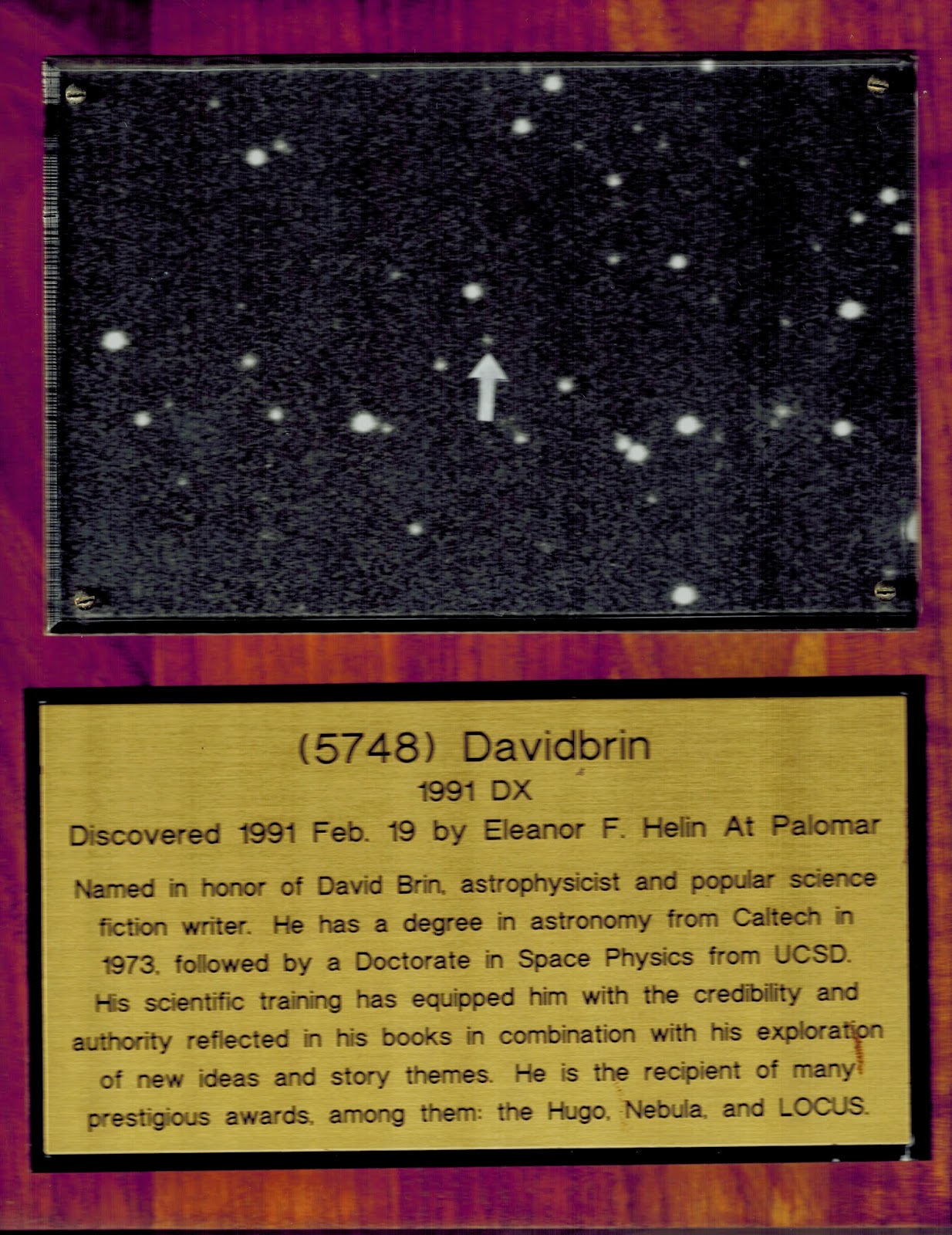
My own asteroid had its closest approach to Earth on November 18. Asteroid 5748 Davebrin passed within 1.256 AU for a summer that's actually pretty balmy and close.  So close that humanity might someday include it in efforts to access the fantastic riches out there.  May it be disassembled and turned into wonderful things! I just have two wishes. 

First, to share in the action! Hey, I got a claim.

Second? To go out there in person and kiss my...

...oh, never mind. ;-) May you ALL get your own space rocks.  

And each live for fifty more of its orbits.