Excitement is building for the New Horizons Mission and its hurried swing past Pluto on July 14. What a terrific way to celebrate Bastille Day! Watch this terrific video - Fast and Light to Pluto - about New Horizons, created by the NY Times.
I met Pluto discoverer Clyde Tombaugh when I was 15...
Spread the word about this! Grab lapels and shout at your co-workers. Get neighborhood kids to watch the encounter on SCI or NASA TV... and remind them to then stand up, remembering they are members of a civilization that does stuff like this!
 Those of our fellow citizens who cannot feel even a little thrill and pride? Alas, pity such impoverished souls.
And see how the IAU and the New Horizons mission team will come up with names for all the great new features the mission will (we hope) reveal.
Okay, so there's rough news from space, as well... the latest SpaceX launch failed. With the take home lesson that space is hard. Hang in there, Elon. If failures didn't happen, it would be a sure-fire clue that we aren't pushing hard enough.
Still, there hasn't been a time like this one -- in humanity's exploration of the universe -- since the early seventies. Daily, you are being yammered-at by dour cynicism addicts of all kinds -- especially of the "left" and of the "right" -- but pay them no attention.
Dare. Dare to feel some pride.
== It's aliiiiive! Sinkholes and “signs of life” on comet 67/P ? ==
 |
| surface of comet 67P |
Though, now that I think on it, what seemed bad luck, back in November, might instead be fortunate! According to my doctoral dissertation (1981) activity will wildly vary across a comet's surface, because of accumulated dust layers -- which helps explain 67-P's wildly varied surface features. (See a blatant sea of dust in the accompanying photo.) This suggests that Philae bounced and plopped into a shaded region where activity is low… and may remain low enough for the little probe to stay put during perihelion passage. If so, then we may have a monitoring station during that exciting phase.
 In fact, fascinating news keeps coming. Like that collapsing sinkholes may be responsible for 200 meter-deep pits on comet 67. Cameras on Rosetta's OSIRIS
instrument have spotted dust jets shooting out of some of the deeper depressions,
but those that are more shallow do not seem to be active.
In fact, fascinating news keeps coming. Like that collapsing sinkholes may be responsible for 200 meter-deep pits on comet 67. Cameras on Rosetta's OSIRIS
instrument have spotted dust jets shooting out of some of the deeper depressions,
but those that are more shallow do not seem to be active.Scientists “wondered if the pits might have formed as a result of the melting of frozen materials on the comet's surface, also known as sublimation, but computer models nixed this idea as well. The researchers say that excavating just one of the pits this way would take more than 7,000 years. Although the comet likely formed 4.5 billion years ago, it has only been flying close enough to the sun for sublimation to occur since 1959, when a close encounter with Jupiter changed its orbit.”
 Hmm. well, in fact I have an idea about that. And it relates to the other comet-related "news" that media have been raving about. Chandra Wickramasinghe is a remnant colleague of iconoclast astronomer and sometime science fiction author Fred Hoyle. Chandra does some solid science... but also relentlessly pushes Hoyle's notion of
life burgeoning in interplanetary space. “He and colleague Dr Max Wallis, from the University
of Cardiff, believe 67P and other comets like it could provide homes for living
microbes similar to the “extremophiles” that inhabit the most inhospitable
regions of the Earth. Comets may have helped to sow the seeds of life on Earth
and possibly other planets such as Mars, they argue.”
Hmm. well, in fact I have an idea about that. And it relates to the other comet-related "news" that media have been raving about. Chandra Wickramasinghe is a remnant colleague of iconoclast astronomer and sometime science fiction author Fred Hoyle. Chandra does some solid science... but also relentlessly pushes Hoyle's notion of
life burgeoning in interplanetary space. “He and colleague Dr Max Wallis, from the University
of Cardiff, believe 67P and other comets like it could provide homes for living
microbes similar to the “extremophiles” that inhabit the most inhospitable
regions of the Earth. Comets may have helped to sow the seeds of life on Earth
and possibly other planets such as Mars, they argue.”
They suggest that the comet's black hydrocarbon crust, subsurface ice,
flat-bottomed craters, and smooth, icy “seas”—are the result of microbial organisms living beneath the comet’s icy surface. (Alas, their credibility has been self-injured by some cult-like ways their Panspermia Zealot followers have behaved, especially at the tendentiously unscientific so-called "Journal of Cosmology.")

Indeed, might this account for the "sink-holes" that the Rosetta Probe seems to have found, at comet 67/P? I’ve not yet seen anyone
propose that super-ancient vacuoles and chambers thread cometary interiors,
left over from those early, liquidy days – a physical possibility, whether or
not organic chemistry produced “life.”
On the other hand, Wickramasinghe (as usual) reaches way too far.
The dark, quasi-organic dust seen by Philae and Rosetta is far simpler to
explain -- as simply the same stuff as we already observe in carbonaceous
chondrites. Please, we get plenty of dustfall from old comets and so far, evidence for actual microbes is scant. I lean toward lots of early-days organic chemistry. But existing and active organisms? Meh.
Okay, okay. Clearly I still care about this scientific field… because it’s
fascinating!
Do I miss being a world-class
comet guy, who might have been sitting right now in Darmstadt, poring over data
as it comes in? Well… sure. You guys are to blame. Bribing me to play hookie, living off speculative blather and SciFi. Yeah, that's the ticket. It's your fault. Sigh.
== And there's more! ==

Like the continuing stunning effectiveness of our two robot labs on the surface of Mars and four orbiting overhead. Want coolness? Here are images these emissary labs (paid for with pennies each from you taxpayers) took of Comet Siding Spring as it passed by Mars last year, inside the orbit of Phobos! (Picture a comet passing Earth at just 1/3 the distance to the Moon. I am so jealous.)
...as we celebrate the Opportunity rover's completion of a "marathon" having traveled 26.2 miles across the Martian surface on our behalf, doing great science all the way, having lasted more than a decade longer than the originally planned 90 day mission. Watch this terrific video showing a time lapse of Opportunity's journey. (Oh and I served on the commission that chose the names "Spirit" and "Opportunity" proposed by one of several thousand school children.) Be proud of your loyal robots!
And NASA has put money into a Europa mission. Science instruments have just been selected -- to analyze the surface and subsurface ocean of Jupiter's icy moon -- and look for possible clues to life.
Like the continuing stunning effectiveness of our two robot labs on the surface of Mars and four orbiting overhead. Want coolness? Here are images these emissary labs (paid for with pennies each from you taxpayers) took of Comet Siding Spring as it passed by Mars last year, inside the orbit of Phobos! (Picture a comet passing Earth at just 1/3 the distance to the Moon. I am so jealous.)
...as we celebrate the Opportunity rover's completion of a "marathon" having traveled 26.2 miles across the Martian surface on our behalf, doing great science all the way, having lasted more than a decade longer than the originally planned 90 day mission. Watch this terrific video showing a time lapse of Opportunity's journey. (Oh and I served on the commission that chose the names "Spirit" and "Opportunity" proposed by one of several thousand school children.) Be proud of your loyal robots!
And NASA has put money into a Europa mission. Science instruments have just been selected -- to analyze the surface and subsurface ocean of Jupiter's icy moon -- and look for possible clues to life.

Wow. Uttergloss!
A video
animation: Fly-over the dwarf planet Ceres, based on images taken by NASA's Dawn spacecraft,
provides dramatic views of this heavily cratered, mysterious world.
Note: YOUR civilization did this. Just
part of the best year in space exploration since the 1970s.
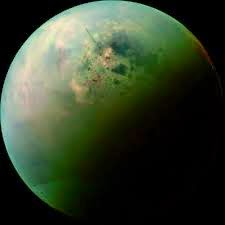
Oh, and we just finished a fabulous orbiter mission to Mercury. And we still have marvelous Cassini, near Saturn and Titan...
Oh, and we just finished a fabulous orbiter mission to Mercury. And we still have marvelous Cassini, near Saturn and Titan...
Here are some of the latest pics of geological features taken by the DAWN probe, at Ceres. Oh, but
there’s no end to fun with “bright patches” (that might be salt, rather than water ice. And now...a 5-mile tall “pyramid” mountain. Take this flyover video! We are SO getting our money’s worth.
Shall we finish with some cool space miscellany? How about a look at some of the space habitats portrayed in science fiction, from Deep Space 9 to Elysium….are they plausible?
Phil Plait offers up a little
allegory about an asteroid heading toward the Earth, and how easy it might be
to save ourselves, if not for mistrust of science itself. And here's hoping you all enjoyed Asteroid Day and decided to support the B612 Foundation!
Did I say we live in fascinating times? It's our mission. We are rising out of kindergarten, at last. Growing up means we're behooved to take more responsibility, for each other and the planet our descendants will inherit. But it also means recognizing there's a lot more to do, beyond the nursery walls.
Spread the excitement. And happy Bastille Day. Allons enfants de la univers...
Did I say we live in fascinating times? It's our mission. We are rising out of kindergarten, at last. Growing up means we're behooved to take more responsibility, for each other and the planet our descendants will inherit. But it also means recognizing there's a lot more to do, beyond the nursery walls.
Spread the excitement. And happy Bastille Day. Allons enfants de la univers...