In Part One we examined the notion that Steven Pinker promotes (in The Better Angels of Our Nature), that palpable progress has been made in reducing violence and poverty, worldwide -- and the harsh reaction these facts ignite, among dogmatics of both right and left. We did this by critiquing a purported pundit's deeply dismal and dishonest "rebuttal" of Pinker.

But I am not done being provocative. For you see, another factor is whether some harshness in the human experience in one more essential ingredient. Whether even war might be part of what has moved us forward.
== The power of opposition ==
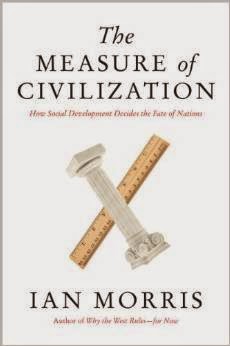
A pair of best-selling books by Stanford Professor Ian Morris make the bold assertion that dynamic competition is just as important for human development as cooperation and shared purpose. His titles are deliberately provocative: “Why The West Rules — For Now” and “WAR! What is it Good For? Conflict and Progress of Civilization from Primates to Robots.”

Well, well. From that alone, you can catch a strong whiff of Morris’s argument, that competition — even the violent kind — can be a core driver that leads to stronger and better human civilizations.
Of course this might, at first sight, appear to be an endorsement of enduring right-wing nostrums — that society should emulate nature, red in tooth and claw, because competitive evolution has been the great driver of adaptation and change, from bacteria to fish to mammals. Species improve their fitness by allowing the devil to take the hindmost. It is a bloody business. Also a slow and highly inefficient one, when competition manifests under Mother Nature.
Nor was it much better across the six to ten millennia since human tribes gathered together in regimes larger than tribes. Urban civilization required a top tier of rulers and priests, whose main obsession soon became staying on top, and ensuring their sons could take other mens’ women and wheat. Below that paramount level, a veneer of specialist scribes and artisans also benefited from taxing the mass of farmers and serfs, though arguably giving value, in return.
Across these eras, in a vast majority of cultures, priests and kings generally suppressed any spirit of lively or fair competition, far more than they encouraged it. Status was inherited, as heaven obviously intended.

Still, despite this pattern of oligarchic conservatism, Morris makes the case that progress often happened anyway, especially when those pyramids of feudal privilege clashed with each other. Indeed, history is a tragic mess of delusion and horrific statecraft. But our ancestors do seem to have stumbled ahead a bit quicker when the lords were worried about other barons across the hills. Spured by outside threats, the elite castes devoted more effort to encouraging innovation from bright subjects, instead of repressing it.
Examples from the past would include the Five Kingdoms of ancient China, which developed far faster than during the subsequent Qin Unification era. And of course post-Renaissance Europe, when innovation skyrocketed under competitive pressure among nations of a fractured continent. Indeed, this lateral competition is likely what led to the Industrial Revolution and its subsequent rapid leveraging of fossil fuels and sail and metals.
== Lateral drive ==
Looking at eras in parallel, comparing apples to apples, past eras tended to be more productive when they featured lateral competition than when they were rigidly top-down hierarchical. The same is true of industrial societies, when viewed in parallel.
Lateral competition can also be unpleasant and destructive! The examples I gave were also times of great violence. In China and Europe, some moderating forces helped keep violence from ruining the renaissances. Still, generally, average folk lived calmer, safer lives under an imperial “pax” like Pax Romana, Pax Sinica and Pax Brittanica, than in eras filled with lateral strife.
But we are discussing progress here, and without question progress does benefit from competition. Ideally competition in which many moderating forces, like law and democracy and mass education regulate the rivalry, maximizing market virtues and minimizing cheating or blood on the floor.
I’ve gone into and discussed the innovative ways that first Periclean Athens and Republican Florence tentatively tried to use rule-systems to keep competition flat-open-fair… then a much stronger experiment ensued, in which (mostly) western markets, democracy, science and courts regulated competition with one foremost aim — to maximize creative output in positive-sum ways by minimizing cheating.
Please dig this as I repeat it: cheating and blood were the chief hallmarks of feudalism, whose variants dominated 99% of societies with agriculture. Fierce repression to maintain inherited privilege was always the biggest kind of cheating, stifling ambitious innovation among those consigned to lower orders. There is no greater defining trait of feudalism… in all its many variants… than conniving cartels of cheaters.
== More comparing oranges to oranges ==
 During the 19th and 20th centuries, innovation thrived most in nations that encouraged middle class ambition, through education, social mobility and some degree of democratic rights. Bismarck’s Germany retained many feudal trappings and privileges, but it accelerated to catch up with the liberal societies of France, England and the U.S. precisely when education, land and rights reforms removed cheater dominance from the necks of farmers, tradesmen, skilled workers and the bourgeoisie.
The very same thing happened in Japan. Indeed, the beginnings of this phenomenon were seen in late Czarist Russia. The process is one that Karl Marx understood far, far better than today’s ill-read leftists do.
What neither Marx nor the classic right expected was the Twentieth Century Crisis that began with European monarchies and oligarchies self-destructing in a stunning maelstrom of stupidity, obstinacy, class-rigidity, stupidity, delusion and stupidity. Whereupon fanatical quasi-religions in Nazi Germany and Soviet Russia repressed free thought and crushed the diversity of viewpoints that engenders flat-open-fair-confident competition.
If the Nazis drove away all their scientists, the Soviets tried to tightly channel creativity. Both empires set up top-cabals of cheating nobility almost exactly like the classic human pattern… based on party membership that soon was heavily family-inherited. Both empires became uncreative and stagnant, as did Maoist China.
If the Nazis drove away all their scientists, the Soviets tried to tightly channel creativity. Both empires set up top-cabals of cheating nobility almost exactly like the classic human pattern… based on party membership that soon was heavily family-inherited. Both empires became uncreative and stagnant, as did Maoist China.

Between the left’s silly rejection of competition as a creative force, and the right’s delusion that flat-open-fair competition can happen without intense regulation to stave off cheaters, it seems we are starved of the intellectual understanding that we need, in order to keep this renaissance going.
== Summing up ==
Yes, pre-industrial societies did innovate! But note how many things were lost — Bagdhad batteries, Hero’s steam engines, Antikiythera-geared computers — all for lack of a patent regime that would protect and reward innovators for sharing, instead of forcing them to rely on secrecy… which was itself a kind of elite cheating. And secrecy of method led, inevitably, to countless innovations simply being lost, the next time a city burned or a master died childless. The result was relentless, cyclical amnesia.
Add to this deliberate repression by policy, as when a Chinese emperor rejected his father's anomalous enthusiasm for curiosity; he burned all of Admiral Cheng-He’s ships and trashed the records of those great voyages, thus setting in stagnation. Indeed, later Ming Dynasty emperors were amazed by the clocks provided by visiting Europeans, till scholars chimed in: “Oh yes, we used to have such things.”
Hyper-conservative societies were unable to totally stifle innovation precisely because they were unstable. But in the future that may not be so. Both Orwell and Huxley showed us methods that - if adopted by a fierce autarchy - might empower it to be both all-seeing and permanent. And paranoid toward any new thing that might disrupt the stable order.

Lest any of you misconstrue that I am saying that primitive societies are inferior, I am not. They did their thing and the few that did move forward, against terrible handicaps, helped to create the dais upon which we stand and accomplish wonders.
No, I am critical of a honey-pot attractor style of governance that seems to have pervaded 90%+ of all societies, in all eras. Till now, that style merely impeded and slowed us down.
In the future… and perhaps across the cosmos… high tech methods of control might not just slow progress, but stifle it completely. Especially technologies like space travel, that would threaten any rigid caste system.
And that is why we must fight today’s oligarchic putsch by an aristocracy-loving entire-right-wing seeking to end the Enlightenment, while we also keep a wary eye on the manias of a far-left that sneers at liberalism for its belief that competition can be a great, creative force.
The First Liberal — Adam Smith — was right (as Ian Morris contends) that competitiveness is the great steed that will overcome all obstacles and take us far — perhaps even across the galaxy.
But it is a steed that requires close attention, regulation and care. Because 6000 years have shown us what happens otherwise.
==
Return to Part I: Violence, War and an Improving World: The Pinker Effect
But it is a steed that requires close attention, regulation and care. Because 6000 years have shown us what happens otherwise.
==
Return to Part I: Violence, War and an Improving World: The Pinker Effect


