Showing posts with label simulation. Show all posts

Tuesday, February 04, 2014

The Latest on Time Travel. An ironic title for news about weird S**T

All right, this is going to get a bit dense and weird, as we glimpse discussions of time travel.  But first... a string of wonderfully interesting bits of science news!
== Is each neuron a quantum computer? ==

neuron-computerThe recent discovery of quantum vibrations in microtubules inside brain neurons appears to corroborate claims that consciousness derives from deeper-level, finer-scale activities inside brain neurons. The eminent mathematical physicist Sir Roger Penrose in the 1990s suggested that quantum vibrational computations in microtubules were “orchestrated” (“Orch”) by synaptic inputs and memory stored in microtubules.  They may be the seat of stored information that neurons (and glia exchanges) intermediate.  Moreover, in a new development it is thought that Microtubule quantum vibrations (e.g. in the megahertz frequency range) appear to interfere and produce much slower EEG “beat frequencies.”
In Consciousness in the universe: A review of the 'Orch OR' theory, Penrose and Hameroff suggest, “Consciousness depends on anharmonic vibrations of microtubules inside neurons, similar to certain kinds of Indian music, but unlike Western music, which is harmonic."  

How cool and weird!  Only I am less interested in the mystical implications about roots of consciousness than whether this nails in "intracellular computing" as a major part of brain function. 
Mathematical-Universe-tegmark
If so, then that boosts by many orders of magnitude how many transactions take place to comprise our minds.  And many more Moore's Law doublings will be needed before that number can be replicated, in silicon.
Is that good news or bad news?  Will this delay the arrival of friendly machines who will solve our problems and help us become better, too?  Or will it save us from the imminent arrival of Terminator/Skynet, giving us time to ponder how to do these things right, as physicist Max Tegmark proposes in his article, Humanity in Jeopardy on the Kurzweil site -- as well as his book, Our Mathematical Universe.
the-second-machine-age-cover-259x394Where are we headed? These tradeoffs are discussed by Erik Brynjolfsson and Andrew McAfee in their new book, The Second Machine Age: Work, Progress, and Prosperity in a Time of Brilliant Technologies.

And, of course, well… I explore them pretty extensively, too. See my earlier posting: Could Our Universe Be a Fake?
== Why Glass is so limited? ==
What are the design tradeoffs in delivering actual immersive augmented reality glasses, of the sort I called "tru-vu goggles" in EARTH (1989)? Google Glass finesses the problem with a very narrow angle of view, offset from straight-ahead.  In this article you can see some of the problems… and how a new company has come up with clever ways to solve them.
At Google last week, I described to Head of Research Peter Norvig the reasons why I thought Google was keeping Glass simple, and not covering the user's visual field, or offering face recog features.  He said yep. The company with big pockets cannot afford to be the first to offer full Augmented Reality.  Not when the first ten years will be (as I describe in fiction) filled with accidents and lawsuits.
== What I learned while visiting tomorrow ==
All right then…  David Deutsch, a pioneer of quantum computing and a physicist at Oxford -- as well as the author of The Beginning of Infinity -- came up with a simplified model of time travel to deal with the Grandfather paradox*.  He solved the paradox originally using a slight change to quantum theory, proposing that you could change the past as long as you did so in a self-consistent manner.
clone-information-past“Meaning that, if you kill your grandfather, you do it with only probability one-half,” said PRL co-author Mark Wilde, an LSU assistant professor. “Then, he’s dead with probability one-half, and you are not born with probability one-half, but the opposite is a fair chance. You could have existed with probability one-half to go back and kill your grandfather.”
The original article cited here maintains that, to be consistent with Deutsch’s model, which holds that you can only change the past as long as you can do it in a self-consistent manner, Wilde and colleagues had to come up with a solution that would allow for a looping curve back in time, and copying of quantum data based on a time traveling particle, without disturbing the past.
“That was the major breakthrough, to figure out what could happen at the beginning of this time loop to enable us to effectively read out many copies of the data without disturbing the past,” Wilde said. “It just worked.”
“If an adversary, if a malicious person, were to have access to these time loops, then they could break the security of quantum key distribution,” Wilde said. “That’s one way of interpreting it. But it’s a very strong practical implication because the big push of quantum communication is this secure way of communicating. We believe that this is the strongest form of encryption that is out there because it’s based on physical principles.”Such encryption is believed to be unbreakable — that is, as long as hackers don’t have access to Wilde’s looping closed timelike curves.
=== So?  Are we being visited from the future? ===
EVIDENCE-TIME-TRAVELERSIn a recent paper, Robert J. Nemiroff and Teresa Wilson, suggest that we actually search for time travelers… via Internet searches, by seeking a prescient mention of information not previously available. Their first search covered prescient content placed on the Internet, highlighted by a comprehensive search for specific terms in tweets on Twitter. The second search examined prescient inquiries submitted to a search engine.  Whereupon, lo and behold… "no time travelers were discovered." Although these negative results do not disprove time travel, given the great reach of the Internet, this search is perhaps the most comprehensive to date.
Well, well, didn't the authors kind of assume that the time travelers either want to be found or else that - when back home in the future - they failed to do a web search for traps like the one laid by Nemiroff and Wilson?
OpenLetterAlienLurkersIt reminds me of the "Invitation to Extra-Terrestrial Intelligences" that was issued on the internet by the late professor Allan Tough, who felt certain that mechanical envoy-lurkers -- waiting in the asteroid belt for millions of years -- had already inveigled their way into our networks to read our web pages. (And much more? Are there NSAliens out there?)  Further that they were only awaiting an invitation to speak up and announce themselves.  Allan was brave enough to invite me to post my own variant (deviant?) invitation… or else decryption of why lurkers might refrain and just keep lurking.
All the same logics apply to time travelers, I'm afraid.  Oh, that invitation of mine to lurkers?  It became a number of chapters in Existence!
For an exploration of time travel scenarios in science fiction, see an extensive list of Time Travel in Fiction, or the more recent anthology The Mammoth Book of Time Travel SF, with short stories by Silverberg, Rusch, Levinson, Swanwick, Priest and others.
== And finally ==
Two newly discovered species of spider -- in far-apart Peru and the Philippines -- make decoy spiders to place on their webs, each one about the size of a half-dollar, constructed from debris and food carcasses, with eight legs radiating from its bulky center. The tiny sculptor dwells inside her creation.
Batteries will be vital in the new world of dispersed and sustainable power systems. The prospect of low-cost storage has long been a nirvana for the renewable energy industry with the intermittent nature of wind and solar energy restraining their competitiveness against fossil fuels such as coal.  Now researchers have found ways to use cheap/abundant materials in Flow Batteries.
Coolest commercial mini-drone I've seen so far.

Wednesday, January 23, 2013

Brin Classics: Other Intelligent Designs: alternatives to Darwin that merit "equal time"

Part of a series of re-issues of my most-popular online postings, which first appeared as a featured article in SKEPTIC Magazine.  This one about the deep illogic underlying the claims by the fundamentalist community that they "just want students to be exposed to all sides and make up their own minds."

==================

OtherIntelligentDesign
THERE IS RICH IRONY in how the present battle over Creationism v. Darwinism has taken shape, and especially how this round differs from previous episodes. A clue to both the recent success — and the inevitable collapse — of “Intelligent Design” can be found in its name, and in the new tactics that are being used to support its incorporation into school curricula. In what must be taken as sincere flattery, these tactics appear to acknowledge just how deeply the inner lessons of science have pervaded modern culture.

Intelligent Design (ID) pays tribute to its rival, by demanding to be recognized as a direct and “scientific” competitor with the Theory of Evolution. Unlike the Creationists of 20 years ago, proponents of ID no longer refer to biblical passages. Instead, they invoke skepticism and cite alleged faulty evidence as reasons to teach students alternatives to evolution.

True, they produce little or no evidence to support their own position. ID promoters barely try to undermine evolution as a vast and sophisticated model of the world, supported by millions of tested and interlocking facts. At the level that they are fighting, none of that matters. Their target is millions of onlookers and voters, for whom the battle is as emotional and symbolic as it ever was.

11178287-the-creation-of-adamWhat has changed is the armory of symbols and ideas being used. Proponents of Intelligent Design now appeal to notions that are far more a part of the lexicon of science than religion, notably openness to criticismfair play, and respect for the contingent nature of truth.

These concepts proved successful in helping our civilization to thrive, not only in science, but markets, democracy and a myriad other modern processes. Indeed, they have been incorporated into the moral foundations held by average citizens, of all parties and creeds. Hence, the New Creationists have adapted and learned to base their arguments upon these same principles. One might paraphrase the new position, that has been expressed by many, as follows:
What do evolutionists have to fear? Are they so worried about competition and criticism that they must censor what bright students are allowed to hear? Let all sides present their evidence and students will decide for themselves!
EvolutionOne has to appreciate not only irony, but an implied tribute to the scientific enlightenment, when we realize that openness to criticismfair play, and respect for the contingent nature of truth are now the main justifications set forward by those who still do not fully accept science. Some of those promoting a fundamentalist- religious agenda now appeal to principles they once fiercely resisted. (In fairness, some religions helped to promote these concepts.) Perhaps they find it a tactically useful maneuver.

It’s an impressive one. And it has allowed them to steal a march. While scientists and their supporters try to fight back with judicious reasoning and mountains of evidence, a certain fraction of the population perceives only smug professors, battling only to protect their turf — authority figures trying to squelch brave underdogs before they can compete. Image matters. And this self-portrayal — as champions of open debate, standing up to stodgy authorities — has worked well for the proponents of Intelligent Design (ID). For now.

Yet, I believe they have made a mistake. By basing their offensive on core notions of fair play and completeness, ID promoters have employed a clever short-term tactic, but have incurred a long-term strategic liability. Because, their grand conceptual error is in believing that their incantation of Intelligent Design is the only alternative to Darwinian evolution.

But they have laid themselves open to a jiu jitsu move of startling effectiveness.  Simply by responding "all right, then let's have students ALSO discuss alternatives other than Christian creationism If students deserve to weigh ID against natural selection, then why not also expose them to…
1. Guided Evolution
9780316013338_p0_v1_s260x420This is the deist compromise most commonly held by thousands — possibly millions — of very modern people, including many working scientists who want to reconcile science and faith. Yes, the Earth is 4.6 billion years old and our earliest ancestors emerged from a stew of amino acids that also led to crabs, monkeys and slime molds who are all distant relatives. Still, a creative force may have been behind the Big Bang, and especially the selection of some finely tuned physical constants, whose narrow balance appears to make the evolution of life possible, maybe even inevitable. Likewise, such a force may have given frequent or occasional nudges of subtle guidance to evolution, all along, as part of a Divine Plan.

There is one advantage — and drawback — to this notion (depending on your perspective): it is compatible with everything we see around us — all the evidence we’ve accumulated — and it is utterly impossible to prove or disprove. Not only does this let many scientists continue both to pray and do research, but it has allowed the Catholic Church and many other religious organizations to accept (at long last) evolution as fact, with relatively good grace.

To be clear, atheists still have trouble with this alternative.  But if it were included among the "alternatives" offered to young people in school, it would quickly prove far more vexing for those pushing creationism and ID! Biblical literalists would lose far more ground to this competitor than atheism would.

 And let there be no mistake.  If they succeed in dilluting biolgy curricula with "alternatives" to darwinian evolution, this one will be there, whether they like it or not.  We'll make sure it is! Also...
2. Intelligent Design of Intelligent Designers (IDOID)
evolutionMost Judeo-Christian sects dislike speculating about possible origins of the Creator. But not all avoid the topic. Mormons, for example, hold that the God of this universe — who created humanity (or else guided our evolution) — was once Himself a mortal being who was created by a previous God in a prior universe or context.

One can imagine someone applying the very same logic that Intelligent Design promoters have used.
There is no way that such a fantastic entity as God could have simply erupted out of nothing. Such order and magnificence could not possibly have self-organized out of chaos. Only intelligence can truly create order, especially order of such a supreme nature.
Oh, certainly there are theological arguments that have been around since Augustine to try and quell such thoughts, arguing in favor of ex nihilio or timeless pre-existence, or threatening punishment for even asking the question. But that’s the point! Any effort to raise these rebuttals will:
  1. make this a matter of theology (something the ID people have strenuously avoided).
  2. smack as an attempt to quash other ideas, flying against the very same principles of fair play and completeness that ID proponents have used to prop up this whole effort.
IDOID will have to be let in - and Mormons will help push it - or the whole program must collapse under howling derision and accusations of hypocrisy.
3. Evolution of Intelligent Designers
TimeRebornYes, you read me right. Recent advances in cosmology have led some of the world’s leading cosmologists, such as Syracuse University’s Lee Smolin, to suggest that each time a large black hole forms (and our universe contains many) it serves as an “egg” for the creation of an entirely new “baby universe” that detaches from ours completely, beginning an independent existence in some non-causally connected region of false vacuum. Out of this collapsing black hole arises a new cosmos, perhaps with its own subsequent Big Bang and expansion, including the formation of stars, planets, etc. Smolin further posits that our own universe may have come about that way, and so did its “parent” cosmos, and so on, backward through countless cycles of hyper-time.

Moreover, in a leap of highly original logic, Smolin went on to persuasively argue that each new universe might be slightly better adapted than its ancestor. Adapted for what? Why, to create more black holes — the eggs — needed for reproducing more universes.

Up to this point we have a more sophisticated and vastly larger-scale version of what Richard Dawkins called the evolution of evolvability. But Lee Smolin takes it farther still, contending that, zillions of cycles of increasingly sophisticated universes would lead to some that inherit just the right physical constants and boundary conditions.

Conditions that enable life to form. And then intelligence … and then…

Well, now it’s our turn to take things even farther than Smolin did. Any advocate of completeness would have to extend this evolutionary process beyond achieving mere sapience like ours, all the way to producing intelligence so potent that it can then start performing acts of creation on its own, manipulating and using black holes to fashion universes to specific design.

In other words, there might be an intelligent designer of this world … who nevertheless came into being as a result of evolution.

Sound a little newfangled and contrived? So do all innovative ideas! And yet, no one can deny that it covers a legitimate portion of idea space. And since “weighing the evidence” is to be left to students, well, shouldn’t they be exposed to this idea too? Again, the principles now used by proponents of ID — fair play and completeness — may turn around and bite them.  Indeed, I promise that if they get their alternative to Darwin into schools, this one will also be there.  We'll make sure of it.

Which brings us to some of the classics.
4. Cycles of Creation
Perhaps the whole thing does not have a clear-cut beginning or end, but rolls along like a wheel? That certainly would allow enough macro-time for everything and anything to happen. Interestingly, the cyclical notion opens up infinite time for both evolution and intelligent designers … though not of any kind that will please ID promoters. Shall Hindu gurus and Mayan priest kings step up and demand equal time for their theories of creation cycles? How can you stop them, once the principle is established that every hypothesis deserves equal treatment in the schools, allowing students to hear and weigh any notion that claims to explain the world?  They can be presented in "non-religious terms" a gimmick that ID activists pioneered, showing the way.

Be careful what you wish for.
5. Panspermia
PanspermiaThis one is venerable and quite old within the scientific community, which posits that life on Earth may have been seeded from elsewhere in the cosmos. Panspermia was trotted out for the “Scopes II” trial in the 1980s, when Fred Hoyle and Chandra Wickramasinge were among the few first-rank scientists to openly disbelieve the standard Origins model — the one that posits life appeared independently out of nonliving chemicals in Earth’s early oceans. Their calculations (since then refuted) suggested that it would take hundreds of oceans and many times the age of the Earth for random chemistry to achieve a workable, living cell.

Alas for the Creationists of that day, Hoyle and Wickramasinge did not turn out to be useful as friendly experts, because their alternative offered no comfort to the biblical Genesis story. They pointed out that our galaxy probably contains a whole lot more than a few hundred Earth oceans. Multiplying the age of the Milky Way times many billions of possible planets — and comets too — they readily conceded that random chance could make successful cells, eventually, on one world or another. (Or, possibly, in the liquid interiors of trillions of newborn comets. See Heart of the Comet!) All it would take then are asteroid impacts ejecting hardy cells into the void for life to then spread gradually throughout the cosmos. Perhaps it might even be done deliberately, once a single lucky source world achieved intelligence through … well … evolution. (Needless to say, Creationists found Hoyle and Wickramasinge big disappointments.)

Why-Darwin-Matters-Shermer-Michael-9780805083064So far, we have amassed quite a list of legitimate competitors … that is, if Intelligent Design is one. Now a cautionary pause. Some alternative theories that I have left out include satirical pseudo-religions, like one recent internet fad attributing creation to something called the “Flying Spaghetti Monster.” These humorous jibes have a place, but their blows do not land on-target. They miss the twin pillars of completeness and fair play, upon which promoters of Intelligent Design have based their attack against secular-modernist science. By erasing all theological details, ID activists hoped to eliminate any vulnerabilities arising from those details. Indeed, since the Spaghetti Monster is purported to be an Intelligent Designer, they can even chuckle and welcome it into the fold, knowing that it will win no real converts.

Not so for the other items listed here. Each of these concepts — adding to idea-space completeness and deserving fair play — implies a dangerous competitor for Intelligent Design, a competitor that may seduce at least a few students into its sphere of influence. This undermines the implicit goal of ID, which is to proselytize a fundamentalist/literalist interpretation of the Christian Bible.

There are other possibilities, and I am sure readers could continue adding to the list, long after I am done, such as…
  • We’re living in a simulation
  • Non-omnipotent others meddled/uplifted us (Chariots of 'gods")
  • We’ve been resurrected at the Omega Point…
  • It’s all in your imagination … and so on.

UNIVERSEFAKEI doubt that the promoters of Intelligent Design really want to see a day come when every biology teacher says: “Okay, you’ve heard from Darwin. Now we’ll spend a week on each of the following: intelligent design, guided evolution, intelligent design of intelligent designers, evolution of intelligent designers, the Hindu cycle of karma, the Mayan yuga cycle, panspermia, the Universe as a simulation…” and so on.

Each of these viewpoints can muster advocacy from philosophers and even some modern physicists, and can gather as much supporting evidence as ID. In any case they are all equally defensible as concepts. And only censoring bullies would prevent students from hearing them and exercising their sovereign right to decide for themselves, right?

Or, perhaps, here's an idea. After enduring weeks of this stuff, the brighter students might even start private sessions after school, to study a quaint science called … biology.

A day may come when the promoters of Intelligent Design wish they had left well enough alone.

(Article reprinted from Skeptic Magazine, Volume 12, Issue 2)

===  ===  ===

David Brin
Twitter                Facebook

Monday, May 23, 2011

On the Immorality of "Rapture"

== A final word on the "rapture" event ==

I just saw that Mr. Camping was "disappointed" after expecting 200 million to be raptured! Wow, what a liberal. When I first heard of this rapture thing, the number was 144,000 exactly, and unbaptized children need not apply! (see below) BTW that's not the number going to heaven, it's the number who are so wonderful they don't have to suffer Tribulation first.

Funny how memes mutate, under criticism. By the time the “Left Behind” series took this up, they realized that sending a billion kids into years of torment might not be the best way to pitch their story! So pre-puberty children got taken up, even from Hindu or Muslim homes! Huge change. Some flexibility! (To get a clear picture of the story they are talking about - derived from a portion of the Christian Bible that Martin Luther personally despised, and that Jesus would have reviled, see Patrick Farley's Apocamon.) So the circle of inclusion has gradually expanded - though it still encourages followers to gleefully relish their inherent superiority and the prospect of their neighbors' coming torment.


(One person writes in to explain the original 144,000 figure: "They were to be the first "fruit" and once they were "sealed" they could go forth and bring the rest of the world in, therefore allowing for many more people. But the first 144,000 were crucial, coming from the 12 tribes of Israel. "Revelation 7:3-8 - saying: "Do not harm the earth or the sea or the trees, until after we have sealed the servants of God on their foreheads." And I heard the number of the sealed, a hundred and forty-four thousand, sealed from every tribe of the sons of Israel" (12 tribes, and 12,000 from each). Jehovah's Witnesses are said to believe in this firmly, and the rest of their member will be left behind to teach."

(Ah... so what part of not harming the Earth is so hard to understand? And why have they stopped mentioning this 144,000 thing? And wasn't the Temple supposed to be rebuilt (God forbid) before all this happens, so the newly Christianized twelve Jewish tribes (including the ten missing ones) can be sealed? In which case, all we need to do, in order to prevent this psychopathic Patmos scenario from ever happening is simply NOT build a building? Okay then.)

The crucial point. This is all so self-centered and solipsistic - so totally focused on the individual's greedy urge to leave everybody else behind - that Jesus would certainly have nothing to do with the whole thing. People who pray for such an event to happen are inherently UNWORTHY of rapture because they are praying for their neighbors to suffer. That’s it. Summarized accurately. Top, middle and bottom.

Putting it all in completely Christian terms, Paul and Patmos may be vengeful cusses, but Jesus overrules them, and he says LOVE thy neighbor.

Don't pray for events that will send your neighbor into torment and hell --

-- which is what a number of leading presidential candidates openly avow to do! They avow to follow preachers who openly call more than half of all living Americans "damned souls." Pastors and congregations who pray for the coming of events that will send more than half of their countrymen into agony and eternal hell. Events that will end democracy, abolish rule "by the people" and terminate the United States of America. Events that will rain "fire from the sky."

And these folks want us "damned souls" to vote them keys to our nuclear arsenal.

This isn't just amusing, people. (Though I had hoped there'd be more stunts with empty suits of clothes left on sidewalks!) This matter is one that's relevant to politics and the rise of a new Know-Nothing movement that hates modernity, that hates science. And that hates us.

Every date of prophecies devastation has passed without event. No matter. Doom-seers are well-practiced at the art of recalculation.

I explore this further in my posting: Whose Rapture?


==And a clarification==

And now... a clarification. Satiation? I call satiability one of the hallmarks of sanity, and it is... but only if it means you shift your longings! When you get what you said you wanted, you should be happier! And need that thing (e.g. money) less) But that should not stop ambition and longing in general!

Mignon McLaughlin put it, “Youth is not enough. And love is not enough. And success is not enough. And, if we could achieve it, enough would not be enough.”

== Some Science and Cool Tidbits.==

This wondrous solar powered plane isn't a gimmick anymore! It looks so retro nostalgic... like something from the 1920s... yet it works. It stayed aloft 26 hours on just sunlight & batteries... and looks so cool. Also, it probably doesn't have much of a heat signature....

Pixar as an early propaganda wing of the Uplift Institute? Pushing the notion of non human intelligence?

The world's leading climate change research organization issued a report yesterday that has renewable energy boosters cheering, as it foresees substantial growth in alternative energy sources over the next 40 years.

The military is taking climate change seriously. A recent report for Mike Mullen, Chairman of the Joint Chief of Staff, said: "We must recognise that security means more than defense” -- urging a strategy of sustainability as climate change is "already shaping a 'new normal' in our strategic environment." The military intends to adapt, as must shipping, insurance, and even oil companies…

No one has ever floated a boat on another world, but NASA is now considering doing just that, on Saturn's icy moon Titan.

Red wine turns metal compound into superconductor. Sake, beer and whiskey also work?

Red colobus monkeys in Uganda's Kibale National Park are being hunted to extinction—by chimpanzees. According to a study published May 9 in the , this is the first documented case of a nonhuman primate significantly overhunting another primate species.

Wow. Stunning video: NASA captures giant comet hitting the sun. My doctorate was for analyzing the composition and behavior of comets BTW. Put a lot of it into Heart of the Comet. And at Caltech I was a solar astronomer! Combo-interests! Amazing.

== As for generations... ==

At last! Someone takes on generational nostalgia! Bill Clinton points out that if the Boomers are worse people than the WWII "greatest generation" then those “greatest” must not have been such great parents, hm? Mind you! I do believe that generation accomplished their historical missions pretty well. Moreover, we boomers have our problems. Our inherent generational trait is self-righteous indignation, a drug high we cannot kick and that is poisoning America with "culture war." America in particular will be better when our calmer kids take over! But that, too is the point.

Looking at our kids, I have to say -- we appear to have been terrific parents.

==Brin-news==

For H+ Magazine, I was recently interviewed by Ben Goertzel: The Path to Positive Surveillance... on transparency, accountability, surveillance and sousveillance. and our chances to keep a little privacy in the coming age of light.

An example of the "big picture" perspective is this piece I did for Thomas Kuhn's PBS series "Closer to Truth." Are we living in a simulation? -- now posted online: Could Our Universe Be a Fake?

If any of you know teachers or librarians who happen to love science fiction and also live near Northern California or Nevada, clue them in that this year’s World Science Fiction Convention - in Reno this August - will feature a college credit course on the teaching of science fiction!


Sunday, May 08, 2011

Could Our Universe Be a Fake?

Does the emperor exist, when he dreams that he is a butterfly? Does the butterfly dream of being an emperor?

Since long before Chuang Tzu posed this ancient Chinese conundrum, some version of it has bedeviled bright youths in every generation—especially college sophomores. It seems the same specialized organs in our brains that allow us to make pragmatic plans and perform thought experiments, or gedankenexperiments, also unleash a human imagination so eager and creative that we can—briefly or permanently—lose track of what is real.

For example, although it might be called a form of lying, most societies have highly valued storytelling. In my role as a novelist, I join this tradition by stringing together lengthy chains of coded squiggles—in the Roman alphabet—that highly skilled readers later deconvolute and transform into stirring mental images, rollicking action, empathy with imagined characters, and even (possibly) an insight or two. Motion pictures shortcut and amplify this process with a firehose stream of visual images, cues and crutches that cater to the same human genius—a knack for picturing things, people and events that never (objectively) existed.

If “magic” is the creation of subjective realities in the minds of other peoples, then we moderns have learned how to perform magical incantations on a vast, industrial scale.

And now comes an era when we live immersed in computer-generated “virtual” realities, rendered through lavish games where ersatz selves get to do countless things that our mundane, fleshy selves cannot. Is it any wonder that some people have been talking about a near future when this process may reach its ultimate conclusion? When the denizens of Reality will not be able to verify, by any clear-cut means, that they aren’t living in—or even existing because of—a simulation?

Picture some future time when thinking beings may occupy simulated software realms within some vast cybernetic space—either in “holodeck” style physical manifestations or in purely cybernetic downloads. Realms that emulate the palpable “pinch-me test” of reality, with fine attention to every detail. We don’t yet know how far simulation can be extended, or whether there are inherent limits. Some very smart people believe there aren’t any, in which case there’s no guarantee that you, reading this paragraph right now, aren’t already living in such a simulation.

In such a software-emulated world, Rene Descartes’ brain-body dualism might easily be true! And if it ain’t true now, it could plausibly become true, tomorrow. And if it could come true tomorrow, again how do you know that you aren’t right now living as a character of a simulation of the early 21st century that is being implemented in some machine or demigod imagination, hundreds or thousands of years farther ahead along the river of time? In much the same way that you might implement a version of Captain Ahab, by thinking for a while about Moby Dick?

StonesSignificanceNuevoTo illustrate, let me offer a scene from one of my own short stories, Stones of Significance, a somewhat intense and difficult tale, because it is set in a future far in advance of ours. A tomorrow wherein the main character—a designer of simulated worlds—has been asked about his relationship with the artificial beings that live in them:

In every grand simulation there is a gradient of detail. Despite having access to vast computing power, it is mathematically impossible to re-create the entire world, in all its texture, within the confines of any calculating engine. That will not happen until we all reach the Omega Point.

Fortunately, there are shortcuts. Even today, most true humans go through life as if they were background characters in some film, with predictable ambitions and reaction sets. The vast majority of my characters can therefore be simplified, while a few are modelled in great detail.


Most complex of all is the point-of-view character—or “pov”—the individual simulacrum through whose eyes and thoughts the feigned world will be subjectively observed. This persona must be rich in fine-grained memory and high fidelity sensation. It must perceive and feel itself to be a real player in the labyrinthine tides of causality, as if part of a very real world. Even as simple an act as reading or writing a sentence must be surrounded by perceptory nap and weave … an itch, a stray memory from childhood, the distant sound of a barking dog, or something leftover from lunch that is found caught between the teeth. One must include all the little things, even a touch of normal human paranoia—such as the feeling we all sometimes get (even in this post-singularity age) that “someone is watching.”


I’m proud of my povs, especially the historical recreations that have proved so popular—Joan on her pyre, Akiba in his last torment, Galileo contemplating the pendulum. I won awards for Ghenghiz and Napoleon, leading armies, and for Haldeman savagely indicting the habit of war. Millions in Heaven have paid well to lurk as silent observers, experiencing the passion of little Ananda Gupta as she crawled, half-blind and with agonized lungs, out of the maelstrom of poisoned Bhopal.

Is it any wonder why I oppose reification? Their very richness makes my povs prime candidates for “liberation.”


Once they are free, what could I possibly say to them?


This notion of simulated realities is getting a lot of attention lately, both in philosophical scientific literature and in serious science fiction. There are endless ramifications, more than we could go into here. But to me, one implied conundrum stands head and shoulders above the rest.

Here is the prime theological question. The one whose answer affects all others. And yet, one that is almost never asked:


Is there moral or logical justification for a creator to wield capricious power of life and death over his creations … and is there any fundamental moral reason why those creations should have to obey?

Humanity long ago replied with a resounding “no!”… at least when talking about parents and their offspring. (There have been a few exceptions, such as the principle of pater familias in Roman law, which permitted a father to kill even adult offspring, if they offended him.) In most cultures, the created—our kids—eventually get full authority and a right to make their own way. In some societies, they are even welcome to argue with their creators along the way.

And yet, without noticing any irony, we have implicitly answered the same question “yes” when it came to God! The Creator, it seemed, was owed unquestioning servitude, just because this creator made us.

It is the ghost at the banquet, the underlying assumption of all religions, taken for granted for far too long. Is it puzzling that—after more than four millennia of theological wrangling, and the investment of millions of hours of thought to religious matters—this question only comes up now? Now that we are picking up creation’s tools, like bright apprentices? Tools of physics and biology, and also tools that let us simulate the creation of whole worlds.

It provokes some odd thoughts. For example, heaven and hell may not be such bizarre notions, after all! Consider our demigodlike descendants, with power at their fingertips to compute and emulate any reality. They will be able to “call up“ simulated versions of people from times past, especially 20th century folk, what with all the data available about us, including skin cells in all our old letters and scrap books. What will they do with that power?

Perhaps, those who helped build the utopia of tomorrow will be remembered, immortalized, in software simulations by our descendants. Those who hindered progress, who obstructed or simply did nothing, will at best not be invited back. At worst, they might be assigned unpleasant roles in software scenarios. Might the old notion of “purgatory” have some resurrected relevance, after all? I leave possible extrapolations of this idea to the reader.

As I said, this topic has a million permutations. Here’s another:

Can we see any evidence that we live in a simulation already?

I see a few clues. For example, quantum mechanics. Specifically, the division of reality into “quanta” that are fundamentally indivisible, like the submicroscopic Planck length, below which no questions may be asked. Isn’t this exactly the sort of truncation that a computer model would use, in order to prevent being taxed with infinite demands on processing power—which would happen if the model could look into ever-smaller domains like the fractal Mandelbrot set? Likewise, at the high end, both the speed-of-light speed limit and the intrinsically contained dimensions of a big-bang universe may be artifacts introduced in order not to have to deal with the software loads of modeling a cosmos that is infinitely observable.

Still, some of the “clues” are far more visceral and impulsive. Take the coincidence of names that keeps cropping up, almost as if the “author” of our cosmic simulation were having a little joke. Like the almost unlimited amount of fun you can have with Barack Obama’s name. Or the fact that World War II featured a battle in which Adolf the Wolf attacked the Church on the Hill*, who begged help from the Field of Roses, which asked its Marshall to send an Iron-hewer to fight in the Old World and a Man of Arthur to fight across the greatest lake (the Pacific) … does the Designer really think we don’t notice stuff like this?

Or maybe this designer just doesn’t care.

(Reprinted from a posting on Closer to Truth)

*That unlikely World War II scenario came from a science fiction story, "Letter from a Higher Critic" by Stewart Robb, in the November 1966 issue of Analog.

Saturday, March 18, 2006

Universe by Design? Accident? Or Simulation?

Did our universe come about by design? By accident? Or are we living in a simulation?

9780316013338_p0_v1_s260x420Leonard Susskind's new book, The Cosmic Landscape: String Theory and the Illusion of Intelligent Design pits Intelligent Design against string theory and the megaverse. Susskind, one of the developers of string theory, takes on the 'Anthropic Principle' -- that the universe seems to be perfectly tailored to us: If it wasn't we wouldn't be here to observe it.

Surprisingly, Autodesk founder John Walker, in his review, sides with intelligent design, but not by a deity -- rather by post-Singularity intelligences creating a reality simulation: "What would we expect to see if we inhabited a simulation?"

Yes, I have discussed this in fact & fiction, many times. But the “symptoms” delineated by Susskind are definitely the kind plumbed by theoretical physicists who have a more extensive union card than I do!
reality check
To see this scenario played out in one of my short stories, go to: Stones of Significance  or my story, Reality Check.

From Walker’s posting: . “What would we expect to see if we inhabited a simulation? Well, there would probably be a discrete time step and granularity in position fixed by the time and position resolution of the simulation—check, and check: the Planck time and distance appear to behave this way in our universe.

. . “There would probably be an absolute speed limit to constrain the extent we could directly explore and impose a locality constraint on propagating updates throughout the simulation—check: speed of light.

. . “There would be a limit on the extent of the universe we could observe—check: the Hubble radius is an absolute horizon we cannot penetrate, and the last scattering surface of the cosmic background radiation limits electromagnetic observation to a still smaller radius. There would be a limit on the accuracy of physical measurements due to the finite precision of the computation in the simulation—check: Heisenberg uncertainty principle—and, as in games, randomness would be used as a fudge when precision limits were hit—check: quantum mechanics.

UNIVERSEFAKE. . “Might we expect surprises as we subject our simulated universe to ever more precise scrutiny, perhaps even astonishing the being which programmed it with our cunning and deviousness (as the author of any software package has experienced at the hands of real world users)? Who knows, we might run into round-off errors which “hit us like a ton of bricks”!"

See these topics explored in my essay: Could Our Universe Be a Fake?

---More cool Items...

* Looking toward a bold future: Scientists are now talking about people staying young and not aging. Ray Kurzweil is taking it a step further: "In addition to radical life extension, we’ll also have radical life expansion. The nanobots will be able to go inside the brain and extend our mental functioning by interacting with our biological neurons."

* A computer controlled by the power of thought alone has been demonstrated at a major trade fair in Germany. The device could provide a way for paralysed patients to operate computers, or for amputees to operate electronically controlled artificial limbs. But it also has non-medical applications, such as in the computer games and entertainment industries.

* Google Inc. apparently hopes to persuade everyone with a computer to entrust all their digital data with the online search engine leader, even though the company is having trouble controlling its own internal communications. Plans for a Google service offering "infinite" storage capacity leaked out last week when the company inadvertently shared some information about several projects, including one named "GDrive," on its Web site.

. . Ironically, this endeavor depends upon Google’s “don’t be evil” sense of trust, engendered at great cost over the years... and now threatened by public perception of a “cave-in” to the Government of China, on the issue of censorship. One of the hot topics we should all watch and discuss. 

* Human genes involved in metabolism, skin pigmentation, brain function and reproduction have evolved recently in response to recent environmental changes, according to a new study of natural selection in the human genome. http://www.newscientist.com/article.ns?id=dn8812&print=true

* Here’s an item that could go in political OR non-political categories: ”Search engine newcomer Kosmix, which lets users look in specific topic areas, recently introduced its politics engine. For any search term, Kosmix organizes results into conservative, liberal or libertarian categories, allowing seekers to explore results associated with a certain political persuasion. Though still in its alpha version, the politics engine is fairly adept at teasing out ideological orientations on the web.”

. . Now, at first sight this looks very much like another predictive hit for EARTH, tools empowering people to filter the world so that the Net will only bring them information that reinforces their pre-conceptions. Great, all we need is more slavish devotion to the crippling left-right metaphor that has taken a sophisticated, 21st Century civilization down the path of 18th Century culture war. Is this the intention? Or is it possible the designers of this system might try to “not be evil” by incorporating methods that provoke re-appraisal of simplistic litmus-nostrums?

. . One way to save this idea might be to encourage users to take questionnaires like the one I have long posted at: http://www.davidbrin.com/questionnaire.html But I don’t have the time/energy to contact these guys.

* In the category of yet another predictive hit for EARTH,, crotchety fools are using high tech to harass kids: ”A high pitched "dog whistle" device is to be used by police in north Staffordshire to stop groups of nuisance youths hanging around shops. The Mosquito sends out a pulsing 80-decibel frequency noise which can usually only be heard by teenagers and those in their early 20s. The device is fitted outside the shop and can be turned on by shopkeepers to move youths on.”

For the first time, scientists have confirmed Earth is melting at both ends, which could have disastrous effects for coastal cities and villages.

and coolest yet....

Scientists have discovered a mutant chicken with a full set of crocodile-like chompers.


.

Sunday, October 23, 2005

The Holodeck Scenario: Part I

GlobalI just finished a 13,000 word contribution to Nick Bostrum’s new anthologized nonfiction treatment of calamity, to be titled GLOBAL CATASTROPHIC RISKS, containing articles on everything from nuclear war to nanotechnology “gray goo” to cometary impacts. I plan to serialize my draft here, seeking feedback before putting it online, either on Amazon Shorts or Jim Baen’s exciting new zine ASTOUNDING SF. (Yes, he has the title.)

Won’t that be a nice break from politics?

But first, before I start in on that heady tome, let me weigh in on what I consider to be the worst possible catastrophe of them all. One that would explain every stupidity in the world today. That we are living in a very poor simulation.

StonesSignificanceNuevoCome on, guys, face the evidence. Science fiction (starting with my own stories "Reality Check" and "Stones of Significance") has been toying for some time with the notion that we are living in a simulation. This notion has been supported from two directions.

First, witness our own burgeoning ability to create vividly realistic simulations, using computers, making ever more plausible the notion that simulations might someday become so detailed that the entities within it would experience ersatz emotions and memories indistinguishable from the "real thing."

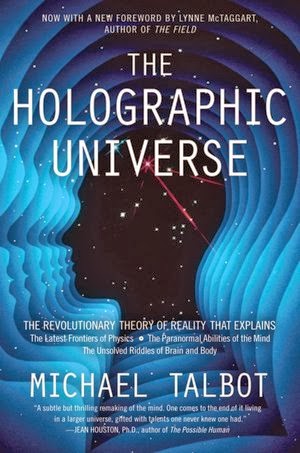
Then there are strange results from science. Physicist Alain Aspect and his team discovered that under certain circumstances subatomic particles such as electrons are able to instantaneously communicate with each other regardless of the distance separating them. It doesn't matter whether they are 10 feet or 10 billion miles apart, apparently violating standard notions of "causality connection" which are supposed to be limited by the speed of light. University of London physicist David Bohm believes that Aspect's findings imply that objective reality does not exist, that despite its apparent solidity the universe is at heart a phantasm, a gigantic and splendidly detailed hologram. Stanford neurophysiologist Karl Pribram has also become persuaded of the holographic nature of reality, from the
The-Holographic-Universe-Talbot-Michael-9780062014108completely different direction of explaining the power of the human brain. (For more, see Michael Talbot's book The Holographic Universe.)

All right, the notion is gaining some degree of plausibility. But suppose it's true. In that case, whose simulation are we living in? Some vast future Omega Point consciousness? Aliens, simulating weird alternative life forms? (Plausible, since human beings are so crazy.)

Naw, it should be simpler than that. And much more consistent with the irrationality we see around us?

How about this one? That we are all living inside someone else's Start Trek Holodeck dream. Is there any way we could test this hypothesis? A method that goes even deeper than cybernetics, neurophysiology or even physics?

Simply look around and see who has been impossibly fortunate, vastly out of all proportion to personal talent and competence, or even family privilege, or even any possible intervention by anomalous good luck!

Next, consider that a long-lasting Holodeck experience will not just be about being lucky, winning every poker hand and getting every girl. Heck, that's boring. Sitting around in a harem on a pile of jewels? feh. Gets tired quickly, take my word for it!

UNIVERSEFAKEAnyway, if you simply win every hand, it's hard to forget that this is a simulation. If that is your aim -- to live in a wish fantasy while still being able to pretend it's real -- well then you want all the cool stuff to happen in ways that at least marginally let you fool yourself... into believing that you earned it all. Not because you dropped a lot of quarters into the Holodeck slot, but because you're more deserving. Because you’re gooder. Because you're better than everybody else.

Yeah! That’s the ticket. Tell the Holodeck computer to simulate real opponents - all the smug, assured, brainy types you hate. Only in this new universe they will lose despite all their fancy book smarts.

And your allies? Fun guys who know how to party and help you give wedgies to the smug, smartypants nerds. Yeah! As for luck? Well, set the game to easy, of course, but with LOTS of nerds to overcome and lots of social rules to flaut. And while victory should follow victory, it should never be TOO obvious. Make it gradual enough to last. So you can avoid the real enemy. Boredom.

All right, then, folks. Can YOU see anybody around you whose life we must clearly all be revolving around, in his personal holodeck program?

Continue to the Holodeck Scenario Part 2...