What makes
a science fictional webcomic? Many offer insights into science or space, artificial intelligence or how technology impacts our lives. Some
have speculative fiction plotlines and are set in the distant future… but not
all. A good number depict spaceships, colony planets, faster than light travel, time
travel, or alternate universes… but not all. Many portray alien species or talking
anthropomorphic animals -- and reflect on the nature of humanity.
More than a few explore post-apocalyptic scenarios after a fall from plague or widespread war; others have more mundane modern day settings, but deal with technological quandaries. Some offer drama or adventure; others are humorous or wry... and a few are rather dark. They tend to avoid tales of wizards and superheroes… or excess magic or mysticism.
TV Tropes offers an extensive source of information about the common concepts of sci fi webcomics.
More than a few explore post-apocalyptic scenarios after a fall from plague or widespread war; others have more mundane modern day settings, but deal with technological quandaries. Some offer drama or adventure; others are humorous or wry... and a few are rather dark. They tend to avoid tales of wizards and superheroes… or excess magic or mysticism.
TV Tropes offers an extensive source of information about the common concepts of sci fi webcomics.
This is a
follow-up to my earlier postings on science and Science Fiction related comics: Part 1 looked at many excellent works such as Dresdan Codak, Schlock Mercenary, Girl Genius, SMBC, and xkcd; Part 2 moved on to Brewster Rockit, Outsider, Freefall, Drive, Quantum Vibe, and many others. Here in Part 3 we'll do cleanup, covering some neglected treasures and others that you readers suggested, down in comments. (And yes, the Contrary Brin comments community is one of the oldest and most articulate/interesting blogmunities on the web, consisting mostly of erudite folks who care about ideas... and almost troll free!)
== Continuing our Web Comic Roundup ==
First a suggestion. Support these talented webartists -- and those listed in Parts 1 & 2 -- on the crowd-funding site Patreon – for these talented artists consistently post their work online for free.
First a suggestion. Support these talented webartists -- and those listed in Parts 1 & 2 -- on the crowd-funding site Patreon – for these talented artists consistently post their work online for free.

Questionable Content, by Jeff Jacques, has been running
since 2003, with well over 3000 episodes. A “slice of life” comic, the light-hearted, humorous series is set in
Massachusetts in the near future. It follows the ever-evolving relationship dramas between
Marten Reed, an indie-rock fan, his friends Faye and
Hannelore (who grew up on a space station), his mischievous and often sociopathic
robot Pintsize, and a cast that expands as the series progresses. Most tech is
present day, other than the anthropomorphic sentient robots -- called AnthroPCs.
The storyline takes many twists and turns over the years, at times developing the more futuristic and science fictional aspects of the plot, such as androids and artificial intelligence. See Issue 2017 for the start of their trip to the space station.
The storyline takes many twists and turns over the years, at times developing the more futuristic and science fictional aspects of the plot, such as androids and artificial intelligence. See Issue 2017 for the start of their trip to the space station.

Trying Human, by Emy Bitner follows Rose Marie
Williams, a secretary for the New York City police, who wakes each morning suffering form insomnia and nosebleeds. Under hypnosis she discovers she is being abducted by aliens, the telepathic
Greys; one male, Hue, has become fixated on her. Unknown to Rose, her boyfriend
has become an agent of the secretive “Majestic 12” – a "Men in Black" - like unit which monitors alien
activity on Earth.
On a parallel plot line, flashbacks from the 1940s follow Phillis, a translator for the Air Force, who develops a special connection to an alien, EBE1, who has been recovered from a crashed ship. The title comes from a “trying human circuit” – which aliens use to appear human during their time on Earth. Start from the beginning here.
On a parallel plot line, flashbacks from the 1940s follow Phillis, a translator for the Air Force, who develops a special connection to an alien, EBE1, who has been recovered from a crashed ship. The title comes from a “trying human circuit” – which aliens use to appear human during their time on Earth. Start from the beginning here.

Trekker, by Ron Randall: This
retrofuturistic adventure story begins in the gritty city of New Gelaph in the
23rd century, but later expands to encompass an interstellar society.
It centers around the no-nonsense, kick-ass Mercy St. Clair, a bounty hunter or
“Trekker,” tracking down criminals, gang members, underworld bosses, “…alive or
dead, the pay’s the same.” In more recent issues, she takes on political
intrigue and war as she ventures out to other planets and colonies. Wherever
she goes, trouble always finds her.
Released in print by Dark Horse in the late 1980’s, the series has been revived online. Nice artwork, vivid story with lots of action and fight scenes. Start from the beginning here, or indulge in the collected Trekker Omnibus.
Released in print by Dark Horse in the late 1980’s, the series has been revived online. Nice artwork, vivid story with lots of action and fight scenes. Start from the beginning here, or indulge in the collected Trekker Omnibus.

Inhuman, by Icarus, is set 1000 years in the
future, after aliens have contacted earth. Near light speed travel has been
achieved and Jump Gates enable rapid interstellar travel. A militaristic
religious group, Rulerism, has spread across the galaxy; violence and massacres
have followed as they forcibly seek converts with the mantra, “Save everyone’s
soul. Save them from themselves.” Many of the (animalistic) aliens are
prejudiced against humans for their role in the Ruleristic cult. Grey, a blind,
mute, schizophrenic human, covered in scars, has escaped from an alien psych
ward… and the Rulerists are desperate to find him. Flashbacks and
hallucinations begin to fill in the often dark backstory. Hand drawn in ink and
watercolors … a reflection on what it means to be human. Start at the beginning here.

Crowded Void, by Mike West offers one of the
more unusual concepts. Finding Earth too crowded and people rather distasteful,
Vincent Foxwell thought he could find peace when he took a job on a cargo
vessel, hauling junk in space, with only an AI for company. Space turns out to
be more crowded than he imagined…. when his spacecraft is swallowed by a massive
space worm, where there is already an intestinal civilization of over a million
humans and aliens, jockeying for position in the worm's digestive cycle. He must find
a way to escape… before digestion is complete. But first he must deal with the The Joint Intestinal Monarchy, which controls the worm, harvesting parts from spaceships. No end of good material for
humor… a new theory of wormholes? Start at the beginning here.

O Human Star, by Blue Delliquanti, tells the tale of Alastair (Al) Sterling,
an inventor whose work sparked the robot revolution, but didn’t live to see it.
Sixteen years after his sudden death, Al wakes up in a synthetic replica of his
original body, with his memories intact. His technical designs have become reality;
advanced robots coexist with humans. Meanwhile Brendan, his former business
partner and best friend, had tried but failed to resurrect Al. However, Brendan did succeed in
generating a synthetic being, Sulla, that looks like Al -- but decided to
become female. She’s like him in every other way, except that she doesn’t have all his memories. Flashbacks illuminate Al’s formerly intimate
relationship with Brendan (some sex scenes). And now Al must struggle to figure out who had him
resurrected -- and discover his role in this new world of ever present artificial intelligence. Start at the beginning here.

Sunset Grill, by Kat Feete, is set in in a bar
in the year 2426, in the gritty streets of Kieselburg, somewhere in the
Midwest. “Earth is a patchwork quilt of restive, squabbling Domains, loosely
joined under the mantle of the Empire, whose primary goal is to present a
united front to the dozens of technologically advanced, land-hungry, and not
particularly moral alien races.” The serial comic centers around the bar’s
owners, workers and patrons, as well as the street kids, criminals, gangsters, corrupt
cops, prostitutes, drug dealers… the low-life of the city’s slums, as well as
glimpses of the justice system and Imperial officers. Science fictional
elements are rare (genetically-engineered greenies) and some advanced technology.
3D computer graphics, with lots of backstory on the website. Start at the beginning here... and see it
reviewed more extensively on Tangents Review.

The Wandering Ones by Clint Hollingsworth An action
comic set in the post-apocalyptic world of the mid 21st century,
after a man-made viral weapon, a plague bomb released from orbit by religious
zealots (as they were leaving earth) - has killed off most humans. But not all.
The comic follows the stealthy scouts of the Clan of the Hawk, in the Columbia
River area of the Pacific Northwest. These rebels, led by the tough female
Ravenwing, use their survival and tracking skills (as well as some modern
technology and a fair amount of mysticism) to live off the land as they
struggle against the encroaching fascist Farnham’s Empire, aka The Reich. Start at the beginning here.

A Miracle of Science, written by Jon Kilgannon, drawn by
Mark Sachs. This light-hearted webcomic ran from 2002 to 2007. Set in the year
2148 in an interplanetary civilization that extends out to the Jovian moons.
This romantic comedy follows two members of the Vorstellen Police, whose job it
is to track down and stop a virulent plague of… mad scientists. Bwa ha ha ha!
The onset of Science Related Memetic Disorder (S.R.M.D.) has led to rogue
scientists conducting dangerous research (to make robot armies) to achieve
world domination. Lots of chase scenes and explosions, plus advanced tech like
AI, androids, big attack robots, orbital cannons and terraforming. Fun. Start from the beginning.

Thunderpaw: In the Ashes of Fire Mountain, an
animated comic by Jen Lee. This is a buddy roadtrip tale with anthropomorphic
talking dogs. It was the brightest night… when humanity suddenly disappeared. “They’re not coming back are they?” Doggy pals Bruno and
Ollie are trapped inside a car when fire rains from the sky and breaks open the
vehicle. They can’t help but wonder…If only they hadn’t chewed up the garden,
maybe this wouldn’t have happened. Bruno and Ollie wander across a
post-apocalyptic fiery wasteland, with danger everywhere… and they just want to
return home to their doggy bed and backyard where treasures are buried. Lee’s gray
and orange panels jitter and flash to create a sense of immediacy. Start at the beginning here.

Sluggy Freelance, by Pete Abrams. This humorous strip has been
running since 1997; longer story lines developed over time. The main characters
are Torg, his inventor friend Riff, Zoë, Gwynn and a psychopathic switchblade-wielding,
talking mini-lop rabbit, Bun-Bun. They encounter aliens, monsters, ghosts, demons, vampires,
mad scientists, and alternate universes.. with large doses of pop culture references, puns, parodies
and gag lines. Read the New Viewer’s Guide or
sample the Sci-Fi Adventure, where Riff invents a “dimensional flux agitator
which opens rifts in random reality paths,” intending to blast Bun-Bun into
another dimension – but of course things go wrong….

Anna Galactic, by Christopher Baldwin (creator of Space Trawler), is a
sci fi web comedy. The spaceship Mary Celeste has landed on a carbon-based
world when their lauridium power cube nearly died. But why were no SOS signals sent? And why
hasn’t the captain gone in search of lauridium on the planet?
Passengers Foxglove and Anna, with crewmember Dilvan -- and a nannybot Pewter -- suspect something’s amiss… and head off to the planet surface seeking answers. They encounter bizarre and hostile alien lifeforms and landforms and a mysterious colony settlement. Start at the beginning here.
Passengers Foxglove and Anna, with crewmember Dilvan -- and a nannybot Pewter -- suspect something’s amiss… and head off to the planet surface seeking answers. They encounter bizarre and hostile alien lifeforms and landforms and a mysterious colony settlement. Start at the beginning here.
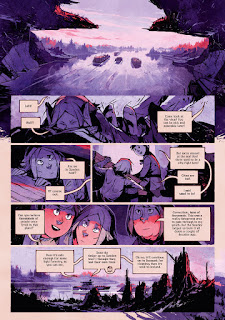
Stand Still. Stay Silent, by Minna Sundburg is a
post-apocalyptic adventure webcomic set in Iceland, which sealed its borders
after a virulent pathogen wiped out most of the “Old World.” Ninety years
later, a poorly funded research crew has set off to explore the outside
territories of the Silent World – and gather info about those dark lands outside the known world, which consists of Iceland, Norway, Sweden, Denmark, and Finland. Their journeys bring them in contact with a multitude of
dangers -- beasts, giants, trolls and monsters – many the result of mutation from the
plague. Elements of Nordic mythology arise, as much of the population has
reverted to worshiping the ancient Norse or Finnish gods. Start at the beginning here.

Space Junk Arlia, by Alex Miller and Orange This
relatively recent space opera follows a gang of pirates aboard the frigate
Dela-Ru, their tough captain, Rana Borlei (known as Lady Luck) and their partly
alien crew. Anyone going up against her “is gonna need all the luck they can
get.” Even so, these pirates barely eke out a living, smuggling goods, avoiding the
law when possible. When they agree to secretly escort a member of royalty, they find themselves
under attack, enmeshed in webs of conspiracy… even as Rana’s past comes back to
haunt her. Vivid space battles and starships. Start at the beginning here.

Erin Dies Alone, written by Cory Rydell and drawn
by Grey Carter. A darker offering, this comic is about “isolation, mental illness and videogames.” It
centers around a writer named Erin, a lonely young woman who has not left her
condo in two years, her meds delivered through a slot in the door. Erin spends
her days immersed in video games, hallucinating and talking with imaginary
video game characters, particularly Red Panda, “the one who will save us all.”
Is it all in her head… and can she step back into the real world? The strip
satirizes classic video games from Sonic the Hedgehog to Halo and Final
Fantasy, video violence, and leveling up. Start at the beginning here.
Brief Looks:
 |
| Space Mullet |
Space Mullet, by Daniel Warren Johnson, is “an episodic style comic about a washed up, Ex-Space Marine trucker named Jonah, and his alien co-pilot, Alphius. Together they do their best (and usually fail) to do good throughout the galaxy.” (>Pictured to right.)
Relativity, by Beck Kramer: “When Irina Novak
set off on NASA’s first light speed travel mission, she knew the flight would
change her life. She just had no idea how much.”
 Bicycle Boy
Bicycle Boy
Space Corps, by Bryan Richmond and Gannon Beck: this series follows “a platoon of Space
Marines fighting in a planet-hopping campaign in an intergalactic war.”
Nine Planets Without Intelligent Life, by Kit Roebuck and Alec Reed. "A philosophical road trip about two unemployed robots on an improvised interplanetary voyage of self discovery."
Greasy Space Monkeys, by Reine Brand and Mark Kestler, tells “the adventure of two idiots in a dead end job on a run-down space station.”
Velocidad Bikers in Space, by Kasey Quevedo is “a sci fi genre webcomic about fast ships, space-heists, and even faster space bikes.” (Pictured to right.)
Greasy Space Monkeys, by Reine Brand and Mark Kestler, tells “the adventure of two idiots in a dead end job on a run-down space station.”
 |
| Velocidad by Kasey Quevedo |
Supermassive Black Hole A!, by Ben Chamberlain. A hard sci fi webcomic, the story follows
“human civilization at the center of the Milky Way galaxy, an area of space dominated by a gigantic
black hole, where energy is abundant and life is cheap.”
Am I recommending all of these? Well some are better than others, but I leave that to you. Also, many of the very best were listed already, in Parts 1 & 2. But the number one consideration is this...
...enjoy! But also protect your lifespan and productivity! Our wondrous civilization is filled with distractions. Have fun. But ration yourself and get done what needs doing! Then... rewards await...
Am I recommending all of these? Well some are better than others, but I leave that to you. Also, many of the very best were listed already, in Parts 1 & 2. But the number one consideration is this...
...enjoy! But also protect your lifespan and productivity! Our wondrous civilization is filled with distractions. Have fun. But ration yourself and get done what needs doing! Then... rewards await...
== Return to Part 1: A look at Science - oriented webcomics