Showing posts with label fantasy. Show all posts

Sunday, February 05, 2012

More on the Difference Between Science Fiction and Fantasy

==More on Fantasy and SF==

I enjoyed the guest essay, A Far Green Country, that fantasy Author Catheryn Valente contributed to Charlie Stross's blog.  I found many of her insights and metaphors fascinating and fun, such as why magic realism as a sub-genre seems to crop up especially in countries ruled by brutal despotisms.

Nor is magical thinking solely the province of non-technological minds.  I agree that the nerdy-techno "singularity" is - at root - just a modern manifestation of magical-transcendentalism.  Indeed, our 21st Century America is awash in mystics!  The technological illiterates among them either wallow in the Book of Revelations or lefty-Gaian nostalgism or else solipsistic AynRandianism,  Those who are tech-empowered shift their transcendentalism to what's been called the "rapture of the nerds."  Same stuff though, when you dig deep to the level of personality, and thousands of years old.

I found the anecdote about Cotton Mather and obsession with the Rapture erudite, hilarious, persuasive and rather moving!

Still, in the end, I found Cat's missive troubling.  We all know there IS a difference and distinction between Fantasy and SF. Simply pointing the finger at some sci fi and saying "that's also magical thinking!" is not a truly helpful step toward understanding.  Cat knows very well that there is a lot of science fiction that explores the processes of change in human civilization, thought and nature without pleading a transcendent dispensation or rapture.

No, the root element is right there in that word "change." Science fiction borrows many elements from the mother genre - fantasy -- elements of boldness and the fantastic that date back to Homer & Gilgamesh. But sci fi then rebels against all literary foundations by embracing change.  Even when it warns against BAD change it is relishing, exulting, expanding upon what Einstein called the "gedankenexperiment" or thought experiment.

When SciFi goes "whatif" it takes the sacred word seriously.

 Fantasy is almost perfectly encapsulated by the presumption of changelessness.  Oh, kingly rulers my topple and shift, but the abiding assumptions and social castes generally do not. This is why, despite her dragons and bards and medieval crafts, Anne McCaffrey proclaimed loudly that "I am a science fiction writer!"  Because her characters know that change is coming.  Some resist, many are eager to bring it on as fast as they can.  And the future on Pern will have both dragons and flush toilets.  Songs and tapestries and universities and hyperdrive ships.

Terry Pratchett writes science fiction because his discworld (borne through space by a mythical turtle) has something called progress.  People are waking, rising up. George Martin's depressing Game of Thrones saga has very little magic in it, but it consigns the peasants to endless, endless, endless misery and feudal oppression, with absolutely no hope of progress.  It is part of the longer/older tradition stretching back to Homer. It is fantasy.

I go into this elsewhere in my essay,  The Difference between Science Fiction and Fantasy.

But other than that...terrific article.  Thanks Cat, I learned a lot.  I must look up your books.

== And Miscellaneous Cool Stuff! ==

Watch this segment of Neil deGrasse Tyson about America's decline amid the changing landscape of modern science. I mean it.  Watch this and make your uncles and cousins watch it. Half of our economic growth since WWII came from science and technology. This last decade was the first in 60 years in which the US did not stun the world with some terrific "new thing" that let us get rich enough to then buy megatons of crap from foreign factory workers and uplift a new world middle class. The Fox War on Science is nothing less than pure, unadulterated treason.

No more Virtual reality headsets or helmets: DARPA is developing megapixel augmented reality contact lenses that will allow users to focus on both faraway objects and images placed very close to the eye. I portray this in EXISTENCE.

Too pretty for words. Gorgeous planets in drops of water.

Comedian -- Dara O'Briain -- opines on science and quackery. Brilliant, utterly brilliant: "The difference is that science knows it doesn't know everything. If it thought it knew everything it would stop.”

Some of us, including fellow author John Shirley, used to muse about the possibility of using a plasma blaster to turn trash into component atoms--a trash DISINTEGRATOR. It's apparently energy efficient and could solve many environmental problems.

What exactly are your online rights? What protections are offered under the First Amendment and intellectual property laws? Chilling Effects offers an extensive database of info about copyright and trademark infringement, fan fiction, cease and desist notices, issues of anonymity and freedom of expression. A joint project of the Electronic Frontier Foundation and Law Schools at Harvard, Stanford, Berkeley and the George Washington School of Law, Chilling Effects is a first stop to determine your legal rights in the on hot issues in the ever-evolving online world. I’ve been known to differ over matters of emphasis with my friends at EFF.  I am far less worried about what governments and the mighty “see” about me -- and history shows little hope of stopping them -- while I am more vexed and angry over government and the mighty hiding from citizen supervision.  Still this is a good and important move and I am glad these folks are doing things like this!

== And Snippets From the Political Year ==


If you think wealth is concentrated in the United States, just wait till you look at the data on campaign spending. In the 2010 election cycle, 26,783 individuals (or slightly less than one in ten thousand Americans) each contributed more than $10,000 to federal political campaigns. Combined, these donors spent $774 million. That's 24.3% of the total from individuals to politicians, parties, PACs, and independent expenditure groups. Together, they would fill only two-thirds of the 41,222 seats at Nationals Park the baseball field two miles from the U.S. Capitol. When it comes to politics, they are The One Percent of the One Percent.

A Sunlight Foundation examination of data from the Federal Election Commission  reveals a growing dependence of candidates and political parties on the One Percent of the One Percent, resulting in a political system that could be disproportionately influenced by donors in a handful of wealthy enclaves. (And remember, this is just the up-top data and does not include Super Pacs!)

One percent of one percent... that is about the ratio of nobility in feudal societies.  welcome back to the human normal.  The Enlightenment was cool while it lasted, hm?

==Online Media==

Patrick Farley has resurrected his Electric Sheep Comix site.  This brilliant... and cosmically under-rated ... visual artist and innovative storyteller is back!  You can view the dramatic and politically cogent "Spiders" saga, which I cite regularly for its implications about citizen-centered civilization... or view the psychedelic future in the sci fi "Don't Look Back"... finally grasp the full implications of the terrifyingly bizarre fixation called the Book of Revelation, in "Apocamon"...

Or scroll through the stunningly beautiful, thought-provoking... and sexy... newest Farley work... "First Word." And I may have a very special Farley-related announcement  soon!

Friday, January 20, 2012

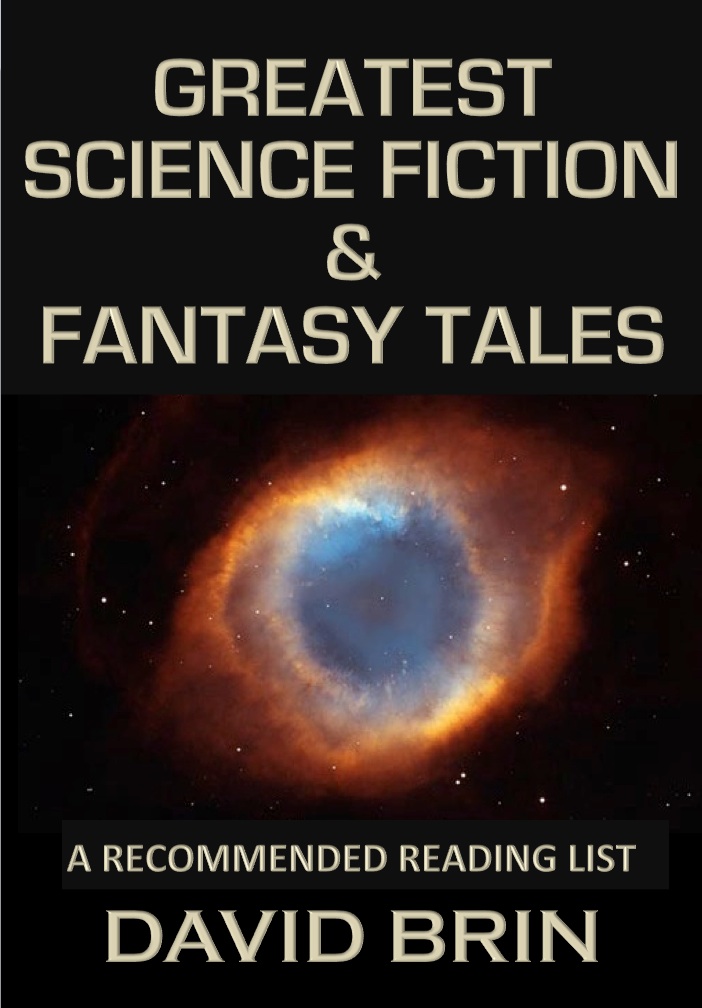
David Brin's List of "Greatest Science Fiction and Fantasy Tales"

Many folks have created tallies of favorite Science Fiction novels.  I've already weighed in with my Top SF for Young Adults . For more insight into Science Fiction, see also these essays: A Comparison of Science Fiction vs. Fantasy and How to Define Science Fiction.

But now let's try something much more ambitious -- a bigger, broader reading compilation.  This is still just a sampler - for something comprehensive, see the Science Fiction Encyclopedia or the user-friendly Worlds Without End. But any person who has read all the books and stories and authors noted here (and I admit they are heavy on "classics") can come away with bragging rights to say: "I know something about science fiction."

For this list I divide the novels authors and stories in my own quirky manner, according to categories...

* DIRE WARNINGS AND SELF PREVENTING PROPHECIES:

These novels and shorter works have drawn millions to ponder many different kinds of danger that may lurk down the road ahead. Among our possible tomorrows, so many might be dreadful-but-avoidable - from tyranny to ecological deterioration to some tragic failure of citizenship.  A few of these books even attained the most powerful status any work of fiction can achieve ... changing the future, by alerting millions, who then girded themselves, discussing the problem with neighbors, becoming active, vowing to help ensure the bad thing never happens.

The following examples of self-preventing prophecy stand out. All of them help us focus on something that we may desperately miss, if it were ever gone

Nineteen Eighty-Four, by George Orwell.
The Sheep Look Up, by John Brunner
A Canticle for Leibowitz, by Walter M. Miller, Jr.
Make Room! Make Room!  by Harry Harrison (basis for the film Soylent Green)
Brave New World,  by Aldous Huxley
"Harrison Bergeron" by Kurt Vonnegut Jr.
On The Beach, by Nevil Shute
We, by Yevgeny Zamyatin
The Cool War, by Frederik Pohl
The Disappearance, by Philip Wylie
Flood, by Stephen Baxter
The Windup Girl, by Paolo Bacigalupi
The Unincorporated Man, by Dani Kollin & Eytan Kollin
Station Eleven, by Emily St. John Mandel
Oryx and Crake by Margaret Atwood

... plus almost anything by Alice Sheldon (James Tiptree Jr.), or Nancy Kress or Octavia Butler... I leave it to others to decide whether my own apocalyptic warning novel, The Postman. belongs on this list.

* HARBINGERS OF HOPE:

These tales offer something almost as important as warnings... a tantalyzing glimpse at (guardedly and tentatively) better tomorrows. It's actually much harder to do than issuing dire warnings! (That may be why there's so little optimism in print. Most authors and directors are simply too lazy.)

Stand on Zanzibar, by John Brunner
Beyond This Horizon, by Robert A. Heinlein*
Rainbows End, by Vernor Vinge
Consider Phlebas,  by Iain Banks (and his Culture Series)
Island, by Aldous Huxley
Pacific Edge, by Kim Stanley Robinson

... plus the entire sub-genre known as Star Trek, among the few places where you come away feeling envious of our grandkids - the way things ought to be....

* HUH! I NEVER REALIZED!

Some tales simply rock readers back with wondrous stories that also broaden their perspective... from strange cultures to alternate social systems to unusual ways of thinking.

Lord of Light, by Roger Zelazny
Dune, by Frank Herbert
The Dispossessed, by Ursula K. LeGuin
Courtship Rite, by Donald Kingsbury
The Years of Rice and Salt,  by Kim Stanley Robinson
A Deepness in the Sky, by Vernor Vinge
Snow Crash, by Neal Stephenson
Ancillary Justice, by Ann Leckie

...plus the "Nine Worlds" series of John Varley and the brain-twistings of  Samuel Delaney...

* THE HARD STUFF:

Take me someplace new.  Boggle me with possibilities grounded in this strange-real universe of science! Almost anything by these authors will give you tons of the real meat of SF.

Timescape, by Gregory Benford
Eon, by Greg Bear
The Foundation Trilogy, by Isaac Asimov
FlashForward, by Robert Sawyer
Tau Zero, by Poul Anderson
Ringworld, by Larry Niven
Diaspora or Quarantine, by Greg Egan
To Crush the Moon, by Wil McCarthy
Vast, by Linda Nagata
Anti-Ice, by Stephen Baxter
The Web Between the Worlds by Charles Sheffield
Spin, by Robert Charles Wilson

... plus many works by Joe Haldeman, John Varley, Elizabeth Bear, Charles Gannon, Jack McDevitt....

* FANTASY - WITH BRAINS:

Just because there's magic and wizards and kings and such...  doesn't mean it has to be lobotomizing.  There really are exceptions!

The Drawing of the Dark, by Tim Powers
The Lord of the Rings, by JRR Tolkien (yes, there are Elfs. But JRRT was exceptionally smart and honest about the attractions and  drawbacks of nostalgia)
Harry Potter and the Methods of Rationality, by Eliezer Yudkowsky (only available for free, online)
Neverwhere, by Neil Gaiman
The City and The City, by China Mieville
Boneshaker, by Cherie Priest
The Fifth Season, by N.K. Jemison
Binti, by Nnedi Okorafor

... plus "urban" fantasies by Emma Bull, Nalo Hopkinson, Geoff Ryman...

*GEDANKENEXPERIMENTS: 

Or... what if things were different?

The Stars My Destination, by Alfred Bester
Dying Inside, by Robert Silverberg
Childhood's End, by Arthur C. Clarke
Brain Wave, by Poul Anderson
The Yiddish Policeman's Union, by Michael Chabon
BlindSight, by Peter Watts

*RIP-SNORTING GOOD STORYTELLING:
 

Explains itself. Just go along for the ride.

The Forever War, by Joe Haldeman
Gateway, by Frederick Pohl
The Mote in God's Eye, by Larry Niven and Jerry Pournelle
Old Man's War, by John Scalzi
The Great Time Machine Hoax or Earthblood, by Keith Laumer
The Princess Bride, by William Goldman
Genus Homo & The Incomplete Enchanter, by L. Sprague De Camp

... plus anything at all by Poul Anderson.  I mean it.

*ALTERNATIVE HISTORY/PARALLEL WORLDS:


Extra points if it seems plausible that this might-have-been really might have been. And even more points if the reader goes, "That world seems likelier than this one I'm living in!"

The Man in the High Castle, by Philip K. Dick
1632, by Eric Flint
Cryptonomicon, by Neal Stephenson
The Great War (series)   by Harry Turtledove
Bring the Jubilee, Ward W. Moore
Lest Darkness Fall, by L. Sprague deCamp


*TIME TRAVEL:

Here the biggest test is whether you can offer a new or surprising logical twist. Bring on them paradoxes!

The Man Who Folded Himself, by David Gerrold
Up the Line, by Robert Silverberg
Run, Come See Jerusalem, by Richard Meredith
The Big Time, by Fritz Leiber
Doomsday Book, by Connie Willis
The Technicolor Time Machine, by Harry Harrison
"All You Zombies" and "By His Bootstraps" by Robert A. Heinlein

* HUMOR:

The hardest thing of all to do well.   Someday I might dare to try this most-difficult type!

The Ultimate Hitchhiker's Guide to the Galaxy, Douglas Adams
Bored of the Rings, A Parody of J.R.R. Tolkien's Lord of the Rings, by the Harvard Lampoon
Hoka! Hoka! Hoka! by Poul Anderson and Gordon Dickson
The Colour of Magic, by Terry Pratchett
"Blued Moon" in Fire Watch, by Connie Willis
The Flying Sorcerers, by David Gerrold & Larry Niven
Star Smashers, and Bill the Galactic Hero, by Harry Harrison
Split Heirs, by Esther Friesner

... plus snorkers & groaners by Mike Resnick.
.
* SHEER BEAUTY:

Forget science, logic and other superficialities.  Just love it.  The words... the words...

The Martian Chronicles,  by Ray Bradbury
Gravity's Rainbow, by Thomas Pynchon
Riddley Walker, by Russel Hoban
Hyperion, by Dan Simmons
The Book of the New Sun, by Gene Wolf
The Rediscovery of Men, by Cordwainer Smith
More than Human, by Theodore Sturgeon
"'Repent Harlequin!' Said the Ticktockman" by Harlan Ellison

...plus anything by Robert Sheckley (one of my all time favorite authors).


* QUIRKY CLASSICS: 

Going farther back ... hey it's a kind of time travel!


The Time Machine, by H.G. Wells
20,000 Leagues Under the Sea, by Jules Verne
Last and First Men, by Olaf Stapledon
Herland, by Charlotte Perkins Gilman
After Many a Summer Dies the Swan, by Aldous Huxley
The World, The Flesh, and the Devil by JD Bernal
When Worlds Collide, by Balmer & Wylie

...plus... well... you aren't truly steeped in the genre till you've wallowed in Doc Smith and Edgar Rice Burroughs.. and Conan!

* PREDICTIVE SUCCESS!

We SF authors often disclaim any intent to foretell the future.  We explore it, test possibilities, perform gedankenexperiments, even warn or entice.  But predict?  Well, at times we do try... and even keep score! My fans maintain a wiki tracking hits and misses from my most predictive near-term book to date - Earth. Here are some looks-ahead that have been impressively on-target.

Shockwave Rider, by John Brunner
Beyond This Horizon, by Robert A. Heinlein*
"The Brick Moon" by E. E. Hale (1865)
Neuromancer, by William Gibson
Age of the Pussyfoot, by Frederick Pohl

...plus at least half of the tales ever written by Jules Verne!

* BEST FOR YOUNG ADULTS AND KIDS:

Or for those young at heart. (See my separate list of Young Adult Recommendations.)

Rite of Passage, by Alexei Panshin
Little Fuzzy, by H. Beam Piper
The Door into Summer, by Robert A. Heinlein
The High Crusade, by Poul Anderson
A Spell for Chameleon, by Piers Anthony
Orbital Resonance, by John Barnes
The Chanur Saga, by C.J. Cherryh
The Ship Who Sang, by Anne McCaffrey
The Disappearance, by Philip Wylie
Pilgrimage, by Zenna Henderson
Emergence, by David Palmer
Little Brother, by Cory Doctorow
Leviathan, by Scott Westerfield

... plus anything by Andre Norton, H. Beam Piper...  and check out my Out of Time series!

*RISING STARS OF SCIENCE FICTION:

Wool, by Hugh Howey
Dark Eden, by Chris Beckett
Semiosis, by Sue Burke
Medusa Uploaded, by Emily Devenport
The Murderbot Series, by Martha Wells
The Calculating Stars, by Mary Robinette Kowal
The Quantum Thief, by Hannu Rajamieni

* OTHER WORTHY AUTHORS:  Try some on!

Accelerando_(book_cover)Charles Stross, Kay Kenyon, Syne Mitchell. Paul McAuley, Howard Hendrix, Charles Gannon,... but also explore on your own!

 *AND SF ISN'T JUST ANGLO-AMERICAN
International contributions to this genre are undeniable. Indeed, it would be churlishly socio-centric to ignore great titles like Roadside Picnic (Arkady and Boris Strugatsky), The Cyberiad (Stanislaw Lem), The Paper Spaceship (Tetsu Yano), The Three Body Problem (by Liu Cixin) and Japan Sinks (by my Worldcon co-GoH Sakyo Komatsu).  In fact, this is a whole 'nother category deserving a whole 'nother list! And your suggestions are welcome.
.

ScienceFictionYoungAdultListOkay... that will have to do.  Eccentric and opinionated and far from comprehensive, this is hardly more than a sampling and a biased one too. Yes, there are a fair number of older classics, but also a sampling of marvelous works by new, upcoming authors.

(Note: surely there will be many suggested titles pushed in followup discussion!)

Still, I am confident that if you went thoroughly through this list, you'd at least have made a good start getting a taste of the boldness, the excitement, the intellectual verve and challenging ideas to be found in this, the most unabashed and courageous of all literary forms.

* Regarding Heinlein's Beyond This Horizon, it is in the thoughtful second half of the book that you get amazingly insightful ruminations about what a smarter human civilization might be like. This requires wading through a much more pedestrian and even silly "action" half. But it's worth the effort.


See more Speculations on Science Fiction


David Brin


Twitter                Facebook

Saturday, November 26, 2011

Pining for Feudalism as an Antidote for Modernity

I promised a cogent and careful review of Ayn Rand's ATLAS SHRUGGED: The Motion Picture. And I'll get to it soon.  But first, may I unleash an informal screed? One scribbled in rapid response to a manifesto that was posted online a few days ago - one that I found intellectually offensive.

It's an unbelievable essay, Not Last Long, Even as Slaves,  written - in apparent sincerity - by my colleague John C. Wright (a pretty good author (The Golden Age), by the way), in which he asserts that the long darkness called feudalism was admirable, and that - by dismal contrast - we now live in an age that is benighted by crudely materialistic modernity and a shabby shallowness of the soul.

Commenting on the specific stretch of abject misery and ignorance known as the European Dark Ages, Wright redefines it -- "or, as historians call it, ‘Late Antiquity’ or, as we Catholics call it, the ‘Lost, Glorious, Honorable, Ancient and Most Chivalric Golden Age of High Christendom...’"

He goes on:

"No one wants to die at thirty, half a mile from where he was born, unless of course he likes his home, and any patient would prefer antibiotics to leeches, I grant you. But man does not live by bread alone, or even by jet travel and space age medicine. We paid the price to enjoy the mixed blessings of the modern day, and something beyond the price we paid was lost, something precious.


"To look at mankind, who so clearly yearns for some sort of communion or reunion with nature that the pagans people the woods with nymphs and satyrs, or the nursery tales or Aesop fables with talking animals, and conclude the only possible relation between man and elf is mutual genocide is a Darwinian rather than sacramental view of life: it is simply blind to what in man, weak though it may be, is not devout to totalitarian modernism and ideas of total war. It is the world view of François de Robespierre, who guillotined the aristocracy of France like vermin, not the view of Francis of Assisi, who saluted the verminous wolf as his brother."

Woof. Naturally, I am torn.  I love a good contrarian!  And Wright clearly envisions himself in that role, leveling his lance to charge against the giant, clanking, soul-grinding mill called modernity...

...even though a mere glance at the last 6000 years shows which human phenomenon is standard fare - feudalism, serving the darwinian reproductive success of brutal men - and which type of society (modernity) is the brash upstart, with all odds stacked against it.

Okay, I love a contrarian. And yet, those who have read my denunciations of romantic nostalgia - (respectful denunciation, when I speak of the honest romantic Tolkien, but disdainful when it comes to the cosmic ingrate, George Lucas) - won't be surprised to learn that another part of me has no patience for this utter, counterfactual drivel.

Man, oh man. Where to start on this sophistry?? As if the pagan forest-lovers weren't vastly worse-off in the era Wright idolizes? Hounded and burned at the stake by medieval catholic bishops? (OMG, which era produced copious numbers of wistful, pastoral-loving fantasy novels?)

As if the aristocracy of 1790 France were prime examples of humanity, wisdom and charity, instead of monstrous persecutors who stupidly hand-crafted their own fates? Or as if 99% of the noble-born Assisi's peers were anything other than drooling-evil horrors, who only paused in their relentless reciprocal treachery long enough to join forces in a grand overall program of oppressing the serf-masses, cauterizing every low-born child's dreams?

Zoom in upon Wright's claim that those who criticize nostalgist romanticism "...conclude the only possible relation between man and elf is mutual genocide is a Darwinian rather than sacramental view of life: it is simply blind to what in man, weak though it may be, is not devout to totalitarian modernism and ideas of total war."

Oh cripes.  Where to begin.  First.  We owe absolutely nothing to $%#! elfs or wizards who clutch secret "wisdom" (what we moderns call "useful information about the world") to themselves for thousands of years, leaving men and women to flounder in miserable ignorance, when they might have opened a college in Lothlorien Forest, so we'd have flush toilets and palantirs on every desktop. Oh, thank God such creatures are mythological, because Tolkien himself opined that they were - in truth - the enemies of humankind.

Evidently, Wright swallows the romantic turd-wallow that things are better when knowledge is mysterious.  Or, as the wise authors of BORED OF THE RINGS put it:

                                          "Rings go better with hocus pocus."

(All right, you have to be over 50 to get that joke.  But trust me: Bored of the Rings is every bit as sagacious and insightful as the tome that it satirizes!)

Total war?  Oh man, John, you dare to lecture us about TOTAL WAR? Sorry, I do like you and you write well, but anyone who thinks we've gotten worse in our brutal savagery is simply a historical ignoramus.  I mean an ignoramus of historical proportions, who knows nothing of what the Assyrians did to the lost ten tribes of Israel, or the Romans to Judea, or the Mongols to Poland, or the Spanish to every native population they encountered. Or the Polynesians to each other, every year. Do you doubt that I could go on with this list? All day and all week? Can you cite counter-examples? Sure, but not many.

better-angels-of-our-nature By comparison, ever since the heroes of the democratic enlightenment conquered Mordor... I mean toppled Hitler's Nazi uber-romantics, who Tolkien himself diagnosed as super-examples of the nostalgic way... ever since George Marshall's brave men of the west pounded those monsters into dust, the per capita rate of violence on planet Earth has plummeted every single decade

Don't believe it? Watch this: Stephen Pinker on the Myth of Violence. Then ponder the most marvelous irony: that you think modernity is more violent and cruel only because modernity has succeeded in raising our standards of decent behavior, making us more self-critical about the travesties that remain.  Crimes that are so much milder than our ancestors commited routinely, without a twinge.

Oh, oh, the irony! Only... it gets richer:

"But we all know, or should all know, that modern society for all its hard and metallic glories and all its cold and soaring skyscrapers, and for the miracles of moonshots and penicillin shots, and the blessings of good plumbing and the opium of twenty-four-hour television, has lost something. Anyone who does not sense or suspect that modernity is missing something, something important, has no heart and no taste for High Fantasy."

No heart. What miserable donkey-hockey! John Wright suggests that everybody, across those dark  millennia, spent their time - while hunkering in frigid huts - thinking noble thoughts and experiencing wondrous insights of soul-expanding wisdom, instead of grunting like beasts and knifing each other for scraps.  What a reach! Based on what evidence?  Just because one priest per generation scribbled something poetical by candle light?

Good lord! Extraordinary claims demand extraordinary evidence. Show us how grinding poverty and ignorance have ever elevated great numbers of human souls.  Ever.  And I mean ever. You don't have to prove it, just show us any correlation. Any at all!

Let's see. Who wrote - during those long, awful centuries - the fine, poetically wise things that John Wright admires?  From Augustine to Aquinas to Assisi... to Maimonides, Lao Tze and Buddha?  Aristocrats, all!  Men who had free time and plenty of food and access to every scrap of "media" available during their era.  And yes, the low-brow media too, that Aristotle and Archimedes and Socrates all enjoyed, attending every bawdy play they possibly could.  As did Shakespeare, Goethe and Voltaire.

So... because there is vastly more media crap around today, that means we should ignore how much more good stuff we also have at-hand? Every glimmer of wisdom that survived the burning of the Alexandrine Library or being hidden in wizard grimoires is now available.  And those who choose to explore it all now can.

Um, instead of proclaiming that poverty and ignorance made our ancestors wise... perhaps... might one venture to suggest an alternative, vastly more realistic hypothesis? That as we increase the percentage of humanity who have surfeited bellies and disposable incomes and free time, then perhaps we might also see a commensurate increase in the percentage who feel the stirring of God's Second Greatest Gift? 

What gift am I talking about? One that comes in close-behind compassionate love?  The attribute that comes nearest to making us just like God....

The gift called curiosity.

Oh, sure, the fraction who engage in wonder, while trawling today's internet, is far from a majority.  Perhaps it always will be. But to deny that the number who actually ponder and wonder and who compassionately care about the suffering of those who dwell very far away is vastly, profoundly, overwhelmingly greater than it used to be, during epochs of tooth-and-claw, is just plain pathetic.

Is there more diversity in their glimpses of the sublime? Do these millions who are liberated by modernity contemplate -- and argue over -- a wider range of marvelous thoughts than just the virgin birth? Sure! Does that make us lesser beings, as John Wright presumes? Or does it perhaps make us incrementally more like the God who conceives an entire cosmos, filled with marvelous contradictions? The latter, you betcha.

Lost something? John are you serious?  Trotting out the old "lost something" cliche?

John Wright beckons us with the sweet-sick smugness of the Zero Sum Game.  The notion that we cannot gain the treasures of modernity without giving away something precious in return.  A sourpuss idee fixee that was well-distilled by Walt Whitman in his despicable poem: "When I heard the Learn'd Astronomer." As if the man of science does not also stare skyward, in wonder. Take it from this "learn'd astronomer": you can scrutinize the cosmos and stare at it in aesthetic joy. You can do both.

Pause. visit this brief symphony, this aria to science

It is this rejection of the Enlightenment's Positive Sum Game that makes an ingrate of John Wright.  And ingratitude -- toward the generations who strove so hard to lift their children, one rung at a time, to better and more sagacious lives -- is the most churlish human habit. This is not reverence of our ancestors, but the most atrocious way to insult them!

In contrast, I am the one here who honors the men and women of the middle ages, along with all the brutal centuries that both preceded and followed.  I honor them because I admit and avow that, amid all of that horror, some of them built more than they tore down, That - amid terror and ignorance - they succeeded at a grand and noble project. To conceive and labor and give birth - generation by slow generation - to a marvel. To a miracle.  To us.

We are the crowning glory - so far - of their hard strivings. Moreover, the geas that this lays upon us - to raise kids who are better still - is the greatest duty and burden we could possibly take upon our backs. It's what we owe them.

Oh, sure, I recognize this snarky grouchiness as what it is... part of today's viciously treasonous phenomenon called "culture war." It all fits into a tsunami of know-nothing rage expressed by the Murdochians, their anti-science, anti-progress rejection of all possibility of human improvability. Their hatred of this spectacular civilization that Ben Franklin and George Marshall and so many other heroes helped us build with our own hands. Their blatant putsch to re-establish feudalism.

But let me make plain that this is not a matter of mere politics alone. Indeed, there are anti-tech, pastoral-mystical troglodytes on the left, as well!

No, it goes far beyond mere politics. This fever is an immune response against modernity, by a portion of our genes that arose out of the harems of feudal lords. The dank, pitiable part of our human soul that yearns for hierarchy and prim order and mystically secretive gate-keepers of knowledge.  A spiteful grudge against modernity's level playing field and wide-open frontier of opportunity.

If I might borrow and adapt a metaphor from H.G. Wells -- although today's major villains are the murdochs, there is plenty of the same sickness among our eloi friends on the other side. This isn't left-versus-right. It is about personality.

The crime, the betrayal of hope, is identical at both extremes. It lies in their cultish mystifying and worshipping - without a scintilla's evidence or proof - a golden past that irrefutably wasn't, and a cruel darkness that only now is parting from before our eyes.