Showing posts with label modernism. Show all posts

Saturday, September 15, 2012

The New Modernism: Blending Science, Engineering, Art, and Human Imagination

INTRO:  On September 14, 2012, I served as the guest speaker at the grand opening and dedication of the new Structural/ Materials Engineering Building at UC San Diego (UCSD).  Present also and offering remarks were Frieder Seible, Dean of the Jacobs School of Engineering; Pradeep Khosla, the new Chancellor of UCSD; Nathan Fletcher, State Assemblyman; Seth Lerer, dean of UCSD's Division of Arts and Humanities; and Karl Beucke, President of Weimar's famed Bauhaus University. Also present: Irwin Jacobs, founder of Qualcomm and benefactor of the Jacobs School, Bob Akins, my old office mate in graduate school and a founder of Cymer Corp. A video of my talk is available.

The new building is a marvel. Many afterward asked if I would publish my speech.  I hadn't intended to!  But fortunately, my notes were easy to transcribe. So here it is.


The New Modernism: Blending science, engineering, art, and human imagination

Deans Seible and Lerer ... Chancellor Khosla... Assemblyman  Fletcher.. distinguished guests from the Bauhaus,  faculty, students and friends. It's a great honor to speak at the dedication of the latest wonder here at UC San Diego.  The mammoth and magnificent Structural & Materials Engineering Building whose every trait and design feature should help unleash the creativity of those who work within.

Built by the people of this state, with help from generous donors, it represents a major investment in the future of the University of California system, a system which I deem to be one of the diadems in the crown of human civilization.

Here you'll find the new home for endeavors ranging from the ultra-small up to macro and even mega scales.  Problem-solvers within these walls will send robots into the bloodstream and mysterious, non-linear realms within the cell. New work in fluidics, materials and battery storage systems will help us tackle vexing energy problems, extending efficient sufficiency to many of the world's rising poor and helping sustain a planet-wide middle class.

Here, researchers will test the stability of the Earth and strengthen the structures that we plant upon it. They'll innovate and improve the vehicles that carry us across and under the seas, or into the sky and space.

The composites  that make up our vehicles, aircraft and sporting equipment will grow stronger and lighter, and save vast amounts of energy while making us safer. Some will be capable of activity, flexing like muscle or re-shaping themselves, on command. They might also serve as substrates for embedded computational elements, so that the phrase "smart materials" will take on new meaning.

It will be an amazing world when your shoes, your shirt and your dinner plate all actively compute according to your stated desires, responding to your will, learning to serve you with the same graceful assurance that you now expect, when you command the fingers of your hand.

And yet another group will operate within these fascinating walls.  The Medical Devices department will continue UCSD's tradition of finding ways to overcome illness, debilitating handicaps and even some of the limitations placed on us by evolution.

But I want to remark on another milestone.  It is fifty years since the great philosopher C.P. Snow gave his famous address lamenting how the academic world had divided into "two cultures" - one scientific and the other consisting of the arts, the humanities and so on.

Both realms attract great minds! Yet, Snow appraised how these worlds of discourse appeared to speak different languages, parse different logics and view reality in fundamentally incompatible ways.

Academic "scholarship" in the humanities and arts seemed to view Truth with a rear-view mirror of citation, reputation and precedence, in a tradition going back millennia.

Science took a very different approach, in which fame or reputation could be trumped or overcome by fresh facts. In this new culture, every assertion was viewed as contingent, requiring perpetual re-evaluation through criticism and scrutiny by the next experiment.  Then the next.

And yet, this contingency did not led to murky chaos, but to ever-rising confidence in an ever-growing model of the world.

Science distrusted the squishiness of subjective intuition or reasoning.  In return, those who dwelled across campus saw scientists as "boffins" obsessed with merely solid things, bereft of vision or soul.

Underlying this divide was the noxious notion that limited so many of our ancestors... the Zero Sum Game... the assumption that you cannot achieve new powers without abandoning or losing something else. Perhaps something precious. And make no mistake, this way of thinking dominated nearly all human cultures, leading to the banal and stifling logic of feudalism.

One might even envision the great Enlightenment Project -- with its creative markets, science, democracy and so on -- as boiling down to one thing, a rebellion against Zero Sum thinking. A two century campaign to become more than just the sum of our small victories and individual defeats.

Snow despaired over these two cultures ever crossing their divide, though he hoped that it would happen somehow... someday...

...and behold! Look around you now.  It is here, at UCSD... situated in the "bottom left corner of the continent," where anything loose can roll into a wondrous pile... that the dream is coming true, at last.  Where members of both academic cultures want it to come true.

For here, in this marvelous new SME building, fiercely pragmatic researchers and dissectors of objective reality will share floors with the Department of Visual Arts, in spaces that are deliberately intermingled so that engineers will constantly find themselves engaged in conversations with right-brain creators.

And our friends from the Bauhaus know what emerges when that happens.
Something called design.

The joyful blending of breakthrough technology with artistic sensibility... extravagant imagination merging with utilitarian vision, leading, it is hoped, to spaces and tools and devices and projects and inventions... as well as wonderful frivolities...  that people not only find useful but love to use, amid a growing prosperity that's perfectly compatible with a sustainable Earth.

Attention to design becomes clear as you wander this new building.  Observe the way that open space is used, taking advantage of views and the spectacular San Diego environment.  A paradise, indeed! Though one that is also a desert, with little water or energy to spare, And so the design strives hard to compensate with breakthrough efforts at efficiency.

Within, you'll find the groups and departments arranged in clusters that gather professors near their students around common collaborative areas... then other commons areas attract interactions between departments and groups.

And as Dean Lerer alluded in his remarks about building bridges, SME is well situated to stimulate the rest of the campus, encouraging ideas to infiltrate outward, and within.
This building will thrive because its "cells" are leaky. Its structure is malleable and adaptable to changing needs, deliberately almost biological.

Not a rigid expression of one architect's ego, but a willing servant to many more generations of pioneers, who will work within these walls. And who will want to move some of the walls, to make this structure truly theirs.

That is they way design will have to be in the future.

And speaking of the future, the SME has not left out foresight, the gift that springs, as if from the prefrontal lamps of our brows shining light on the perils and opportunities ahead.

Two institutions dedicated to foresight will have their homes here:

and

It happens that I had a humble role in helping Professors Sheldon Brown and David Kirsh plan this bold venture with the Clarke Foundation and every single dean at UCSD, along with the heads of the Salk and Neuroscience Institutes and many other partners, aiming to bring to bear all the tools of science and the arts toward plumbing a great mystery -- where does the fantastic gift of imagination come from?

How can it be taught and nurtured? Can we simultaneously unleash imagination with greater freedom, yet better harness it to individual and human needs?

This cross fertilizing goal of the Arthur Clarke Center is a fitting tribute to Arthur's life, as both a scientist and vividly prescient storyteller... and one who was my personal role model.  I'm proud that my alma mater is honoring him with this bold endeavor.

May I mention a pertinent point? More successful science fiction authors have emerged from UCSD than any other campus on Earth, prompting one of your predecessors, Chancellor Khosla, to ask "Is there something in the water?"

No, it is in the air.  In the ambiance. In the attitude of a civilization, a state, a county, a campus... a building... that views prim scholarly categories as mere suggestions.

A place where the core emphasis remains on our scientific projects... using new structures and new materials to augment our tools, aircraft, buildings, and even our lives...

... but where that process benefits and derives much from openmindedness, curiosity, even humor and art.
A place where collaboration, innovation, and flow between cultures is not only allowed, but encouraged.

Even better, it is taken for granted. A palace for the Positive Sum Game... the notion that we are not bound by limiting assumptions. Where students and faculty and regular folks feel empowered to say: "I can always be a little more than I am."

It is the theme of a new culture that some find frightening in its hubris. One that is so brash and confident that it takes up the challenge we were thrown long ago, wandering in confusion amid the rubble of that Tower in Babel...

...a challenge to grow mature, to overcome the barriers of misunderstanding that separate us, combining both science and art with wisdom to re-gather in a polyglot world. To decipher the universe. To love and understand it and become its co-creators.

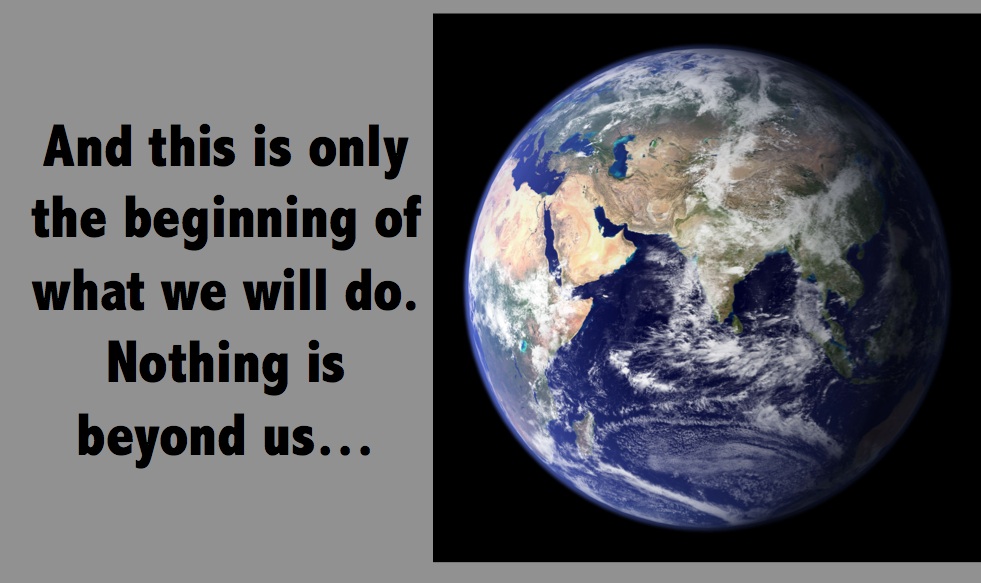
And this is only the beginning of what we will do. Until, truly, as was once promised, we find that nothing is beyond us.
Friday, May 08, 2009

The old and new versions of "culture war"

375369This month, we note the 50th Anniversary of C.P. Snow's famous Rede Lecture, "The Two Cultures," which described the wide and seemingly unbridgeable gulf of language, assumptions and mindset, between people working in the sciences and intellectuals in the literary arts and humanities.  In a a followup essay, "The Two Cultures: A Second Look," Snow optimistically suggested that a new culture, a "third culture," might emerge and close the communications gap. In Snow's third culture, the literary intellectuals would be on speaking terms with the scientists.

According to sci-tech book agent John Brockman ”This never happened. Although I borrowed Snow's phrase in my 1991 essay "The Third Culture", it does not describe the third culture he predicted.”   Indeed, Brockman portrays recent progress as more one-sided than any act of collaboration, with the bridging largely undertaken from the scientific side and most literary mavens playing the unhelpful role of cantankerous curmudgeons. 

”The third culture consists of those scientists and other thinkers in the empirical world who, through their work and expository writing, are taking the place of the traditional intellectual in rendering visible the deeper meanings of our lives, redefining who and what we are. Increasingly, The Third Culture has moved into the mainstream and the questions it is asking are those that inform us about ourselves and the world around us.”

Speaking as someone who has moved across both of these worlds without impediment, all my life, I can say that Brockman is mostly right about this.  High-end scientists do tend to be vastly more agile and forward-looking thinkers, than their counterparts in almost any other field of endeavor.  Instead of narrowly-specialized “boffins,” those at the top of their fields seem to be smarter, more-broadminded and deeply curious than anyone else alive. The reason for this is so astonishingly simple that it seems to have escaped notice.  It has nothing to do with any intrinsic superiority of scientific minds.  Rather, suppose that a person is truly broadminded and eclectic, wanting to excel in a wide span of fields. He or she must thereupon choose the scientific field of interest to work hardest in, at the professional level, simply because science is exceptionally demanding.  That person's other interests, in contrast, can be pursued part-time.   Indeed, nearly all of the top scientists I’ve met (and I know many) also nurtured impressive artistic hobbies and passionate avocations, at near-professional levels.  They bridge the gap not as invaders from science but as brilliant people who never accepted the existence of any gap, in the first place!

Meanwhile, the intellectual curse of vapid, simpleminded postmodernism has been slow to dissipate from hundreds of university English, Literature and social studies departments.  One symptom of this obdurate troglodytism has been the refusal of all but a dozen U.S. universities to pay more than nodding attention to science fiction, the most exploratory and truly American of all genres.  Another diagnosable illness is the slavish devotion that so many have pledged to the rigid storytelling tropes that Joseph Campbell called “fundamental” to myth.  These rigid prescriptions may have been nearly ubiquitous for 4,000 years, but nobody seems willing to also point out the downside -- that those bardic straightjackets were also fundamentally debasing of the human imagination, helping to limit and crush our shared cultural experience... until we finally broke free of our chains.

And yet, having agreed with much of Brockman’s point, I do have to take some exception.  Because the literary types that he and Snow call the “first culture” are not really relevant to the intellectual problems of our age. Self-marginalized and generally silly, the literature profs are no more pertinent for their anti-science thetoric than they ever were a threat to young minds, by promoting “leftist memes.”  These were strawman foes, hardly even worth the time spent shrugging them off.

Then why talk about this cultural gap at all?  C.P. Snow had an excuse.  Especially in his day, the British education system was in large part designed to cauterize scientific or technical “boffins,” keeping them physically and intellectually isolated while ensuring that real power -- cabinet posts , corporate directorships and such -- would be preserved for those steeped in the classics. (Whereupon, completely subjective grading ensured that the sons of aristocracy would slip gracefully into the high positions set aside for them.)  Hence a nearly complete lack of “breadth requirements” in most British (indeed, European) baccalaureate programs.

Meanwhile, U.S. students take an extra fourth year longer for their bachelor’s degree, getting exposure across lateral horizons of interest.  This important feature of American academic life is seldom mentioned, even though it is an inherent expression of a very different intellectual worldview.

Hence, while American lit departments are only slowly awakening from their prickly, faux-European inferiority complex, others on campus have no problem embracing a new culture of change. At the University of California, San Diego (UCSD), for example, several arts departments have joined with scientific colleagues to forge Sixth College, and the Center for the Study of Computing in the Arts, dedicated to the mission of bridging every perceived gap, with tech-savvy artists and art-loving techies.

No, in America the dangerous gap is not between CP Snow’s old archetype intellectual cultures.  Rather, what we are challenged by is a very different “culture war,” in which every kind of anti-intellectualism is fanned by those who most directly benefit from this put-up distraction.  One of the tools that help to maintain this debilitating chasm?  The metaphor of an obsolete and profoundly misleading, so-called “left-right political axis” -- a curse from 18th Century France that has been a lobotomizing political discourse for generations, focusing attention on a silly, almost meaningless “gap,” when the real chasm is much simpler -- between non-thieves and thieves.

=========

Want to attend Worldcon? The World Science Fiction Convention is always a marvelous show and this year's event Anticipation -- in Montreal, city of fine food and hospitality -- should prove no exception with great panels, previews, the Hugo Awards and a special min-conference on teaching science fiction in the classroom that I labored to help create, along with the fine folks at www.AboutSF and Reading for the Future. 

=  OTHER STUFF =

 So cool In case you haven't already seen it -- the launch of a 1/10-scale model of a Saturn V rocket, built by hobbyists. I'd have been impressed if it used liquid hydrogen and multi stages.

 Inside These Lenses, a Digital Dimension -- now appearing... my “TruVu Specs”...  (Please do let me know when anybody spots more on this trend.  I have particular interest.)

 ELECTROMAGNETIC pulse weapons capable of frying the electronics in civil airliners can be built using information and components available on the net, warn counter-terrorism analysts. Yael Shahar, director of the International Institute for Counter-Terrorism in Herzliya, Israel, and her colleagues have analysed electromagnetic weapons in development or used by military forces worldwide, and have discovered that there is low-cost equipment available online that can act in similar ways. "These will become more of a threat as the electromagnetic weapons technology matures," she says.  Douglas Beason, a director at the Los Alamos National Laboratory in New Mexico, says it may be straightforward to build a do-it-yourself EMP weapon, but more difficult to make one that can be stowed in an aircraft. 

 BTW - Beason is a Brin-pal. See my own suggested measure we should take, in order to solve this threat.

VisionCare Ophthalmic Technologies has developed a miniature telephoto lens that can be implanted into the eye and could soon help people with vision loss from end-stage macular degeneration. (VisionCare) Because only the central parts of the retina are damaged in the disease, magnifying the image on the eye allows the retinal cells. 

 Chris Phoenix of the Center for Responsible Nanotechnology: ”I learned about research that is nearing completion to develop a strain of E. coli which cannot be infected by bacteriophages.  Phages are a major mechanism - likely *the* major mechanism - that keeps bacteria from growing out of control. A phage-proof bacterium might behave very similarly to "red tide" algae blooms, which apparently happen when an algae strain is transported away from its specialized parasites. But E. coli is capable of living in a wide range of environments, including soil, fresh water, and anaerobic conditions.  A virus-proof version, with perhaps 50% lower mortality, and (over time) less metabolic load from shedding virus defenses that are no longer needed, might thrive in many conditions where it currently only survives. The researchers doing this acknowledge the theoretical risk that some bacteria might become invasive, but they don't seem to be taking anywhere near the appropriate level of precaution. They are one gene deletion away from creating the strain.”  Church's recent article describing the possible future benefits of his work, and possible future safety precautions."

Oh, think it’s time for bold amateur sci fi television?

Cool stuff on Stranger Things TV.

Monday, August 07, 2006

Despair amid signs of hope...

I was invited recently to a gathering that I could not attend, in San Francisco, where “New Politics” would be discussed, "re evaluating strategies and tactics" for what’s come to be called the new progressive movement.

Of course, this terminology is telling. Consider the way that “progressive” has been used to avoid a certain hot button “L word”... even as some historians are starting to discuss the historical origins of “liberal,” rediscovering tap root that lead to Adam Smith, of all people.

Here at this site, I have weighed in, calling for resurrection of the word “modernism,” complete with its implicit rejection of left-right dogma in favor of a can-do spirit, so very much in tune with FDR and Martin Luther King, as well as Dwight Eisenhower, embodying a spirit of scientific adventure and confident problem-solving - traits that are completely opposite to narrowminded dogmatism - and that we seem to be fast-forgetting in this benighted and fearful 21st Century.

I pick “modernism” exactly because of the low esteem that the word is given by kneejerk cynics of every extreme. But that quirky linguistic choice doesn’t mean that I’m alone in generally yearning for a restoration of courageous (and possibly militantly-moderate) pragmatism. A return to passionately eager problem-solving and a dedication to human self-improvement.

Others are calling for us all to remember The Enlightenment - an umbrella term that encompasses everything from science and democracy to free markets and individual empowerment. All key elements of The Revolution. The only revolution in history that was ever worth more than a bucket of spit.

Alas, it’s going to be a hard struggle to keep all those good things alive, what with the Iranian president calling the American president his “brother” in a worldwide campaign to replace all of those newfangled “liberal” gimmicks with older standbys, like authority, hierarchy, order, tradition and fanatical religiosity. Especially when mass media empower demagogues to co-opt words like “freedom” and turn them into little more than patriotic/tribal grunts.

But let’s focus for a moment upon what the “new politics” folks are asking for. Certainly, we should be generally sympathetic with their goals. But do any of the Enlightenment’s friends have a clue how to fight this battle, well enough to win? In a year when GOP popularity has plummeted - deservedly, because of an unprecedented run of utter incompetence, dogmatic drivel and outright thievery - shouldn’t the coming Congressional elections be set for a no-brainer sweep? A reflexive shrug by the American citizenry, throwing the bums out?

Of course not! As I point out elsewhere things are very different today, than they were in 1994, the last time the People expressed their sovereign will and changed the balance of power in Congress.

Since then, there has been a quiet putsch by the professional political caste -- an event completely at right angles to normal politics -- in which both parties have colluded in common cause, arranging for the REAL enemy - (capricious voters) - to be denied any meaningful choice in their legislative representation. Almost nowhere in America can any citizen hope for his or her House member to face real challenge, even if they are caught breaking the law. Even if their party’s image has plunged to the level of a cheap pimp in a two dollar hotel.

Few recall the basic assumption of our Constitutional founders. That the US House of Representatives was supposed to be the legislative body that would be responsive to public mood, infused with fresh blood every two years. Not a sinecure for professional pols. At one level, the Gerrymander Raid is a crime against democracy in general, independent of party affiliation. The political caste that has performed this market rigging - in collusive defiance of every anti-trust law - absolutely counts on voters - whether Republicans or Democrats - being too busy screaming at each other to ever notice.

Imagine if Pepsi and Coke had arranged to divide up the cola market into tidy little local geographic monopolies, where each could charge whatever they liked for colored sugar water... while claiming that their nearly 50:50 overall split means “healthy competition”! Hell, they could even do this while hating each others’ guts, the same way that democrats and republicans now do. The same way that English and French feudal lords despised each other... and yet acted in mutual support against the common foe. Uppity commoners.

What we are witnessing in U.S. politics today amounts to exactly the same thing. A collusive imperative that has always been attempted by elites for their own class benefit, though hampered by tools of Enlightenment citizenship. (Want to ponder something both pathetic and enraging? Most of the men and women who have done this to us are sincere! The reflex is overwhelming, inherited in the same genes that make us nature’s ultimate rationalizers.)

That’s at the deeper level; the layer running far deeper than simple partisanship. Hence, alas, I have no hope of being heard. So far, only a few venues, like Playboy Magazine, have taken the issue on, directly. As for the Supreme Court - consisting of nine palladin-tribunes who were supposed to defend us against this kind of Constitution-eviscerating travesty - they have shown their true colors. Dominated by petty partisans who murmur polysyllabic rationalizations in order to sleep while utterly betraying their oaths, their honor and their sacred duty to the one Great Experiment to have a chance since Pericles.

==Can we rise above?==

All right, let us rise out of that depressing level, lest I be tempted to slit my wrists.

At another level, all of this gerrymandering is partisan, after all.

Because the GOP has been so much better at it, gerrymandering is devastating to any chance that the Democrats may have, of leading the same kind of “revolution” that Newt Gingrich did, in 1994. A cleverly-managed turnover of power that Democrats would be wise to study, with some sincere respect, instead of reflex revulsion.

Because of gerrymandering-induced radicalism, democrats appear to be inherently incapable of recognizing what they must do, in order to win in gerrymandered districts. Enough GOP-assigned districts to make the change decisive as it needs to be.

They must recognize that a district that’s been tweaked to overwhelmingly represent conservative voters ought to have a conservative representative! I mean, isn't that atleast fair? Trying to hector those voters to become Santa Monica liberals will not work!

But helping them to pick BETTER conservative representatives... possible only-mildly conservative Democratic ones, who are decent and moderate and can be negotiated-with... could turn this thing into a rout. You don't have to ask a conservative district to abandon everything they believe overnight. Just give them a chance to eject neocon monsters and replace them with DECENT PEOPLE! Even if those are conservative decent people. They may just surprise us all.

But there’s no chance of that - or any other sensible suggestion - happening soon. Most Democrats have accepted the beckoning lure of Karl Rove’s “culture war.” Even knowing that it is his chosen battlefield and that they are doing his bidding will not entice them to change tactics. They will go tilting at windmills, abandoning the tools and weapons that lie scattered about, ready to be used, and sharp enough to slay real dragons. The ones who are burning a great nation, searing away its hope and turning it into something little, petty, whiney and sad.

====

(Ah, but what about a side bet? Let's suppose that the POPULAR VOTE comes out overwhelmingly in the democrats' favor... but the House of Representatives remains -- because of gerrymandering -- in GOP control. Certainly this will provoke sighs of deep relief among those who would otherwise face a flood of revealing subpoenas, if a branch of our government were somehow to suddenly resume functioning again. But might their sense of victory be short-lived?

(No other result could more devastatingly point out for all to see just what gerrymandering has done. Nothing could better show how far - in their betrayal - the political caste has gone. Possibly provoking us all, as citizens to finally act. To take our government back.)


====

Addendum. Shall I revise the look/feel of this blog? Frankly, I like looking different. Still, how much better to run it off an address at http://www.davidbrin.com If that were easy to do. I’d need something turn key.....

Thursday, July 20, 2006

An Interesting Guest Posting...Post-Modernism, Science, and Religion

One of my interlocutors at the recent International Conference on Complexity was Blake Stacey. A very bright fellow to whom I will now give a brief guest spot, on account of some interesting books that relate to the Modernism Project.

1068966
David, I mentioned Meera Nanda's Prophets Facing Backward: Postmodern Critiques of Science and Hindu Nationalism in India (Rutgers University Press, 2003). The week after the conference, I happened to discover that this book comes with the recommendation of Daniel Dennett, who mentions it approvingly in the preface to Breaking the Spell: Religion as a Natural Phenomenon (Viking, 2006). I originally made my way to Nanda via Alan Sokal, who draws upon Prophets Facing Backward in his essay "Pseudoscience and Postmodernism: Antagonists or Fellow-Travelers?", which is available from his NYU website.

The central irony which Nanda explores is that our common notion of postmodern ideas --- science as a social construct, "incredulity toward metanarrative", all that --- which we associate with the "political Left" is really an illusion due to a Eurocentric bias. If we look farther afield than the Parisian faculty lounge, we find that these same ideas have been appropriated by fervently nationalistic ideologues. In the ivory towers of the West, "postcolonialism" is a trendy pomo thing, a way of feeling warm and fuzzy after decades of imperialist stomping over these other cultures. Uphold the validity of their beliefs! Give them affirmation, confirm their customs and their "ways of knowing".


DENNETT-SPELLThe problem arises when actual members of these former colonies pick up the postcolonial speech habits. Fundamentally, it comes down to the question of what you do when science, whether foreign or domestic, challenges a comfortable ideology. One approach, beloved by Young-Earth Creationists, is flat-out denial. Another, more akin to Intelligent Design, is to appropriate the words but leave behind the music: by practicing a kind of epistemological judo, one can adopt the useful fruits of technology while ignoring what the basic scientific discoveries imply about your belief system. At the same time, all the people who acknowledge the abundant evidence that science **works** --- and who therefore have a default respect for the men in white coats --- have a new reason to trust your ideological pronouncements.

Sokal's essay discusses how practitioners of "alternative medicine" have done this in the United States. There's nothing quite like a dose of quantum physics to make your aura vibrate at a higher harmonic and up the effectiveness of your uber-holistic Touch Therapy! And if the Medical Establishment comes along to question the effectiveness of this Touch Therapy, then you can whip out the "all world views are valid" line. It's not as good as real scientific evidence, but it can compel a degree of belief.

Nanda addresses how this has played out in modern India. One crucial difference between quantum altie woo in America and Hindu "Vedic science" is that the nationalist practitioners of Hindu "Vedanta" **do** uphold the primacy of one worldview: Western science is merely an imperfect realization of the truths spelt out in Vedic texts millennia ago. From page 197:

" [...] the Hindu right wing is modernist in a reactionary, anti-Enlightenment way. Hindutva is gobbling up modern science by declaring the Vedic knowledge systems to be at par with modern science in rationality and credibility. Proponents of Vedic science claim the Vedas to have presaged all the advances in modern science without admitting that in fact, modern sciences challenge the metaphysical foundation of the Vedic view of the world."
decolonizationNotions of "decolonialization" have found a favorable home with these people, because they downgrade the primacy of Western science and insulate the Vedic alternative from disproof. The political beliefs of the French and American postmodernists don't matter, once their ideas have been spread --- ideas which those of all political persuasions can use to rationalize the antirational. (I'm tempted to use the word "meme" here.) The propositions of this "Vedic science" would be laughable if no one believed in them. Nanda summarizes Raja Ram Mohan Roy's **Vedic Physics** (1999) in the following words (p. 114):

"Roy's book is a compendium of absurdities where references to animals mean bosons and fermions, animal sacrifices stand for quark containment, where annihilation of dark-skinned people means annihilation of anti-matter, food is matter-energy, and where the reference to 10 directions stands for superspace, so on and so forth . . . ad nauseam."

Roy's ideas, and those of Vedanta enthusiasts like him, have been adopted wholesale by the Bharatiya Janata political party (now in opposition).

Nanda's book contains large amounts of interesting stuff which is not easy to summarize. Methinks the verbal ejaculations of postcolonials, whether in American literary journals or Vedic-science textbooks, are particularly resistant to my old-fashioned linear paradigm of thought.


Blake goes on to add:

SHERMEROne quick note before I forget: on the subject of Ayn Rand, you should check out (if you haven't already) Michael Shermer's essay "The Unlikeliest  Cult", which was published in **Skeptic** magazine and reprinted as a chapter of his book Why People Believe Weird Things.

I was able to dredge a copy out of a Google hit parade:

Here's the money quote:

"The cultic flaw in Ayn Rand's philosophy of Objectivism is not in the use of reason, or in the emphasis on individuality, or in the belief that humans are self motivated, or in the conviction that capitalism is the ideal system. The fallacy in Objectivism is the belief that absolute knowledge and final Truths are attainable through reason, and therefore there can be absolute right and wrong knowledge, and absolute moral and immoral thought and action. For Objectivists, once a principle has been discovered through reason to be True, that is the end of the discussion.

If you disagree with the principle, then your reasoning is flawed. If your reasoning is flawed it can be corrected, but if it is not, you remain flawed and do not belong in the group. Excommunication is the final step for such unreformed heretics."

-- Blake Stacey


MY RESPONSE:

Randroids are what I call Platonists. And alas, the libertarian movement, which OUGHT to be supremely modernist and pragmatic and logical, is instead one of the modern movements most rife with romanticism, impracticality, misplaced idealism, obsessive cultism and an absolute dedication to incantations whose sole result is to provoke a drug high of indignation. Never practical and incremental improvement of markets or freedom.

Platonism is the very worst enemy of democracy and modernism because it is the romantic variant that KNOWS democracy and understands it, and yet loathes and despises it down to the very roots. It has poisoned so much of the Enlightenment and provides intellectual fiber to the mad neocon priests like Perle and Wolfowitz and other followers of Leo Strauss. True, much of their coalition is made up of OTHER enemies of the Enlightenment... neo-feudalist oligarchs and kleptocrats and future-terrified nostalgists. But these are the guys who betray us with open eyes.

neoromanticssee my article: Neoconservatism, Islam and Ideology: The Real Culture War

Slowly, we are coming to see that the real enemy is human nature itself, which seems always lured and tempted by certain things: Self-delusion. Incantation. Nostalgia. Self-serving demonization... and a level of self-interest that ruins markets instead of playing fair in them.

Human nature would destroy the Enlightenment, if it ever gets a chance, and snuff it out far LONGER than those same forces kept Pericleanism quashed, the first time. 2500 years of darkness. It happens so easily! The French wing of the Enlightenment got lured back into Platonism - believing you can attain truth through incantation.

Even American modernist ikons like Frank Lloyd Wright and Robert Moses gave into the temptation to become tyrannical gurus, in the wizardric tradition, rather than collaborative modernist pragmatists. Modernism barely survived their antics and the NAME was driven into the wilderness.

What a slender thread is the trail that leads from Pericles, through scattered candles of light, to John Locke and Adam Smith and Ben Franklin, who pointed us down a new path.

One that is under attack even as we speak.

I think the very unlikeliness of this event helps to explain why the stars seem so empty of intelligent
life.

And (as I have often said) this time our enemies have vowed. When it is quashed, they will NEVER let it be tried again.

Wednesday, May 31, 2006

Decrypting My Own Central Theme: Increasing "Aggregate Intelligence."

Been remiss in posting. Swamped with work, taking my holocene project to its next level. Now that the patent is being granted. Still, I can at least put up some informally interesting items.

One of you pointed me to Jamais Cascio’s attempt to offer a two dimensional axis-landscape representing belief sets about the future. As ever, when this quintessential New Modernist speaks, it is well worth your time spent listening! See this spectrum metaphor at: Open the Future.

(In response to an earlier draft of this posting - and other commentary - Jamais has posted a revised version  I will nevertheless continue to post my comments because I just learned of his revision, of-late. Readers are free to view this as a dynamic exchange.)

There is much to agree with in Cascio’s metaphor -- especially his caution, almost a core tenet of the New Modernism -- that the map is not the territory. Metaphors are tools, not crutches or constraints. The sooner we admit that simplistic models can’t encompass human complexity, the sooner that complexity will become (somewhat) tractable.

Good stuff! Still, in the spirit of CITOKATE, I find it far more interesting to (respectfully!) carp and poke. So let me point out a few aspects of the chart and explanation that Jamais presented.

First off, he is quite right that there is more than a little frenetic and quasi-religious millennialism to be found in the “Idealist-Optimist” camp of Ray Kurzweil and the extropian-singularitans. See my paper about the yin/yang of a coming “technological singularity,” where I take this tradition all the way back to Teilhard de Chardin. It is a vein of “techno-transcendentalism” that seems (as Jamais says) to be at least as much a function of personality as evidence. See Singularities and Nightmares: Extremes of Optimism and Pessimism About the Human Future.

singularityStill, if you trace the persistence and age of this tradition , you quickly see how it blends with and emerges from other strains of millennialism. Personality traits do not seem to map on Cascio’s axes the way he suggests. Indeed, the people he put in the lower-right corner -- e.g. classic Marxists and rapture-revelation fundamentalists -- would hardly agree to call themselves “pessimists”! They perceive a happy ending in the offing, with all of their incantations are proved right as the curtain is rung down at the completion of history.

True, by Cascio’s defined standards, the fundies are “pessimistic,” in that WE (those of us reading this) would all be losers, consigned to perpetual torture for the fault of having believed (with all good intent) in a Creator who spectacularly made trillions of worlds, rather than a cramped and boring little one. Yes, their definition of “success” is highly discriminatory, bigoted and exclusive. We New Modernists are especially slated to gush blood from our eyeballs, when The Day arrives. Yum. Still, it is a goal, and you gotta hand them that. They are cheerfully optimistic and working hard to achieve it. God bless em.

This raises the first very important point, when it comes to efforts like this one, to create new “axis” metaphors, by which to make sense of a political or personality landscape.

1. A spectrum should not be pejorative. Ideally, you should choose axes that everybody can agree upon, because the values represented by those axes really do reflect how each person and/or group sees themselves. No one should much mind or disagree with where they fall on the chart.

Let me admit that I’ve thought a lot about this. I, too, have tried my hand at this kind of arrogant modelling. Enraged by the continuing use of that French Monstrosity... the hoary-horrific and nearly meaningless so-called “left right political axis,” that nobody can ever define, yet constrains and hampers 21st Century minds... I tried to present an alternative or two.

Of course others have done likewise. But if you look closely at those presented by the Libertarian Party, by Jerry Pournelle, and so on you will see that they all suffer from yet more demeaning faults.

2. Tendentiousness. The axes seem designed to coax people into choosing a predetermined quadrant. They are polemical, aimed at recruitment, or drawing a foregone conclusion.

3. Axes aren’t orthogonal. You learn this in physics. It’s best when the two or three “axis traits” don’t have anything in common. This allows a far better separation of variables and a better picture to form. Example, both Pournelle and the LP use “statism” and “coercion” which certainly shadow each other, as does a belief in proactive human and social perfectibility.

4. The axes should pragmatically separate groups that clearly do not like each other and have different goals. Likewise, they should illustrate nearness when groups share goals and the means to achieve them. And above all, nearness and farness ought to matter.

addictionGetting back to Cascio’s personality spectrum, one can immediately see a problem in that all of his examples are people who CARE about the future! They all believe that better days may lie ahead. There are huge differences between those who believe that apotheosis will arrive through hard work and hard negotiation vs those who expect it to be hand-delivered... and I applaud Jamais for pointing this out. But even this trait is not cleanly distributed across his chart.

Take Julian Simon & Bjorn Lomborg and other champions of FIBM (Faith In Blind Markets) - the cult that opposes the equally fanatical cult of fatalistic environmental doomsayers like Paul Ehrlich. The FIBMers clearly belong in the lower left of Cascio’s chart and the doomies in the lower right. (Indeed, the latter are far better examples of “pessimists” than the ones Jamais offered.)

And yet, would you call Paul Ehrlich an ally of fundamentalists, or Simon an extropian? YES, Jamais is talking about Personality As It Reflects Upon The Future. A narrow conceptual range. Yet we are behooved to pick at limits to this metaphor.

Finally, about the word “modernism.” Clearly I am a complete (welded at the hip) fellow-traveller with Jamais at the top of his spectrum, a “realist” who yearns to be optimistic, but who knows how much work it will take. And yet, are the extropians not modernist too? In their own way? Their cloud-cuckoo idealism may seem dreamy and silly to us. But we love to be invited to their meetings and play the role of grouchy elder brother. If they claim the title of New Modernists, I will be the last to eject them.

We need all the help we can get.

==ANOTHER COMMENTARY==

Chris Phoenix eloquently weighs in: ”Jamais asks at the end of his post, "What does this matrix miss?" The matrix can't really describe me, because it assumes I have a dichotomous view of the future--that I see the future as either good or bad, either transcendent or mundane.

“Now, I do recognize the possibility that things will go so sour that we wipe ourselves out, and I also recognize the possibility that we'll all live happily ever after, for ever and ever amen. But my view of the future goes beyond ignorance about which of two choices we'll end up in. I see the possibility of a weird superposition of states. We could all be happy slaves. Or we could be struggling individualists who have transcended today's problems but face bigger ones. Or we could split into a race of terrestrial couch potatoes and adventurous starfarers (one of Brunner's books has this theme). Or...

“Ask yourself this koan: Are we happier than our caveman ancestors? It is not only ignorance of the past that prevents us from answering.”


==AND NOW A PERSONAL REFLECTION==

Stepping back, it seems that my version of the New Modernism is way up at the realist-pragmatist end of Cascio's spectrum and I am proud of it. Reciprocal Accountability and Citokate and all that...

. . . .and yet, I now realize that this isn't all of what's going on. In fact, there is a corner of me that's deeply worried - even a little HOSTILE - toward notions like lifespan extension and nanomanufacturing and all of that. Because part of me fears we are still way too stupid to deal with these things in ways that will make us the exception to the Fermi Paradox.

PredictionsRegistryWhen I look across the innovations that I have personally pushing... ranging from research into indignation addiction to to predictions registries to my newly patented Holocene communications software, to all this blather about transparency, I think I now see what's in common.

I feel we have to get smarter. Maybe a LOT smarter, before we will be able to deal with AI and immortality and molecular manufacturing and nanotech and bioengineering. Effective intelligence is where we really should be investing research and development. Because if we do get smarter, or make a next generation that is, then the rest of it could be much easier.

Frankly, when I look at Aubrey de Gray and Ray Kurzweil... and when I look in a mirror... I see jumped up cavemen who want to live forever and get all pushy with the universe and quite frankly, I am not at all sure that cavemen are ready to leap into the role of gods.

Not without either becoming more godlike in the best ways... or making gods who are far more worthy of the tasks ahead.

-----
Chris: “I have sometimes thought that rather than focusing on MM policy and implications and all that stuff, we should just put an all-out effort toward neurotech research--the stuff that Zach Lynch talks about. Neurotech could be developed before MM gets here, and it might well be sufficient to save us--if we actually use the technology once we have it.”

DB: Actually, I consider this to be vastly too important to leave to the dubious powers of biological science. I do not expect it to be easy to artificially augment human intelligence, which may be our most complex and delicate quality. Initial attempts may bring 90% madness. We ALL know very bright people who --- well --- do not handle it well. There are a myriad synergies involved, almost none of which are understood.

This is why I concentrate on the methodologies that have already enhanced human effective intelligence. Our error-detecting transparency traditions and accountability arenas. Sum-of-the-parts citizenship. Suspicion of authority memes. Citizen resiliency + professional anticipation. Philanthropy, markets...

DisputationArenasArrowCover...and have pushed for extensions of these things, so that they can be more effective: predictions registries, philanthropy ideas, neo-markets, a “fifth accountability arena of disputation,” improved online conversation interfaces, and so on. This really is held together by the common theme that human aggregate intelligence is far easier to engender, enhance and fine tune than it will be to make individual humans smarter.

This has been very interesting. I don’t think I ever put all my interests together and saw the unifying theme, before.

====    ====    ====

See:

  Disputation Arenas: Harnessing Conflict and Competition for Society's Benefit

  An Open Letter to Researchers of Addiction, Brain Chemistry and Social Psychology

  Singularities and Nightmares: Extremes of Optimism and Pessimism about the Human Future

  Accountability for Everyday Prophets: A Call for a Predictions Registry

=====


David Brin
Twitter                Facebook

Friday, December 02, 2005

The Political Battle over Modernity: IV

The Political Battle over Modernity

Part IV: MORE WEAPONS IN THE NEOCON ARSENAL


We have spent some time analyzing the most effective tool used by the neoconservative movement, in their march to almost-total power ofer the government and institutions of American life. That trick -- almost never discussed in press or punditry -- has been to maintain a broad “big tent” coalition of wildly disparate (and even contradictory) interest groups. This has been achieved through deliberate inclusiveness, in contrast to increasing left-wing dogmatism and litmus tested exclusivity.

This impressive accomplishment is reminiscent of earlier political alliances built by Franklin Roosevelt. It has also involved an incredible dance of vagueness, abetted by a media that will not report on how little some of these interest groups are actually getting, other than lip service.

But it doesn’t stop there. Coalition-building was only the first of many GOP innovations -- weapons that were honed and sharpened during years spent hungry, in the political wilderness. A shortened, abbreviated list of other methods would have to include:

-- fomenting “culture war” as a function of religious identification, regional identification, rural-vs-urban identification, etc., taking advantage of every possible source of resentment.

-- mobilizing wealthy supporters to buy up crucial companies, gradually gaining control over most news media, radio outlets and manufacturers of most of the nation’s voting machines.

-- perfecting the art of state-by-state gerrymandering, in order to maximize every electoral advantage.

-- associating conservatism with Mother-Pie issues like patriotism, military readiness, preservation of the family, and childhood innocence.

-- systematically using Congressional appointments to fill the US military academies with entering cadets selected according to strict political and religious standards. (This one is obscure and possibly very dangerous.)

-- playing upon fear. Of foreigners. Of terror. Of technology gone out of control.

By combining these and other innovative techniques, conservatives -- (or rather, neoconservatives) -- have overcome the inherent disadvantage that they would normally face in direct debates over specific issues.

This particular point is an important one. As shown by public opinion polls, Americans tend to lean in modernist-progressive directions when asked -- in a neutral manner -- about particular policies, ranging from retirement to budgetary restraint, from energy research to science education, from labor law to conservation, from agriculture to border policy, from taxation to global warming, from teaching evolution in the schools to abortion, from excessive secrecy to civil rights, from foreign intervention to transparency and accountability in government. Consensus opinions on most of these issues generally swing neither left nor right... but do tend toward mildly progressive-moderate, with possibly a tilt toward “liberal.” One consistent example would be overall public support for budget balancing as a priority, instead of tax cuts for the wealthy.

Faced with an intrinsic disadvantage when it comes to the broad sweep of policy, the GOP has viewed it as vital that elections not be about these issues. Party leaders needed every one of the innovative methods that we are describing in this essay. Even so, the last two presidential elections were the closest in a hundred years.

What is clear is that today’s GOP knows how to turn narrow victories into overwhelming political power. By applying a wide range of techniques in a well coordinated manner, the far-right has taken over every branch of the federal government, as well as most of the press, eliminating any need for classic political negotiation.

Which raises another interesting point. Those who used to speak in praise of “divided government,” as a restraint on federal excess -- for example, during the Clinton Administration -- are now strangely -- and hypocritically -- silent, as every kind of exorbitant political indulgence is excused during the Republicans’ total monopoly of power.

One outcome has been the most passive US Congress since 1930. Despite the greatest pork barrel feeding frenzy in hiostory, in fact, rates of actual work on Capitol Hill have slowed almost to a dead stop. Most notably the committees assigned to supervise and investigate executive departments have waned into near complete torpor. Especially telling is the fact that President George W. Bush used his veto power less often than any other president in two centuries. So much for the virtues of “divided government.”

Most dangerously, members and supporters of the Bush Administration have also expanded the use of secrecy, to a degree never seen even during the Cold War, back when we faced the towering enmity of a mighty Soviet empire. What is the rationale for this unprecedented dive into shadows? The vague and amorphous threat of “terrorism” -- a foe that has killed fewer Americans in the last decade than routinely die of car crashes in a month.

This push for secrecy is, of course, what elites have always tried to achieve, in every previous society, but never so relentlessly in our democracy. One result; it effectively quashes almost all prospect of accountability.

==THESE CONSEQUENCES HAVE CAUSES==

While we may bemoan what all of this has done to our country, it is important to recall our central point in this article, which concerns political innovation.

And in that realm there can no longer be any doubt about neoconservative creativity and persistence. Their time in the wilderness left them lean and hungry, filled with energy and fresh ideas about how to wage effective political war.

If their opponents choose not to respect and learn from these accomplishments, well then, the neocons will happily take advantage of that, as well.

After successive electoral debacles in 1994, 2000 and 2004, are Democrats ready to perform a similar re-evaluation? Perhaps even readjusting their priorities and methods for a new century?

By all signs, the answer is no. Instead, we seem set for the same pattern, next election, that we have witnessed time and again.


...next... "Was Clinton Different? The exception to the rule of liberal self-destruction...

or return to Part 1: Ideas for Rescuing Modernity