Showing posts with label Themistocles. Show all posts

Saturday, September 06, 2014

300 (and more) flat-out evil lies

Frank Miller’s Sin City follow-up, Sin City: A Dame to Kill For, has apparently bombed at the box office. Has this lemon -- plus the epic failure of Miller’s The Spirit -- marked him as a “Hollywood one hit wonder?” Well not quite.  Miller had his hands in many pies. Still, one can trace a big, common theme.

In almost every work, his message is the same: “Give up on civilization; there’s no such thing. Democracy is a farce, all civil servants are inherently corrupt and your fellow “citizens” are sheep. The only justice you will ever get is from the muzzle of a gun or the edge of a sword. So pledge your souls to the righteously violent.”

And yes, I deem this noxious. But one Frank Miller franchise, in particular, ticked me off more than the others. Not because of his obsessive hatred toward America and its enlightenment experiment. (He’s entitled; it’s a free country, after all.) But because this series features a fountain, a flash-flood, a veritable tsunami of outright and deliberate lies. 

Orwellian-scale falsehoods that seek to teach a generation of semi-literate viewers his vile version of history.  

== The earlier "300" lie-festival ==

My evisceration of “300” — Miller’s 2007 collaboration with Zack Snyder — exposed one blatant falsehood or omission after another, attempting to convince you that down is up and day is night. 

For example, in portraying ancient Spartans as noble fighters for freedom, Miller and Snyder never hinted at their legendary brutality toward their Helot slaves, several thousand of whom carried luggage and wine for King Leonidas’s three hundred Spartan bullies, into the Thermopylae pass. Slaves who were then thrown into the front battle line, with spears but no armor.  (Real hoplites did not expose their abs, but went into combat covered, tip-to-toe. It’s those never-mentioned slaves who fought half naked.) 

Miller wrote out entirely the 2,000 Thespian volunteers (farmers and shopkeepers) who stayed with Leonidas to the end, but who were inconvenient to “300’s” nonstop rant against citizenship, propagandizing in favor of military rule by tyrants.

I concluded my piece on “300” (years ago) by fantasizing how great it would be to see a film about the Persian Wars from an Athenian perspective! Showing not only their spectacular victory at Marathon but their fantastic second feat, that very same day. Running 26 miles in full armor to face down another army, by nightfall. What epic cinema that would be! 

Then moving on ten years to show the brave stand of citizen volunteers against Persia’s huge navy in the Artemesium Straits, their fighting retreat, after the Spartans let them down at Thermopylae. Plus the deft way Athenian women handled the evacuation of their city, and the bold skill with which their great admiral, Themistocles, lured Xerxes’s fleet into a trap, at Salamis.

I mused publicly about that epic tale, hoping someone might make that film, partly for the sheer dramatic excitement of that story — one of the greatest of all epics in the West — but also as a clear answer to Frank Miller’s fabrication-propaganda …

… little realizing that Miller and Snyder would, after my essay came out, decide to tell that side of things themselves!  

Alas… in their own way.

== The Rise of a Farce ==

All right, I finally rented that sequel — 300: Rise of an Empire”having waited till I could do it in a way that, while legal, sent as little cash as possible to Frank Miller.  Moreover, sitting down with popcorn at my elbow, I felt cognitive dissonance! We all have, within our human natures, many conflicting impulses.  The trick is to be aware — and wary — of them.  

Hence a real part of me hoped that Miller and his partner, Zack Snyder, might have seen the light, or had some kind of awakening.  After all, here they were, about to tell another side of the Greek-Persian wars.  A side that I had urged someone to tell, after “300’s” travesty of slanders.  A side of the story that they suppressed earlier — how Athenian “bakers, tradesmen, farmers and poets” won all the important victories that preserved the seed of Western Civilization. 

In my denunciation of that first “300” travesty, I showed that Leonidas would never - in real life - have sneered at the victors of Marathon.  And he would have at minimum turned his head, during his own battle, at least once, to give a nod of grudging respect toward the heroic Athenian fleet, guarding his flank, holding out much longer than his own pathetic three days.  

Perhaps now Snyder and Miller were about to correct it all! Or so I hoped. (Note: Miller's comic book Xerxes has yet to be finished or handed-in.)

And yet, I admit that another side of me - (all too human) - does like to be proved right. Hence for honesty's sake, when I watched 300: the Rise of an Empire,” I kept careful track of any redeeming qualities. Let’s start with those.

== Some truth, this time! ==

Proposed cover of Xerxes - uncompleted
1) At least the sequence of major historical events was correct.  The gross outline of things that some grizzled Miller fan might dimly recall from high school world history class:

- that Athenians wrecked the first Persian invasion sent by Darius, at Marathon.

- that Xerxes swore vengeance on those who had humiliated his father.

- that Xerxes ordered built a great rope-linked bridge across the Bosporus, so his giant army could march into Greece by land.

- that a mostly-Greek queen named Artemesia did serve Xerxes, with some distinction.

- that a mostly-Athenian, vastly-outnumbered fleet battled the Persian navy to a standstill in the straits, not far from Thermopylae, and that they retreated only when Leonidas failed there.

- that Xerxes took and burned Athens.

- that his fleet was lured into the passage at Salamis, where the Spartans arrived, at last, to help, and where the Persian Navy was largely destroyed.

- that this victory enabled a united Greek force to eliminate Persian ground forces at Platea.

That sequence correlates in both film and history. On can argue that Snyder and Miller had to do that much. Too many in their intended audience would notice, otherwise.

2) Okay, I must admit another redeeming moment. Just showing the Bosporus rope and pontoon bridge was way-cool. And it happened, a spectacular accomplishment of parthian engineering, no lie.

3) To my shock and disbelief, Snyder and Miller actually allowed Themistocles to point out… twice! … that his force was largely amateur, not professional fighters — fishermen, merchants, farmers and poets.  Two brief moments of actual retraction-rebuttal vs. the relentless ranting against citizenship that made the first “300” flick little better than an ode to Leni Riefenstahl. Unfortunately, those twin glimmers never go anywhere. And Miller-Snyder still set things up so that Spartan professionals wind up saving the amateurs’ hash.

That’s pretty much all the quality that you’ll find in “300:2”  A sequence of basic bullet points that Miller had to follow, because his audiences aren’t completely ignorant. Plus a way-cool bridge…

… oh, and action!  Lots and lots of eye-candy, distracting action! 

Ships ramming ships! Slow-motion stabs and decapitations! Ab-flexing and homoerotic kill-em-all prancing! Hey, I can wallow in that stuff as well as the next guy.  I was able to put down my pencil and enjoy the wowzer visuals. (Heck I have to confess: I even pay to see Transformers flicks!) As I said, we are many people, inside of each of our complex heads… and one of me is forever-twelve!  So give let me give this thing an 8.5 score when it comes to gleeful, gladiatorial choreography.

Oh, and the infamous sex scene between Artemesia and Themistocles? Sure. It never happened, but why not? Kinda rough, but consenting adults and all that.  Probably the film’s most creative and memorable moment.

And so, we complete our list of good aspects assigned to 300: The Rise of an Empire. None of which even begin to stack up against the litany of noxious, disgusting, batshit-evil other-crap that filled this monstrosity to overflowing.  Starting and ending with a gusher of outright lies.

== 300-plus fibs ==

I’m not the only one to call-out this franchise for “inaccuracies.” Let’s start with an excerpt from WikipediaPaul Cartledge, a professor of Greek culture at Cambridge University, noted that the film contains historical errors. For example, Darius was not killed as depicted as neither Xerxes nor Darius were present at the Battle of Marathon. Artemisia in reality argued against sailing into the (Salamis) straits and survived the Persian Wars. The Spartan navy contributed a mere 16 warships to the Greek fleet of 400 warships in the ending battle scene, and not a huge army.”  

history-vs-hollywoodThe History vs. Hollywood site is no kinder: “Unlike in the film where Artemisia (Eva Green) demands that Xerxes order the Persian fleet into Salamis to finish off the Greeks, the real Artemisia had actually advised the Persian King Xerxes against the battle, arguing that it is not wise to engage the Greeks at sea.”


From the same site: “Was Artemisia's family murdered by Greek hoplites, after which she was taken as a slave?… No. This backstory for Artemisia was invented by Frank Miller and the filmmakers to explain the motivations behind Artemisia's ruthless thirst for vengeance in the film.”  

A blogger, Bob Dekle, summed up his own objections far better than any of the standard critics: …”Aside from the bleak scenery and the gallons of spilled blood, I enjoyed it. The movie did not, however, even make a feeble attempt at being an accurate retelling of the history of the Greco-Persian War.  This is unfortunate, because the history of the Greco-Persian War as recounted by Herodotus is a much more interesting story populated by much more interesting people than the cardboard characters who populated the movie.”  

While we're at it, here's a link to an extensive article by Alex Pappademas on  Frank Miller's Dark Night.

Fair sized indictments. But way too mild. I will not be so kind.

== It wasn’t like that… at all ==

Some of the lies in this film are somewhat understandable, when you can at least see the propaganda point that Frank Miller wants to push. For example, in the real battle at the Straits of Artemesium there was no trick with a barge-fulla-oil. Themistocles and the Athenians weren’t routed, but fought a well-ordered retreat, after Leonidas let them down by losing the Hot Gates.  

But you can see that Frank Miller can’t leave things that way. He cannot allow the Athenian merchants and fishermen to seem more effective than his beloved Spartans. They must be just as soundly defeated as Leonidas. It is a lie, but at least one with a (vile) purpose.

Likewise, at Salamis, Themistocles is shown rowing out with his few survivors to perform a final gesture of macho defiance, just like Leonidas, instead of coolly and carefully springing the strategic and tactical trap that (in real life) changed the world. Moreover, while amputating the historical Athenian-allied fleet down to a pathetic remnant — a damsel-needing-rescuing — Miller expands the measly, 16 ship Spartan contingent at Salamis into a triumphant armada, arriving in the nick of time to save the foppish Athenians’ hash.  That is no mere quibble.  His central aim in life is to proclaim the futility of citizenship and to extoll the primacy of take-everything lords.

Again, Miller’s reasons for telling these outright falsehoods this are evil reasons… but at least he had reasons for those lies.  

Other betrayals of fact, however, left me deeply puzzled.

== Lies without any purpose at all ==

Not only was Darius not at Marathon (as we’ve seen), but when he died (of natural causes) he made a reluctant Xerxes vow to take vengeance on Athens. That vow and its consequences would have been just as dramatic as the utterly-reversed father-son interplay created by Miller.  It’s one thing to reverse history if you have a point to make. But why do it, when it serves no purpose?

Likewise, for Xerxes to impetuously order the cautious Artemesia into the channel at Salamis would have not only been historically accurate, but made far more sense for the characters, dramatically.  Her film character had every reason to be the wary one!  (As she was, in real life.) Making her the impetuous-imperious one was unnecessary and… weird.

Yes, the Persians torched Athens to the ground. But which portrayal of that event would make better cinema? Showing them slaughtering the population in yet another (yawn) atrocity? Or portraying the skillful way Athenian women snuck everyone out of town, right under Xerxes’s nose, leaving him only wooden timbers to burn? Ashes upon which returning citizens would soon build a beacon -- the beacon -- of civilization?

Time and again, Snyder and Miller chose to do that… to reverse a true-history that was already plenty-dramatic! Leaving one head-scratching and asking… why?

The same goes for all the mystic claptrap. Does Xerxes have to be Artemesia’s leering-silly puppet and a mumbo-jumbo-mutant god-king?  Hey, I didn’t mind the sea serpents… much… though Annalee Newitz at io9 riffs hilariously about them... but are they necessary? Don’t they imply that : “none of this ever really happened; it’s just another Hollywood fantasy”? 

Must you mutate this conflict - one of the foundational epics of our civilization - into the equivalent of “George Washington, Exorcist”? With King George in the role of Lucifer and Benedict Arnold as a talking-flying snake… that has laser beams mounted on its head?  (Come to think of it, that’s a great elevator pitch!  A real winner, in today’s Hollywood. Get agent on phone.)

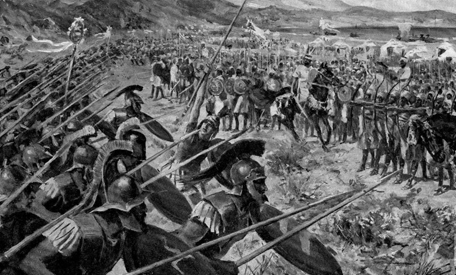
Let’s go back again to Marathon, at which Themistocles was only a common foot-soldier.  The Athenian bakers and poets would never have stood a chance against Darius’s Immortals in leap-n-slash, showoffy-dance-cavort style combat. Anyway, we saw the Spartans doing that in the first flick. Been there, done that.  So how about letting us see what really happened? Farmers and potters lowering their spears, shoulder-to-shoulder in a thin blue line, pushing forward against a great mass of professionals that outnumbered them ten to one? Rushing just in time to fill gaps in that wavering line? Swerving to confront cavalry charges, grunting and shoving death all the way into the surf, until the invaders were overcome… and then…

…and then — almost without pause — turning around to run those grueling 26 miles, and confront a second force before nightfall? Did Spartans ever come close to equalling such incredible… 

…oh, but I’ve said all that, before.

== The aim and the Lesson ==

Summing up, we must divide the falsehoods spewed by 300: The Rise of an Empire into those two categories.  First are lies that served Frank Miller’s purpose — to undermine confidence in our Athenian, citizen-centered civilization.  It is an ambition that Miller shares with science fiction author Orson Scott Card — a message that Card also pushes relentlessly, in all of his works, but especially in a recent book called “Empire.”

Democracy? Citizenship? An open society of laws and flawed-but-improving justice? Institutions and occasional public servants that sometimes do their jobs and that we can criticize and tweak, until they get better? Or, at least, the aspiration for such a nation and society? To achieve perhaps someday? 

These hopes are declared inherently futile by Miller and Card, who always, always prescribe: “find yourselves a demigod to admire. It’s your only hope.”

(I admit that Card spins out demigods who are less brutal, more conflicted and tormented, than Miller's, perpetually wringing their hands -- before always deciding to take over... for our own good, of course.)

Okay, I understand the lies in 300 and 300:2 that actually served Miller's propaganda purpose. But the other, second category of deceit is more telling.  Lies that served no purpose. That didn’t even preach the author’s (evil) message!  Lies made the tale less dramatic and interesting! 

Lies that could only have spilled forth out of habit, a reflex for preferring any falsehood, always, over truth.

== An escape clause ==

Oh, but is there an out? An escape clause? 

There is! Right there, in “300:II”! An excuse for every drooling fabulation and reversal of fact.

R6_V10K3_81313_CO3_PULLS_01rl_0034.tifThe film begins and ends with a narration by Gorgo, the widow of Leonidas, a pep talk for the benefit of her Spartan horde.  

This implies that every exaggeration or historical anomaly is her fault! It is only natural that she would put a superstitious, Spartan spin on things, all the way to sea serpents! And demeaning those Athenians, proclaiming that her own armies saved their bacon.

 Yeah, that’s the ticket. It’s all Gorgo’s fault.

Alas, even this doesn’t help with the TITLE of Miller’s flop: “300: The Rise of an Empire.”  Huh?  What empire arose from this story?  

Oh, sure, across the next 50 years, Athens would gradually climb ever-higher, invigorated by democracy, emboldened by commercial and technological innovation and stimulated by leaders like Pericles, the George Washington of his time.  But that Athenian “empire” (it would become flawed, vainglorious and foolish, in time) isn’t even hinted at, in the movie. Hence one has to wonder, were the makers of this thing stoned, the entire time?

That is easy enough to believe.

== Enough ==

There are so many flaws, so why must I flog a flop and dismal failure?

Because we need to lift our heads — as consumers — and demand better.  

One can have vivid action without lobotomization.  We can have movies that are true to their subject matter (e.g. history) without being dry or boring. Indeed, some historical events make great drama! Especially if you simply retell what actually happened, with truth and heart. Have a look at ZULU, or Ted Turner’s GETTYSBURG, or THE CROSSING.

The question arises again and again “why lie about any of it!”   

One can easily hear the whispered reply of the makers of this wretched mess.

“Why lie?  Because we can!”


Friday, August 02, 2013

Themistocles and the Rise of the Citizen - (a movie?)

Pattern recognition is a human gift… and curse.  Nowhere is this more blatant than in the entertainment biz.  Ideas get ripped-off, right and left -- almost as often as folks hallucinate that they were plagiarized. Both have happened to me... and every shade in between. Have a good look at the "Uplift" scenarios that pervade so many games - like Mass Effect - across the last couple of decades.  Even if they are more "homages" than steals, you'd think they'd at least have the class to buy me dinner?

So yes, it is with many grains of salt -- and a sense of mixed triumph and despair -- that I rise again to glance at a modern propagandist who has tried - throughout his career - to undermine our confidence in our own civilization. The context is a coming cinematic event that I at least foreshadowed... possibly provoked or inspired or goaded into being and… well… I'll let you be the judge.

==Coming Attractions: The Rise of Themistocles & the Common Man==

300RiseEmpireMaking the buzz is news that the garish, dance-'n-flex-abs flick "300" -- based on Frank Miller's comic book of the same name -- will soon have a sequel, 300: Rise of an Empire. With a new hero, Themistocles (Sullivan Stapleton), and a new villain, Artemisia (Eva Green).

Stephen Peterson writes: So "300: Rise of an Empire," besides having a horribly generic title, apparently focuses on the Athenian navy and the battles of Artemisium and Salamis. Famously, this is where Athenians obliterated the invading Persians, while their Spartan allies were busy futilely, but flamboyantly, dying at Thermopylae. Oddly enough, David Brin wrote an article about how the Athenians and other non-Spartan Greeks kicked so much more Persian heiney at Salamis and Marathon, and how a movie about General Themistocles would be so much better than "300." Lo and behold, this sequel is exactly that. Coincidence?

FrankmillerYes, my piece from years ago -- Roll Over Frank Miller, or Why the Occupy Wall Street Kids are Better than the #$%! Spartans -- eviscerating the original "300" - got a lot of attention for pointing out that Miller's flick ignored history… in fact flagrantly pissed all over history. It also insulted the main, heroic characters, like King Leonidas, the Spartan leader at Thermopylae, who in real life would never have openly insulted Athenians or greek "amateur" militias the way Miller had him do.  Not then.  Not just ten years after those same amateurs crushed the first Persian invasion without a drop of Spartan help -- at Marathon.

Oh, but let's scan the press release: Days before Zack Snyder delivers the newest vision of Superman to the world with "Man of Steel," fans of the director's films are getting a glimpse at a follow-up to his first comic-book movie. "300: Rise of an Empire" continues the story that Snyder started in his 2006 film "300", this time under the direction of Noam Murro. "The idea of this movie was always that it takes place at about the same time of the first one," he said. "It's as if you zoomed out and saw a bigger time frame and told a bigger story of what happened in '300.' The first movie speaks to the detail of this sequel."

300RiseOfAnEmpireSpeaks to the detail?  Rather than preaching the opposite? Okay, whatever. Go back and read my essay, which culminated a decade of more informal postings that got wide circulation, recommending that someone who loves democracy finally give the Athenians - and the underlying notions of democracy and volunteer citizenship - fair treatment. Especially the tale of Themistocles and Salamis -- even if it meant repudiating every moral point that Miller pushed in "300."

Such as the notion that Sparta (one of the worst and cruelest slavery states in history) should preen about "freedom" when the true citizen soldiers and sailors (including many escaped Spartan slaves) were down there at sea, on ships that fought the real fight for western civilization. Ships crewed by volunteer bakers, potters, poets and merchant-sailors who achieved the one thing that Miller's beloved "professional" Spartan soldiers never could -- victory.

Oh… and sure, I'll go see this movie. Hey, it'll probably be great fun. At least they are focused on real heroes, this time. And if it's a big success, remember where you read about such things, first.

Ah, pattern recognition.

 == Sci Fi news miscellany ==

WhatIsScienceFictionThe fundamental premise of Science Fiction: I believe it is that...Children can learn from the mistakes of their parents...and create a better future! Take a look at my latest video, What is Science Fiction? 

…and for your further Saturday pleasure, Our Favorite Cliche: A World Filled with Idiots: here are  my own reasons why readers and viewers should cast a wary eye toward the sheer laziness of most modern storytellers who proclaim that citizens and civilizations can accomplish nothing. Those who cannot think of any way to propel a lively plot, except by calling humanity worthless. The secret: they don't really believe this!  They do it out of simple laziness.

Cool Science Fictional World Generator: create planetary and city maps.

Popular Mechanics touts "Seven gadget predictions Sci Fi got right…" The slide show includes one of my own forecasts. A minor thing, really.

Pondering possible movie ideas in the shower, for some reason my mind drifted to the short story, "Deep Safari" by Charles Sheffield, from his collection, Georgia on My Mind and Other Places. Men waldo-control teensy robots to hunt insects.  All the drama of hunting, and with monstrous scale, and no PETA on your back! The last refuge of machismo, in a future when violence and death have been quelled… at least from plain sight!

Looking Toward Tomorrow: Best Future-Oriented Books and Blogs. Which sites and tomes do the best job of exploring what's next?  Well, this survey that I published some years ago is still a trove that many find useful. (Traffic/visits have zoomed lately.)

Watch a 1982 video of Isaac Asimov, Harlan Ellison and Gene Wolfe, discussing writing, books, and the label, “Science Fiction. ”

NulatativeOne of my readers  was fascinated by a word that I invented, in my novel Brightness Reef.  "Nulatative"  stands for a type of reasoning - on a par with associative, inductive and deductive, having to do with Karl Popper's process of falsification in science, finding out what is try by removing what is not-true.  Sherlock Holmes would approve. Donald G Mason added Nulatative to the Urban Dictionary.  

Now available online, you should check out the whole 'Connections' and 'The Day The Universe Changed' documentary series.  They will blow your mind.  Start with Connections (or get it on Amazon.). The only series that ever impressed me more was Bronowski's 'The Ascent of Man'… with 'Cosmos' coming in a third place tie with 'The Universe' and 'Life After People' (because I was in it).  Followed by "The Architechs"!  Watch em all!

StarshipCenturySee a review of Starship Century , edited by James Benford & Gregory Benford. Starship Century: Toward the Grandest Horizon is a collection of articles and stories about the future possibilities of extended space exploration and all its concomitant problems. 

With the recent discovery of Earth-sized planets orbiting other star systems, interest in space has mushroomed. In particular, the Darpa 100 Year Starship Symposium that met in October 2011 and the 2013 Starship Century Symposium at the University of California, San Diego brought both scientists and SF writers together “to set a bar high enough and hard enough to seriously challenge the next generations” and to make sure that the vision doesn’t lack plans for execution. As the promo material succinctly phrases the purpose of the anthology: “Starship Century is an anthology by authors from both science and fiction writing backgrounds, illustrating some of the tech and ideology behind the illustrious goal of traveling to another star within the next century.”

carlson-interrupt-144x216A new novel by my bro Jeff Carlson is always an event. Dig this exciting tease for his newest: Interrupt.  "In the distant past, the leader of a Neanderthal tribe confronts the end of his kind.  Today, a computational biologist, a Navy pilot, and an autistic boy are drawn together by the ancient mystery that gave rise to Homo sapiens.  Planes are falling from the sky. Global communications have ceased. America stands on the brink of war with China — but war is the least of humankind’s concerns. As solar storms destroy Earth’s electronics and plunge the world into another Ice Age, our civilization finds itself overrun by a powerful new species of man…"  Oooooh.  How cool is that!

Science Fiction folk, alas, there won't be Asimov, Heinlein and Herbert postage stamps!  A five-stamp set had been announced by the USPS Commemorative Panel program in February with a July 2013 release date, honoring Isaac Asimov, Ray Bradbury, Philip K. Dick, Robert A. Heinlein and Frank Herbert. Canceled. Sigh.

Random House’s science fiction and fantasy online community Suvudu has launched a blogger community called Suvudu Universe. Writers can register to post on science fiction, fantasy, gaming and comics.

Sunday, November 13, 2011

Roll over, Frank Miller: Or stop lying about prancing-futile Spartans!

Originally published November 13, 2011… based on earlier, informal postings.

I had a new essay prepared -- balanced and funny -- about Ayn Rand and the film version of her epic novel Atlas Shrugged.  But that can wait, because a few days ago, the famous comic book writer Frank Miller issued a howl of hatred toward the young people in the Occupy Wall Street movement.  After reading even one randomly-chosen paragraph, you'll agree that  "howl" understates the red-hot fury and scatalogical spew of Miller's lavish hate:

Occupy” is nothing but a pack of louts, thieves, and rapists, an unruly mob, fed by Woodstock-era nostalgia and putrid false righteousness. These clowns can do nothing but harm America."


Well, well, putting aside contemporary left-right politics, I've been fuming silently at Frank Miller for a years. The time's come, so get ready for steam!

I'll do it by dissecting - calmly and devastatingly - his most famous and lucrative piece of modern propaganda.  The comic book and movie tale about Spartans at the Battle of Thermopylae.

A tale called - "300."


== Leni Riefenstahl would be proud==

Though I'm not best-known for graphic novels*, I've done a few. I've been sketching out a script about one of the greatest heroes of western civilization - Themistocles - the man who actually defeated Xerxes. the Persian emperor, during his brutal invasion of Greece, after the Spartans failed so miserably at Thermopylae.  In part, this would be an answer to Frank Miller's "300"... a book and film that I find both visually stunning and morally disturbing.

For one thing, "300" gave all credit to the Spartans, extolling them as role models and peerless examples of manhood. Adorably macho defenders of freedom.

Uh, right.  Freedom. Sorry, but the word bears a heavy burden of irony when shouted by Spartans, who maintained one of the worst slave-states ever, treating the vast majority of their people as cattle, routinely quenching their swords in the bodies of poor, brutalized helots... who are never mentioned, even glimpsed, in the romanticized book or movie. Indeed, the very same queen who Frank Miller portrayed as so-earthy, so-kind, was said to be quite brutal with a whip, in real life.

Miller's Spartan warriors honestly and openly conveyed the contempt for civilians that was felt across the ages by all feudal warrior castes. An attitude in sharp contrast to American sympathies, which always used to be about Minuteman farmers and shopkeepers - citizen soldiers - the kind who bravely pick up arms to aid their country, adapting and training under fire. Alas, Frank Miller's book and movie "300" ridiculed that kind of soldier...

...even though the first invasion by Persia, ten years earlier - under Xerxes's father - had been defeated by just such a militia army... from Athens... made up of farmers, clerks, tradesmen, artists and mathematicians. A rabble of ill-disciplined "brawlers" who, after waiting in vain for promised help from Sparta, finally decided to handle the problem alone.

On that fateful day that citizen militia leveled their spears and their thin blue line attacked a professional Persian force many times their number, slaughtering them to the last man on the legendary beach of Marathon.


== The inconvenient truth of Marathon

Think about that for a moment. Can you picture it? Damn. Please pause here and Wiki "Marathon." Even better, watch it computer dramatized. Prepare to be amazed there were once such men.  Go on... I'll wait!

BattleMarathon2Frank Miller rails against effete, pansy-boy militias of amateur, citizen soldiers. But funny thing, none of his Spartan characters ever mentions those events, just a decade earlier! How bakers, potters and poets from Athens - after vanquishing one giant invading army, then ran 26 miles in full armor to face down a second Persian horde and sent it packing, a feat of endurance that gave its name to the modern marathon race. A feat that goes unmatched today. Especially by Spartans.

That Athenian triumph deserves a movie! And believe me, it weighed heavily on the real life Leonidas, ten years later. "300" author Frank Miller portrays the Spartans' preening arrogance in the best possible light, as a kind of endearing tribal machismo. Miller never hints at the underlying reason for Leonidas's rant, a deep current of smoldering shame over how Sparta sat out Marathon, leaving it to Athenian amateurs, like the playwright Aeschylus, to save all of Greece. The "shopkeepers" whom Leonidas outrageously and ungratefully despises in the film.

With that shame over Marathon fresh in memory, Leonidas was eager to prove Spartan mettle when Persia invaded a second time, even though he could find just three hundred volunteers.  That much, "300" gets right.  Alas, truth is rare in that book and film. Like the notion that Xerxes cared a whit about rustic Sparta in the first place.  Athens was always his chief target. It was the heart of the West.

Even when it comes to the Battle of Thermopylae itself, "300" tells outright lies.  For example, 1,000 Thespians refused to leave their comrades at the end. They stayed in the pass and died next to Leonidas's 300 Spartans.  More shopkeepers. Their valor was inconvenient to Miller's narrative, So he just wrote them out. Worse, he slandered them, depicting them running away.

Oh, remember those helots? As slavemasters, Spartans made the later Romans seem positively goody-two-shoes, by comparison. In his book and movie "300" Frank Miller never shows the two thousand helot luggage-bearers who Leonidas's gang of bullies whipped before them into the pass at Thermopylae, carrying their masters' gear and food and wine and shields.

Where were those slaves during the battle? Why, in the front line! Handed spears but no armor, they slowed down the Persians with their bodies, then made the ground conveniently slippery with their blood. Huh, funny how that got left out! I'm sure it was just an oversight.

== Thermopylae: what was going on in plain view

But the worst slander of all is one of glaring, outrageous omission and tunnel vision. It is what "300" might have shown happening just offstage, simply by turning the camera! Indeed, Leonidas could see it with his own eyes, in plain view throughout the fight, if only he chose to swivel his head.  (Alas, Frank Miller doesn't let him turn, in the comic and film.)

The Athenian navy, hard-pressed and outnumbered, guarding his flank in the nearby Artemisium Straits.  Again, a citizen militia of fishermen, merchants, blacksmiths and philosophers, they too were at Thermopylae! A few miles out to sea, they battled odds no less desperate than Leonidas faced, without the convenient cliff and wall, against vastly superior Persian forces.  Only with this one important difference.

Where Leonidas failed to hold for more than a day or so, the Athenians kept firm!  They only retreated when the Spartans let them down!

The commander of that brave flotilla, Themistocles, is a hero far more in keeping with American traditions.  A Washington-like commander who makes good use of volunteers - plus new technology and brains - to stave off hordes of arrogant, professional conquerors. Less interested in pompous bragging and macho preening, he cared about his men, striving to achieve both victory and survival. He despised "bold gestures." What mattered were results.  Saving his country. His civilization. His men.

And now that you know this, can you believe that Miller and his partners refused to let Leonidas turn his head and witness such a wonderful thing? And maybe give a brief, respectful nod to his allies' epic courage? Don't you feel cheated? You were.

Forced to give way when Leonidas failed to hold a narrow pass, Themistocles and his sailor militia kept up a fighting retreat, survived the burning of their city, (where their dauntless women handled a skillful evacuation)... till they finally drew the vast Persian navy into a trap at a little island called Salamis... glorious Salamis...

...where outnumbered Athenians - and their neighbors - utterly crushed the invading armada, sending Xerxes fleeing for his life.  THAT was what saved Greece, not futile boasting and choreographed prancing on the bluffs of Thermopylae.  (And again, what a movie someone might make out of the true story!)

As for the later land battle at Platea - glorified by the book and film "300" - it was hard-fought tactically. But strategically it wasn't much more than a mopping-up, slaughtering a demoralized and cut-off Persian force that Xerxes had already abandoned. And even at Platea, there were more men from Athens (and Attican towns) than Spartans! And it was Athenians who raced ahead and turned the Persians' flank.

Oh, one more thing about Platea. At the exact moment that Frank Miller portrays the Spartan Dilios taunting and deriding his own allies before a desperate fight -- (yeah, that's likely) -- it happens that simultaneously Themistocles and his fleet of volunteer sailors were also finishing off the rest of the Persian navy, at Mycale. Dig it, the Athenians fought two epic battles on that same, fateful day. The day the West triumphed and survived.  A day worthy of Tolkien and Peter Jackson!  And those are the facts. Live with it Miller.

Do the Spartans at least get credit for commanding Greek armies ashore?  A couple of years after Platea, repelled by Spartan arrogance and brutality, the Greek cities dumped Sparta from any further leadership role as they spent the next thirty years pushing Persia ever further back, expelling them entirely from Europe and liberating enslaved populations. Led by the democratic rabble from Athens.

In other words.  History wasn't at all like the book, or the movie "300." It was much, much better!

== Artistic license? Or goddam evil-batshit lying?

BattleMarathonLook, artists get a lot of leeway. At least in this society of freedom they do. (They sure didn't get any slack in feudal times, dominated by warrior-caste bullies.) Miller and the makers of the 300 flick were entitled to emphasize the Spartans and their martial spirit, even though their brave "sacrifice" at Thermopylae accomplished very little, except to make a fine tale of futile bravado. A three-day delay? We're supposed to be impressed by a three-day delaying action?

Well, okay, that's about equal to Davy Crockett at the Alamo. I'm willing to give credit and always have been! Okay, Leonidas and the brave 300 Spartans (and 1000 Thespians!) deserve a movie. (They've had several.) But please.  This was a small "feat" at best.

Okay, okay. I'll also admit, "300" certainly offered a great excuse for ninety minutes of homoerotic dancing! Hey, I can appreciate the aesthetics, in abstract. It's not especially my thing - and real Spartans did NOT engage in combat that way - still, 300 gets full marks as a lavishly choreographed fight'n'flex number. And for terrific painted-on abs.

But there comes a point when artistic license turns into deliberate, malicious omission.  And then omission becomes blatant, outright-evil lying propaganda. "300" not only crosses that line, it forges into territory that we haven't seen since the propaganda machine of 1930s Germany. White is black.  Black is white. Good is defined by the triumph of will.

I might have just sat and glowered, if they simply omitted the Athenians.  But to sneer at them and call them effeminate cowards?

After Athens' citizen soldiers accomplished epic triumphs the Spartans never imagined and that they would never, ever come remotely close to equaling? At battles whose names still roll off our tongues today? Achieved by the same kind of "cincinnatus" militias that propelled both Republican Rome and the United States to unparalleled heights, during their time of vigor?

The kind of soldiers who make up our U.S. military today! Citizens-first, despite their vaunted professionalism.

 (Historical note: Yes, the Athenians had their faults too! They owned slaves, though far more gently than Sparta. Women had few rights - though the legend of Lysistrata was born there. After they lost Great Pericles, their democracy fell into the kind of populist foolishness that we see in America today, idiotic foreign adventures and callousness toward neighbors. But all of that came later. And at their worst, they kept the basic virtues that are at-issue in this matter of "300"... and in my response. Fierce pride in citizenship.)

No, this is not just artistic license. Expressed repeatedly - with the relentlessness of deliberate, moralizing indoctrination - "300" idolizes the same arrogant contempt for citizenship that eventually ruined classical Greece and Republican Rome, and that might bring the same fate to America.

My own graphic novel "The Life Eaters" never sold as well as Miller's. Heck, that's not my expertise. (Though it was a finalist in France, where they adore the Graphic Novel art form.)  With gorgeous art by Scott Hampton, "The Life Eaters" tells a vivid story of rebellion and resistance to a very Spartan-like oppression. But forget the shameless plug. I'm not competing with Frank Miller on his turf.  I've got plenty-enough turf of my own.

What I do suggest is this: use your own imagination! Picture an answer to "300," told from the point of view of an escaped Spartan helot-slave serving aboard one of Themistocles's ships, staring up at the frenetic death-prancing of his former masters on the cliff of Thermopylae, shaking his head over their futile, macho posturing, then turning to help the amateur fighters of Athens and Miletus and Corinth get on with the real job of saving civilization.

Doing it without boasting -- or painted-on abs -- but with wit, courage, comradeship, skill... and the one thing that matters most. Something Leonidas never came close to achieving.

The only truly indispensable accomplishment. Something that is often best won by citizen soldiers -

- victory.


David Brin
                        http://www.davidbrin.com
                         Twitter                Facebook