Showing posts with label FAQ. Show all posts

Wednesday, April 10, 2013

Questions I am frequently asked about… (Part V) Transparency, Privacy and the Information Age

I'll now complete my compilation of questions that I’m frequently asked by interviewers. They can all be found on my website. This final section is about… 

== PRIVACY AND TRANSPARENCY==  

Note that my tenure as an expert in these matters arose from the 1997 publication of The Transparent Society: Will Technology Make Us Choose Between Privacy and Freedom?  which won the American Library Association's Freedom of Speech Award and the McGannon Public Policy Prize.  It revealed many surprising aspects to a vexing and complex set of problems that we must negotiate and navigate in the coming decades, with nothing at stake... other than liberty, survival, and all the things that make life worth living.

For more detail, see a compilation of some articles and interviews  about transparency, freedom and technology .

--Do you worry about the loss of privacy as both the government and amateurs have more and more access to surveillance?

TinyTransparentI got some of my nicest letters based on Chapter 9 of The Transparent Society, where I disassemble my own theory, appraise and talk about all sorts of ways that a transparent society could go wrong! For example, you could have a really nasty version of majority-rule, such as Ray Bradbury shows in Fahrenheit 451. Even if transparency prevents Big Brother, will that mean we’ve traded top-down tyranny for the lateral kind? Oppression by hundreds of millions of judgmental Little Brothers? 

Serious concerns, Still, real life offers reason to hope. If you look at the last 50 years, whenever the public learns more about some eccentric group, it judges that group on one criterion: Is this group mean? 

Are they harmful and oppressive to others? When the answer is yes, the more we learn about the group, the less they’re tolerated. If the answer is no, the more we learn about the group, the more they’re tolerated. Look back. More exposure and information about others reduced racism, sexism, homophobia... but increased our aversion to groups like the KKK or Stalinists.  No other criterion explains this. 

9mlZmETE6m2NEkSrxM63fTl72eJkfbmt4t8yenImKBVaiQDB_Rd1H6kmuBWtceBJIf that’s true and if it holds in the future—if people continue to defend others’ eccentricities because...

a) they think it’s cool to live in a world of harmless eccentrics and... 

b) for the sake of their own protection—then you would likely see a 51 percent or 60 percent or 70 percent dictatorship by a majority that insists on crushing just one thing… intolerance. Okay, that’s still group-think majority-imposed will. But the least harmful one you can imagine. 

As far as privacy itself is concerned, I have a simple answer to that. (It makes up Chapter Four of The Transparent Society.) Human beings want it. We naturally are built to want some privacy. Moreover, if we remain a free and knowing people, then sovereign citizens will demand a little privacy, though we’ll find that we must redefine the term for changing times. 

techtransThe question really boils down to: Will tomorrow’s citizens be free and knowing? Will new technologies empower us to exert reciprocal accountability, even upon the mighty? It may seem ironic, but for privacy and freedom to survive, we’ll need a civilization that is mostly open and transparent, so that each of us may catch the would-be voyeurs and Big Brothers.  So that most of us know most of what’s going on, most of the time. 

It can happen!  The proof is us.  Because it is already the method that we’ve used for 200 years. And to see this all laid out, have a look at one of the only public policy books from the 20th Century that’s still in print and selling more each year. 

--What do you foresee as tiny cameras proliferate? 

SousveillanceSurveillanceEssentially, this is the greatest of all human experiments.  In theory… sousveillance (looking at the mighty from below) should cancel our worst fears about the surveillance state, if we get into the habit of stripping the mighty naked. 

If that happens, we should eventually equilibrate into a situation where people - for their own sakes and because they believe in the Golden Rule, and because they will be caught if they violate it - eagerly and fiercely zoom in upon areas where others might be conniving or scheming or cheating or pursuing grossly-harmful deluded paths… 

… while looking away when none of these dangers apply. A socially sanctioned discretion based on “none of my business” and leaving each other alone… because you’ll want that other person to be your ally next time, when you are the one saying “make that guy leave me alone!” 

That is where it should wind up.  If we’re capable of calm, or rationality and acting in our own self-interest.  It is stylishly cynical for most people to guffaw, at this point, and assume this is a fairy tale. I can just hear some readers muttering “Humans aren’t like that!” 

Well, maybe not. But I have seen plenty of evidence that we are now more like that than our ancestors ever imagined they could be.  The goal may not be attainable.  But we’ve already taken strides in that direction.

PrivacyAccountability copy-What do you see as the major problem in achieving a more transparent society?

When it comes to privacy and accountability, people always demand the former for themselves and the latter for everyone else.

-How will greater openness affect our society?

We already live in the openness experiment, and have for two hundred years. It is called the Enlightenment -- with "light" both a core word and a key concept in our turn away from 6,000 years of feudalism. All of the great enlightenment arenas -- markets, science and democracy -- flourish in direct proportion to how much their players (consumers, scientists and voters) know, in order to make good decisions. To whatever extent these arenas get clogged by secrecy, they fail.

imagesBut the next step in people empowerment is even more impressive -- those burgeoning "smart mobs" Howard Rheingold and Clay Shirky and Vernor Vinge talk about. (Also shown in my latest novel, Existence.) It's agile. It's wired. 

Every generation innovates, or the Enlightenment dies.

- In EARTH (1989) you forecast that a huge world issue in the 2010s and 2020s would be international banking secrecy. Now, daily revelations seem to be bearing that out.  Do you still foresee something like a "Helvetian War"?

An actual, physical war, waged by nations of the developing world against the great banking havens?  Well, not really.  That was an exaggerated metaphor for a novel that achieved dramatic effects. But I do still expect increasing radicalization and pressure from many newly rising nations, when they realize that their former, kleptocratic lords stole literally trillions that might save and give hope to millions of children back home, if the money were recovered.

NothingToHideThis issue won't go away. Just recently (April 2013) a cache of 2.5 million files has cracked open, spilling the secrets of more than 120,000 offshore companies and trusts, exposing hidden dealings of politicians, con men and the mega-rich the world over. In my novel, Earth, I predicted this would be the core issue of our times.  I still think things will play out that way.


David Brin
Twitter                Facebook

Monday, March 11, 2013

Questions I am frequently asked about… (Part III) Brin Books, The Postman etc.

Continuing this compilation (from Part 1 and Part 2) of questions that I’m frequently asked by interviewers. This time about…

 ==ABOUT DAVID BRIN’S BOOKS==

 --Which of your own novels is your personal favorite? 

DBBooksMontageThat’s like asking: Which of your children do you like best? Glory Season is my brave, indomitable daughter. The Postman is my courageous, civilization-saving son. Earth is the child who combined science and nature to become a planet. The Uplift War…well, I never had a better character than Fiben the earthy-intellectual chimp!

 --Were you happy with the Kevin Costner adaptation of your post-apocalyptic novel The Postman? 

PostmanPBThe Postman was written as an answer to all those post-apocalypse books and films that seem to revel in the idea of civilization’s fall. It’s a story about how much we take for granted – and how desperately we would miss the little, gracious things that connect us today. It is a story about the last idealist in a fallen America. One who cannot let go of a dream we all once shared. Who sparks restored faith that we can recover, and perhaps even become better than we were. 

Was The Postman film faithful to this? Well, despite several scenes that can only be called self-indulgent, or even goofy… plus the fact that I was never consulted, even once… I nevertheless came away more pleased than unhappy with what Costner created. Though flawed, it’s a pretty good flick – if you let yourself get into it. One that deals (a bit simplistically) with important issues and is more faithful to the book's inner heart than I expected at any point during the long decade before it was released. 

Costner’s postman is a man of decency, a calloused idealist, not particularly courageous, who has to learn the hard way about responsibility and what it means to be a hero. The movie is filled with scenes that convey how deeply we would miss the little things… and big ones like freedom and justice. In fact, it includes some clever or touching moments that I wish I’d thought of, when writing the book. 

Visually and musically, it’s as beautiful as Dances with Wolves. Kevin Costner is foremost a cinematographer, I will gladly grant him that. Rent and watch it on a wide screen.

VideoPostmanBrinWould I have done things differently? You bet! In a million ways. But I didn’t have the 80 million dollars to make it, and in keeping true to the heart of the book, Costner earned some leeway when it came to brains. Anyway, life is filled with compromises. I’d rather look for reasons to be happy. 

I have posted my full response, discussing the book and the movie, on my website: http://www.davidbrin.com/postmanmovie.html 

--Are you planning on returning to the Uplift Universe? 

Yes.  Soon, even!  Next big thing.  Have a look at the Uplift Universe Web Site.

banner_uplift
--Can you reveal some of the inspirations behind the Uplift Saga? How did you come up with the idea? 

If we don't find intelligent life in the galaxy, humanity will create it. We might contrive new entities through artificial intelligence. It could happen the American way - by encouraging more and more of us to diversify in new directions, with new interests and passions and quirky viewpoints. And of course, diversity spreads whenever we add new intelligent life forms called our children. 

Then there is the idea of creating other kinds of beings to talk to through some change in the animal species that already exist around us. 

Other authors have poked at this idea before. Cordwainer Smith and Pierre Boulle and H.G. Wells. Boulle’s Planet of the Apes and Wells's The Food of the Gods or The Island of Dr. Moreau, and all other attempts to deal with this topic did stick to just one perspective, however.  Just one dire warning. 

They all  portray the power to bestow speech being executed in secret by mad scientists, then horribly abused by turning these new intelligent life forms into slaves. 

FoodI believe that - partly because of these cautionary tales - that's not what we will do. Because of those self-preventing prophecies, I wanted to show something else instead. What if we try to uplift other creatures with good intentions? With the aim of making them fellow citizens, interesting people, accepting that in some ways they might be better than us? 

Certainly that's worth a thought experiment too? Adding to the diversity and perspective and wisdom of an ever-widening Earth culture? 

 Wouldn't those creatures still have interesting problems? Of course they would!  More complex and interesting than mere slavery.  At least, that is what I hoped to explore. 


=====     =====     =====


Thursday, March 07, 2013

Questions I’m often asked. Part II: About Science Fiction!

Continuing a compilation of questions that I’m frequently asked by interviewers. This time, we'll talk about…

 == SCIENCE FICTION==

 --What are your favorite Science Fiction novels?

GreatestSFReadingLIstStand on Zanzibar, by John Brunner, was simply creepy in how well it peered ahead and how accurate was its vision, as well as breakthroughs in both style and substance. It should be read alongside Vonnegut and Huxley and Heller. Lord of Light, by Roger Zelazny, was a breakthrough in multicultural SF that was also gorgeous and exciting and all about rebellion! Ursula LeGuin's Lathe of Heaven was darn near perfect. Vernor Vinge's Rainbows End is a gem of recent "singularity fiction." 

Herbert and Heinlein provoke vivid arguments and I like that!  Bear and Robinson poke hard at our biological destiny. Banks and Stephenson believe in us and make me feel we might make it; that counts for something. For short fiction: Robert Sheckley and Alice Sheldon were peerless.


 --Which authors have most influenced your writing? 
 

201817627023143561_yPwhWOwz_cI grew up on Robert Heinlein and Robert Sheckley, moved on to Aldous Huxley and James Joyce, then thawed out a bit with Vonnegut and Amis and Sharpe. Finally, I decided to become a storyteller, and reacquainted myself with the clear, almost tribal rhythms of Poul Anderson. (See my list of recommended SF books for Young Adults.)

My favorite depends on which "me" you ask. The Serious Author in me, who comments on deep human trends, would like to think that he's grounded by Huxley and Orwell. Popper and Locke. Brunner, Sheffield and Wells. Gilman and Delaney. Shakespeare and Donne and Homer and Swift and Defoe. Some night-crawling with Poe and Coleridge. Some world-girdling with Kobayashi Issa and Scholar Wu and South Sea tales.

LordLightOn the other hand, I can' t write more than a page of heady philosophy or social speculation without feeling an itch... the itch to blow something up. To make something exciting happen. Or something fun. That's when I know I've been influenced by the storytellers who made Science Fiction exciting. Like Anderson or Zelazny. 

But I guess the ones I revere most are those who briefly left me speechless. Unable to write or even move, because something in a perfect story left me stunned. Changed. I guess in that category I'd put Tiptree and Varley. Vonnegut at his best. Shakespeare. And Philip K. Dick. 

Ideally, those three personalities -- the thinker, entertainer and "writah" -- can get along. Collaborate. Work together in crafting a tale that speaks to the brain, heart, and organs of adrenaline. Well, you can try. 

--As a genre, where is SF heading? Will the more general population start to take it serious eventually? 

201817627023414467_oGTcLw10_cIn a general sense, Science Fiction is about expanding the available range of settings beyond the parochial present or familiar, freeing literature by extending it into realms of the possible. Fantasy goes farther, by diving into the improbable or impossible. 

This happens to match what's done by our most recent and powerful portions of the human brain, the prefrontal lobes, or the "lamps on the brow," that we use every day to explore our options, making up scenarios about tomorrow or the next day. These organs let us ponder the whole notion of "future" as a place, a destination. Nothing could be more human. 

Let others wall themselves in with their rigid genre boundaries and absurdly oppressive notions of "eternal verities," needing to pretend that today’s familiar obsessions will last forever. (They won't.) No verity is eternal, though some lessons are best learned and re-learned. 

We in SF specialize in imagining that things might be different than they are. In exploring prefrontally the potential dangers and opportunities. As long as that's our playground, no literary ghetto will fence us. 

--Has a fictional work every made you angry. If so, which one? 

Oh tons!  I try not to get my blood pressure or dander up though.

Heck, I even feel mildly positive toward Kevin Costner, who on-balance did more good than bad in his (visually gorgeous and big-hearted) film adaptation of my post-apocalyptic novel, The Postman. (See my essay on the Costner movie.)

Only a few works make me stark fuming outraged. For example,see how I eviscerate Frank Miller's horrifically evil and despicably lying piece of propaganda-for-evil -- a movie called "300."   

In other cases, such as when I co-edited STAR WARS ON TRIAL, I am less angry than concerned that people are missing an important chance to weigh the bad alongside the good. Star Wars has many appealing traits... but Yoda is one evil little oven mitt!

--How do you feel about Fantasy novels? 

Clearly we need both romance and reason, even in creative arts such as fiction. Craft without imagination is like a mill without wheat. Imagination without craft is extravagant… and sterile. 

LordOfRingsThe trend toward feudal-romantic fantasy may seem harmless. Heck, I enjoy Tolkien and steam punk and some of the best fantasists. But dreaming wistfully about kings and lords and secretive, domineering wizards is a sugary path that leads ultimately to betrayal. Because kings and lords and wizards were never our friends! Indeed, for most of history they were the chief plague destroying hope for humankind. 

Oh, some kings and wizards were less bad than others. But they were all "dark lords." Our fixation on them is a legacy of the 10,000 years in which feudalism reigned, when chieftains controlled the fables by ordering the bards what to sing about. A long, grinding era when humanity got nowhere. When the strong took all the women and wheat, and forced everyone else to recite fables about how right it was. 

Till some of us finally rebelled. (Especially women!) It's the Great Enlightenment and the most wonderful story ever told. The story that should have us all transfixed and loyal and grateful as all outdoors. 

201817627023538708_eFnT5b8r_cWe are heirs of the mightiest and best heroes who ever lived. Pericles, Franklin, Faraday, Lincoln, Pankhurst, Einstein, Marshall and so on. Heroes of flesh and blood, any one of whom was worth every elf and dragon and fairy ever imagined.  


Look, I like a dragon. I just want to remember who gave us a world in which I can go meet a dragon any time that I want -- in books and stories and flicks. Not a world in which I cower in actual fear, because I actually think they are actually out there, because some king and his "sages" are keeping all the books for themselves. Imagination and good writing are enough magic for me.  For the rest?  

Give me light. Let's share light.
--David Brin
Twitter                Facebook

Friday, February 15, 2013

Questions I am frequently asked about… Writing and Science Fiction

I’ve been working with Cheryl and Beverly to thoroughly revise my web site. If you haven’t browsed davidbrin.com in a while, have a look! It’s now fleshed out and filled with even more fabulousness! 

DBWebSite
As part of this, we’ve thrown together a FAQ of sorts -- a compilation of questions that I’m asked most often by interviewers. We’ll post them here by category, starting with… 

== ON WRITING == 

-- Being an author wasn’t your first career choice; you earned a Ph.D. in astrophysics.  How did your multi-track career evolve? 

heartofthecometI came from a family of writers and always figured that storytelling would be my artistic side-line… most scientists have one. I knew science would be harder that storytelling and I respected it more, drawn to the Enlightenment’s greatest project. After all, every culture has had storytellers, but only one ever invested heavily in training a myriad brave investigators to find out what’s actually true, despite our preconceptions.

And indeed, I managed to contribute a few new bits of knowledge…. while maintaining passion for my art. (And I incorporate my science into my art, as in Heart of the Comet.)

Ah, but sometimes life takes a turn. Your pastime can take over and become the central profession. I was a pretty good scientist and I still keep my hand in the game. But civilization seems more eager for my art, for tales that shed a different kind of light on the transformations we’re all going through. And who am I to argue with civilization? 

-- What is special about writing? What drew you from seeking scientific facts to literary truths?

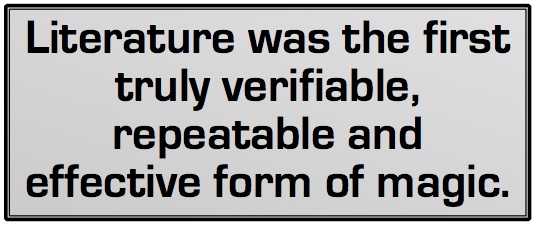
LIteratuareLiterature was the first truly verifiable, repeatable and effective form of magic. Picture how it must have impressed ancient people to look at marks – on papyrus or clay – and know they conveyed the words of scribes and kings long dead. Knowledge, wisdom and art could finally accumulate. Death was robbed some of its sting. 

Writing still is magical. To create strings of black squiggles that millions of others skillfully de-code with just their eyes – into emotions and thoughts, or the struggles of believable characters – or spectacle beyond Hollywood’s wildest dreams. 

Still, despite all of that, science and the honesty that it engenders have been our true accomplishments. I believe in a literature that explores this revolution, that presents alternatives and hard choices and that might help us to be wise about the onrushing process of change. One that helps to remind science and progress that it needs a heart. I reject the dichotomy, the notion that these things oppose each other. 

When a chance came along to combine the two? Who wouldn’t grab the opportunity? 

--Was Science Fiction always your chosen genre? 

Though SF offers me the freedom I need to explore a world undergoing drama and change, I often tell writing students that their first work of fiction should be a murder mystery. 

SundiverOh, it can be an sci fi mystery, like my first novel, Sundiver. Or you might give it romance or set it in the wild west, or ancient Rome. What matters is that it should follow the plot patterns and revelatory structure of a mystery yarn. 

Why? Because only mysteries demand total story-telling discipline. No distractions or arty styling or array of gimmicks can mask or make up for bad plotting. This all becomes apparent when the reader finds out who-dunnit in a mystery. In the end, the reader knows whether or not you cheated.  And once you’ve had that lesson, you will never neglect it again. 

--Do you develop the world of a novel fully in your mind before beginning to write? 

I like to be surprised. Fresh implications and plot twists erupt as a story unfolds. Characters develop backgrounds, adding depth and feeling. Writing feels like exploring. 

Oh, I sometimes plot an outline in advance.  That works well.  Still, not too much detail! I like to be surprised. 

--Do you have any advice for up and coming writers? 

WritingQuote1Write. Love writing. Love stories. Love the sound of language, the vividness of description and ironies of the heart. The marvelous web of misunderstanding that is conversation. The astonishing, non-linear gyrations of cause and effect and surprise. 

Ray Bradbury said that – deep in the heart of the writer’s relationship with story and reader, there has to be love! Love the words. Love the tension that propels your plot and characters like a steam boiler. Love a civilization that gives you plenty to read and the food and shelter and safety to do it in comfort. Love to poke hard at that civilization’s flaws. Love the fact that you have enough conceit to think others might like to read your drivel! 

Only then, amid that love... be competitive! Aim to do it better than anybody else.  Have patience to refine your craft… but never stop burning. Burn like a flame. An inferno. 

Art is like any other exercise in skill: a combination of talent, hard work and learning from criticism. And luck. Any three of those things can make up for a deficit in the fourth one. But those three had better be really strong. 

CITOKATEThe core point? CITOKATE: Criticism Is The Only Known Antidote To Error! 

Seek and relish criticism, because that is how to get even better. If you put your work out there and look upon criticism as your friend -- (not easy, but worthwhile) -- you will improve. And having that attitude will gain you real advantages, leveraging your talent, however great or small it may be. 

Good luck. There are lots of ideas out there waiting to be mined. It's not an endangered resource. 

writeadvicevideoThat's only a very small summary of a long list. There's lots more. After typing countless answers to requests for advice from would-be writers, I finally put it all together in a handy place. It's available on my website: A Long, Lonely Road: Advice to New Writers, as well as a YouTube presentation: How do you succeed at writing fiction?

=================