Friday, June 03, 2022

Space News!

My notoriously fierce objections to the USA getting involved in Footprint Stunts on the moon are well known. But those objections do not extend to the robotic parts of the program! NASA should very much strive for a leading role in robotic lunar exploration and actual, actual science. For example:

“Over the course of 10 Earth days (one lunar day), Lunar-VISE will explore the summit of one of the Gruithuisen Domes. These domes are suspected to have been formed by a sticky magma rich in silica, similar in composition to granite. On Earth, formations like these need oceans of liquid water and plate tectonics to form, but without these key ingredients on the Moon, lunar scientists have been left to wonder how these domes formed and evolved over time.”

Robotic exploration of lunar polar ice fields? That too! And suspected lava tubes. And "ISRU" methods to extract and use local resources, eventually proving me wrong about the near total lack of anything useful on that dusty, poison plain.

What we do NOT need to do is to race to be the next footprint tourists, and thus not only waste half of NASA's resources, but also humiliate other nations who are eager to send astro/cosmo/taikonauts to that sandbox for photo-ops and for symbolism-drenched national rites of passage. 

Let them have their ‘bar moonzvahs.’ We had ours over half a century ago!

We have other business out there, worthy of grownups.


== More mighty space news! ==

This interview about the possibility of life on Mars - and across the universe on KPBS features cogently formulated questions and a fine job of journalistic editing/splicing efficient- informative answers. Veteran reporter Tom Fudge was even able to mine something useful from my garrulously rambling explanations!


The largest comet nucleus ever seen! A newly discovered comet that's on its way in has been estimated at around 140 km or 80 miles wide, that's thousands of times more massive than the pretty consistent average of a few km. (As described with vivid adventure and science in Heart of the Comet!) "It's big and it's blacker than coal," yet already emitting a coma of evaporated volatiles. 

"Comet Bernardinelli-Bernstein follows a 3-million-year-long elliptical orbit, taking it as far from the Sun as roughly half a light-year. The comet is now less than 2 billion miles from the Sun, falling nearly perpendicular to the plane of our solar system. At that distance temperatures are only about minus 348 degrees Fahrenheit. Yet that's warm enough for carbon monoxide to sublimate off the surface to produce the dusty coma."


Our sun in unprecedented detail! These images were taken when Solar Orbiter was at a distance of roughly 75 million kilometers, half way between our world and its parent star, showing the full Sun in unprecedented detail. Amazing how pertinent appear to be every descriptive element in my novel Sundiver!


Odd Radio Circles (ORCs) are space rings so massive that they measure about a million light-years across – 16 times bigger than our Milky Way galaxy. “Astronomers believe it takes the circles 1 billion years to reach their maximum size, and they are so large that the objects have expanded past other galaxies…. Initially, astronomers thought the circles could be galactic shock waves or even the throats of wormholes, among a whole host of ideas.” Only five radio circles have been found in space so far.


ESA’s Gaia telescope has been among the most productive in all science, measuring position and brightness for millions of stars, vastly expanding parallax metrics and now – combined with a Chinese spectrograph – determining something amazing about the age of the Milky Way galaxy. Apparently stars of the ‘thick disk’ component formed very soon after the Big Bang. The thin disc of stars which holds the Sun, was formed during the subsequent, second phase of the galaxy’s formation.  The resulting model of galactic evolution is amazingly detailed. Like the way genetic analysis has let us reconstruct human evolution.

Early life on Earth: Some scientists believe they have found evidence of microbes that were thriving near hydrothermal vents on Earth’s surface just 300m years after the planet formed – the strongest evidence yet that life began far earlier than is widely assumed. And yes, it is a bit of a reach, considering how complex the hematite forms appear. Still, it is amazing what science detectives can reveal.


Does Europa take oxygen (photolytically generated from its surface) and ‘draw it down through the ice roof to the ocean, below? Europa Clipper is the first mission dedicated to Europa. Especially important as we are now pretty sure that almost all of the liquid water in the universe may sit under the ice roofs of Europa-like worlds, vast, numbers of them out there.


 == Space tech ==


Is this for real? Spin launch? The video gives no sign HOW it's done. If you watch not just the video but the clips that play after, there's on glimpse of the hurl cone flung from the end of the rotating arm. One might imagine it being useful for a fixed position area defense system for a high-value base.  The biggest use is likely pop-up replacement of LEO coms and observation CCC assets.  Just being able to do that in a variety of ways could reduce the temptation of rivals to degrade our orbit dependent systems with shotgun pellet denial or EMP.


A University of Georgia team realized that the lesser gravity of Mars means that a lower-quality fuel could nevertheless power rockets into orbit, if it could be made cheaper and easier and store better than methane or hydrogen, and made by a very simple biological ISRU (In Situ Resource Utilization) method relying on cyanobacteria and e.Coli to convert CO2+water+sunlight into LOX and “2,3-butanediol”. A combined process already proved on Earth. A byproduct would be water and oxygen for, well, you know.


Cislunar platforms: Quantum Space announced Feb. 3 it’s starting work on a spacecraft platform that would initially operate at the Earth-moon L-1 Lagrange point and host various payloads. That platform would be serviced by another spacecraft that would deliver and install payloads. The Earth-moon L-1 point, about 60,000 kilometers from the moon in the direction of Earth, offers a “clean sheet” approach compared to working in Earth orbit.


Should we consider a 2-wheel motorcycle for moon astronauts, rather than a 4-wheel buggy?


The Pentagon’s Orbital Prime program is offering seed money to develop technology to gather up the spent rocket parts and dead satellites littering low Earth orbit.


And because the Whole Earth is a planet, after all… John Markoff’s biography of the incredible Stewart Brand. “The definitive biography of iconic serial visionary Stewart Brand, from the Merry Pranksters and the generation-defining Whole Earth Catalog to the marriage of environmental consciousness and hacker capitalism and the rise of a new planetary culture—the story behind so many other stories.”  


Sunday, May 29, 2022

Science Fiction: news & updates

Congratulations to the recently announced Hugo Award nominees for the best in science fiction and fantasy for 2022! To be awarded at Chicon 8, the 80th World Science Fiction Convention, which will be held in Chicago, at the beginning of September. 


Nominees for this year's Best Novel include 

     A Desolation Called Peace, by Arkady Martine, 

     The Galaxy and the Ground Within, by Becky Chambers,

     Light from Uncommon Stars, by Ryka Aoki,

     A Master of Djinn, by Djeli Clark,

     Project Hail Mary, by Andy Weir,

     She Who Became the Sun, by Shelley Parker-Chan.


Amid controversy over whether to impose absolute-zero-tolerance over matters of incantatory symbolism, the annual Nebula Awards were issued. Here is the list of the 2021 winners, with Best Novel going to A Master of Djinn by P. Djeli Clark, and Best Novela to And What We Can Offer You Tonight by Premee Mohammed, and Best Short Story to Where Oaken Hearts Do Gather by Sarah Pinker. Congratulations to all!


== Pertinent for our times - SF ==


He envisioned a nightmarish, dystopian Russia. Now he fears living in one. This New York Times article highlights the literary works of Vladimir Sorokin, who says, "A Russian writer has two options: Either you are afraid, or you write. I write." 


I have long promoted Sorokin's 2011 near-future novel, Day of the Oprichnik.


BTW... Offered without comment but highly apropos: "Putin’s Demise" is one of the song titles (I kid you not) in the film score to the Hunt for Red October. Note the date.


== Seeing the world from different (and non-human) perspectives ==


Bringing aliens to life ... here's an interesting list of novels both old and new, that really put the ‘xeno’ in xeno fiction! From Watership Down to my own Startide Rising as well as Brunner's The Crucible of Time, and Matt Haig's The Humans. Should also include the spiders in Tchikovsky's Children of Time.


A fun list of “20 Must-Read Space Opera Books,” with books by Leckie, Delaney, Chambers, Banks, Scalzi, as well as E.E. "Doc" Smith and James S.A. Corey. I have never read Feintuch, Elliot, or de Pierres. And given the quality of all the others on this list, I really should! Opinions welcome, in comments!


This rumination in Salon by Kyle Galendez about “Why can't sci-fi and fantasy imagine alternatives to capitalism or feudalism?” tries really hard… and is most-cogent when discussing Ursula LeGuin’s The Dispossessed and the feudal fetishisms of Game of Thrones. 

Alas it ignores the fact that it is almost only in thoughtful science fiction novels that all political or economic or social systems get critiqued. And I will happily wager this fellow whether such alternatives (including some of my own) number in the hundreds.

A nice review from The Guardian of Sea of Tranquility, a new time travel speculative fiction novel by Emily St. John Mandel. 

Never knew about this site that compiles the The Best Writing Contests of 2022. Some interesting ones that you might consider entering!


Any obscure pedants out there who might ‘get' why - if I were invited to contribute a story to “New Tales From The White Hart” -  I might offer one called “The PlanetAgent”?  Obscure!


== apropos of not much... ==


“Is there something in the water?” 20 years ago a gala was held to celebrate how many successful science fiction authors graduated or attended or taught at UCSD. So, here is the link to the video from 2002, featuring Kim Stanley Robinson, Vernor Vinge, David Brin and Gregory Benford.


Apropos of absolutely nothing at all… Oh, did you ever see a young William Shatner's entire movie spoken in Esperanto? Take a look at: "Incubus.' The music is eerily Trekky!


Fan Filk! "There's a Star Tide Rising..."


A fascinating mini-biography on SF author and cyberpunk co-founder and Portland acid-punk rocker John Shirley. Creative fellow who was 'there'! Woof. I almost wish I had taken more advantage of opportunities to crush neurons, as so many contemporaries did. Instead... Caltech? Eep. Yet no regrets. Looking at those contemporaries (the ruggedly handsome survivors) now.


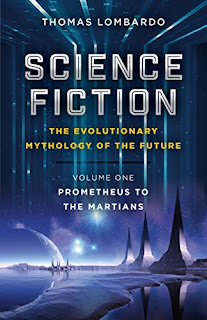
"Whether you are a science fiction scholar, futurist, or enthusiast, Tom Lombardo's Evolution of Science Fiction webinar series will open your mind and expand your knowledge of science fiction. Comprehensive in scope and in-depth in its coverage, the series begins with the ancient mythological origins of science fiction and examines cultural, philosophical, and scientific dimensions of science fiction up to the present. 

Based on Lombardo's multi-volume history of science fiction — Science Fiction: The Evolutionary Mythology of the Future  — the series covers key authors and published works, science fiction cinema and art, and social features of science fiction.


== Resources! ==


Oh heck. While we're discussing scifi, here are some added resources for research in useful science fiction:


- Science Fiction Research Association: http://www.sfra.org/


- SFE: SF Encyclopedia: https://sf-encyclopedia.com/


- The Internet Speculative Fiction Database: http://www.isfdb.org/


- The Science Fiction and Fantasy Research Database (tamu.edu): https://sffrd.library.tamu.edu/site/


- J Wayne and Elsie M Gunn Center for the Study of Science Fiction: http://www.sfcenter.ku.edu/


- Inventions and Ideas from Science Fiction Books and Movies at Technovelgy.com: http://technovelgy.com/


- Science Fiction - TV Tropes:   https://tvtropes.org/pmwiki/pmwiki.php/Main/ScienceFiction


- Science Fiction & Fantasy Stack Exchange: https://scifi.stackexchange.com/
(Newest 'story-identification' Questions): 
https://scifi.stackexchange.com/questions/tagged/story-identification


- Worldbuilding Stack Exchange: https://worldbuilding.stackexchange.com/


Saturday, May 21, 2022

Crypto is not a dog... or doge... or is it?

As this goes online, Bitcoin and other cryptocurrencies are in apparent price-freefall. This posting - prepared over a month ago - will not discuss the recent coin market meltdowns. Still, it seems a good moment to offer some light on one aspect.

First, I actually know a little about this topic. I've consulted with a number of companies, agencies, etc. about the blockchain era. More generally, about the conceptual underpinnings of "smart contracts" and the eerie, free-floating algorithms that were long-predicted by science fiction, but have become reality, as we speak. (Yes they are out there; some may be living right behind the screen you are looking at.)

One topic generating excitement - though the notion has been floating since the 1990s - is that of Decentralized Autonomous Organizations, or DAO, which are portrayed in many novels and utopian manifestos as a way for humans (and their helpers) to bypass sclerotic legacy nations and codger institutions with self-organizing action groups, using NFTs and Blockchain tokens to modernize and revitalize the concept of guilds -- global, quick, low-cost, boundaryless, open and inherently accountable. Bruce Sterling wrote about this notion in the last century (as in his novel, Heavy Weather) and other authors, like Neal Stephenson (Cryptonomicon), Karl Schroeder (Stealing Worlds), as well as Cory Doctorow (Down and Out in the Magic Kingdom), Annalee Newitz (Autonomous), and many others roam this conceptual landscape with agility! 

To a large extent, versions of DAO thinking underlie moves by nations like Estonia (or "E-stonia") to modernize democracy and public services. Also spreading widely is the related notion of Citizen Assemblies. 

But today I want to focus now on just one aspect of this brave new world: whether DAOs can find a middle ground between autonomy and accountability, by self-policing to reduce bad behavior by predators, while retaining their better, freedom enhancing traits.  

== Can blockchain-based DAOs - especially coin communities - self-police? ==

This is an important topic! Because major legacy nations like China are already stomping hard, using as justification the way cryptocurrencies do empower the very worst of parasitic human criminals. That justification might be reduced or eliminated if DAOs or blockchain communities could find a positive-sum sweet spot, cauterizing predators while preserving their role as gritty irritants, creating pearls of creative freedom.

Although there is no way to "ban" crypto currencies in general, there is an approach to making them much more accountable to real life law.

Let's start with an ironic fact. Blockchain-based token systems are not totally secret!  


Yes, they use crypto to mask the identity of token (coin) holders.  But those holders only "own" their tokens by general consent of all members in a communal 'shared ledger' that maintains the list of coins and which public keys stand ready to be turned by each owner's encrypted keys. In that sense it is the opposite of 'secret,' since the ledger is out there in tens of thousands of copies on just as many distributed computers. Attempts to invade or distort or corrupt the ledger are detected and canceled en masse. (The ecologically damaging "coin mining" operations out there are partly about maintaining the ledger.)


All of this means that - to the delight of libertarians - it will be hard to legislate or regulate blockchain token systems. Hard, but not impossible. For example, the value of Bitcoin rises and falls depending on how many real world entities will accept it in payment. And as stated above, and some governments have been hammering on that, lately.

There is another way to modify any given blockchain token system, and that is for the owners themselves to deliberate and decide on a change to their shared economy... to change the ledger and its support software.  No one member/owner can do that. Any effort to do so would be detected by the ledger's built in immune system and canceled. 


Only dig it, all such ledger-blockchain systems are ruled by a weird kind of consensus democracy. While there is no institutional or built in provision for democratic decision making in the commons - (Satoshi himself may have back doors: a separate topic) - there is nothing to stop a majority of bitcoin holders from simply making their own, new version of the shared ledger and inserting all their coins into it, with new software that's tuned to less eagerly reward polluters and extortionist gangs. 


Oh, sure, a large minority would refuse. Their rump or legacy Bitcoin ledger (Rumpcoin?) would continue to operate... with value plummeted as commercial and government and individual entities refuse to accept it and as large numbers of computer systems refuse to host rump-coin ledger operations. Because at that point, the holdouts will include a lot of characters who are doing unsavory things in the real world.


There are vernaculars for this. Indeed it has been done, occasionally, in what are called soft and hard 'forks.' 


== A forking solution? ==


A “fork,” in programming terms, is an open-source code modification. Usually, the forked code is similar to the original, but with important modifications, and the two “prongs” comfortably co-exist. Sometimes a fork is used to test a process, but with cryptocurrencies, it is more often used to implement a fundamental change or to create a new asset with similar (but not equal) characteristics as the original.


With a soft fork, only one blockchain will remain valid as users adopt the update. Whereas with a hard fork, both the old and new blockchains exist side by side, which means that the software must be updated to work by the new rules. But the aim is to render the old code so obsolete and so widely spurned that it ceases to have any use to anyone.


As an example: Etherium did a fork when about $100 million worth of coins (that would now be worth tens of billions) was tied up in a badly written smart contract that a hacker was stealing. The community decided to kill that smart contract showing that immutable blockchains can change if 50% +1 decides to change it.


If you squint at this, it's really not so radical.  (Don't even ask about the blockchain "spork!"). It is just an operating system upgrade that can only occur by majority consent of the owner-members of the commune.  As pioneered at the famous University of Fork... or...


And so the stage is set to 'regulate' in ways that leave the potential benefits of blockchain - self-correction, smart contracts and the like - alone while letting system users deliberate and decide to revise, a trait that should be possible in any democratic or accountable system.


Now, is there a way to use a Grand Fork to change the insane approach to coin "mining" so that ledger maintenance can be achieved without encouraging planet-killing pollution and waste?


== And finally... ==


The concept that I called equiveillance or look-back accountability, in The Transparent Society - and Steve Mann called sousveillance - is labeled "inverse surveillance" by members of the Asimov Institute, in Holland. “How can we use AI as a Panopticon to promote beneficial actions for citizens by organizations?” A proof of concept was explored in a 2021 hackathon. 


Well well. These are harder concepts to relate than they might think, I know from experience! Yet they are fundamental to the very basis of our kind of civilization.

Friday, May 13, 2022

From geology to quantum science to a healthy planet...

For your weekend... as I traditionallly do, here's a round-up of recent science news...


First, here's the latest CARTA conference - the Center for Anthropogeny (human origins) at UCSD. This one with talks having to do with the theme of "The Planet Altering Apes."


== Physical Science ==


The observation of the Higgs boson  at the Large Hadron Collider (LHC) has validated the last missing piece of the standard model (SM) of elementary particle physics.  The mass of the W boson, a mediator of the weak force between elementary particles, should be tightly constrained by the symmetries of the standard model of particle physics.  So… do recent results mean we have a problem here?


“Wireless Sensors: Tiny Battery-Free Devices Float In The Wind Like Dandelion Seeds…” or a lot like the ‘localizer nanochips in Vernor Vinge’s great novel  A Deepness in the Sky.  


A new form of ice discovered, which forms at high-pressures: Shades of Kurt Vonnegut! Here’s ‘ice-ten’ or Ice-X!  Scientists speculate that it could be common on distant, water-rich exoplanets.


Asking the Ultimate Questions, Robert Laurence Kuhn’s recent presentation at the Institute of Art and ideas (IAI-UK), is posted on the Closer To Truth YouTube channel.


== The biologic world ==


States and cities have also begun to decriminalize psilocybin – the core of magic mushrooms - in general or for medicinal purposes, especially treatment of depression. 


The disturbing rise of bird flu; already more than 27 million birds have died or been slaughtered. Will we see a poultry vaccine?


Apparently fish can calculate....stingrays can perform simple addition and subtraction in the low digit range.


Forty to fifty percent of all animal species are actually parasites, including 300,000 different types of worms that parasitize vertebrates.


Interesting question: Why didn't our primitive ancestors get cavities?


== Insights into our planet ==


In Earth’s past, two gargantuan 'super-mountain' ranges may have fueled two of the biggest evolutionary boom times in our planet's history — the first appearance of complex cells roughly 2 billion years ago, and the Cambrian explosion of marine life 541 million years ago.  


Is Earth’s ‘solid’ inner core something like my fictional-hypothetical descriptions in Earth? If the material is ‘superionic,’ then the majority iron atoms might be 'solid' in the crystalline lattice structure, whereas the carbon, hydrogen, and oxygen molecules would diffuse through the medium, creating the liquid-like element.  


And in related matters, the top mineral form of the mantle is perovskites… which are still (since I wrote Earth) among the best high pressure/high temperature superconductors. So… is she alive? Way too soon to tell. But the traits (or potentialities) keep piling up!


Moving a bit outward toward Earth's mantle… “Earth is layered like an onion, with a thin outer crust, a thick viscous mantle, a fluid outer core, and a solid inner core. Within the mantle, there are two massive blob-like structures, roughly on opposite sides of the planet. The blobs, more formally referred to as Large Low-Shear-Velocity Provinces (LLSVPs), are each the size of a continent and 100 times taller than Mt. Everest. One is under the African continent, while the other is under the Pacific Ocean.”  Might this explain the unusual solidity of the African continent?


Meanwhile, fast melting Alpine permafrost may contribute to rising global temperatures.


There have been wonderful paleontologic finds at the Tanis site, in the Dakotas, which show many creatures exceptionally well-preserved who seem to have died suddenly the very day that asteroid ended the era of the dinosaurs. I look forward to the show - Dinosaurs: The Final Day with Sir David Attenborough, which was broadcast on BBC One. A version for the U.S. science series Nova on the PBS network will be broadcast later in the year.


And...an allegory of uncertainty


Four quantum physicists are in a car. Heisenberg is driving like he is in The Matrix. Schrödinger is in the front seat waving at the other cars. Einstein and Bohr are in the back arguing when they get pulled over. The officer asks Heisenberg, “do you know how fast you were going?”

“No, but we know exactly where we are,” Heisenberg replies.


The officer looks confused and says, “you were going 120 km/h!”


Heisenberg throws his arms up and cries, “Great! Now we’re lost!”


The officer looks over the car and asks Schrödinger if they have anything in the trunk.


“A cat,” Schrödinger replies.


The officer opens the trunk and yells, “This cat is dead!”


Schrödinger angrily replies, “Well it is now.”


Bohr says, “on the bright side, a moment ago we didn’t have a position, speed, or a cat. Now we have all three!”


Fed up, the officer says, “I just want to know how many of you I need to bring back to the station!”


“Roll dice for it?” Einstein asks.


heh.


Now back to your regularly scheduled 21st Century crises...


Friday, May 06, 2022

Ripping off masks... and a powerful (if dry) way to pop the lie-bubble

I'll get to a potent meme (below) that shreds one of the clichés most-shared by both left and right. And shredding it will help one against the other. But first...

In Earth - and differently in Existence - I speculated on ways that 'ownership transparency' might solve many of the crimes and contradictions of feral capitalism, without resorting to anti-market socialism. Defenders of capitalism are hypocrites if they talk about free and competitive markets while excusing secrecy that blinds 99% of market participants. They should be the first to demand world transparency of who owns what.

So am I glad that the Ukraine war is causing the U.S., U.K and even Switzerland to rip veils off some of the shell corporations that own all those seized yachts and so much property in London, New York, Paris etc.? Well, yeah. Sure. But watch our own aristos scramble to make sure this remains only about Russian Oligarchs. I'll be shocked if truly broad reforms happen.

It's gonna take a lot more than Ukraine. Possibly even a "Helvetian War."

Thomas Piketty elaborates: "Let’s say it straight away: it is time to imagine a new type of sanction focused on the oligarchs who have prospered thanks to the regime in question. This will require the establishment of an international financial register, which will not be to the liking of western fortunes, whose interests are much more closely linked to those of the Russian and Chinese oligarchs than is sometimes claimed. However, it is at this price that western countries will succeed in winning the political and moral battle against the autocracies and in demonstrating to the world that the resounding speeches on democracy and justice are not simply empty words."


== Again, the one thing that would transform the world almost instantly ==

Transparency of property and ownership would likely make competitive markets work vastly better while slashing the parasitive effects of all sorts of cheating and (likely) reduce effective tax rates on honest citizens, worldwide. But it is the sort of reform that seems unlikely in the near future.

It may not happen till tumbrels are rolling through the streets, alas.

But there is one thing -- one action by one leader -- that could transform America and the world, overnight. You've seen it proposed here time and again. Jobee could do it all by himself, not even needing Congress.

Maybe he is hoping Putin will do it for him.

Only now the topic I promised. A potent meme that shreds one of the clichés most-shared by both left and right. And shredding it will help one against the other.


== The boring stuff – deficits and how each party tries to ‘stimulate’ the economy – actually matters! ==


As I show in Polemical Judo, Democratic Party pols are seldom smart enough to use powerful memes like this one -- that Biden and the dems have actually reduced the federal deficit for the first time since Obama. 


Not only that, but Democratic Administrations are always* more fiscally responsible than GOP ones.  While caring far more for the poor, oppressed and workers… and science and the planet… and rights for women and minorities... they also reduce, rather than lay heavier debt burdens upon our children.  


Is that really, really hard for you to parse in your head?  


We are so used to each party’s clichés, such as Republican-hypocritical demands for fiscal prudence, while spilling tsunamis of red ink, opening America’s carotid arteries for greedy suction by aristocrats… and the almost equally-dumb obsession of the far-left called “Modern Monetary Theory” (MMT.)

In fact, honest Keynesians are the only adults in the room, running deficits to effectively help the working class during rough patches… then paying down debt in the resulting good times. Clinton did it. So did Jerry Brown, Gavin Newsom…. the list goes on. Not just this round, but every round, as I showed here:  


‘So Do Outcomes Matter More than Rhetoric?’ 


This matters! Because there are two large groups we must draw into the Union side in this especially hazardous phase of the U.S. Civil War. And both of these groups are needed by the only coalition that stands a chance of saving the republic, civilization, planet and posterity. 


First, the frippy sanctimony-preeners of the left need to grow up and learn (as AOC, Bernie, Liz and Stacey know) the meaning of the word ‘coalition.’ One keeps hoping the next news item will snap the poseurs out of their ritual chants of “Biden is Republican-lite!”  


Maybe the looming reversal of Roe v. Wade will do it. But don’t hold your breath.


We ALSO absolutely must peel away the 10% - possibly even 20% - of Republicans who maintain at least a sliver of residual sanity. Why? Because the confederate/Red/Foxite/Trumpist/Kremlinite, anti-science and anti-fact treason party is in demographic collapse! If we can peel away just 10%, all their cheats, including gerrymandering, will fail!  


And that’s where the ‘fiscal responsibility’ thing comes in. It is a wedge you can pound in, to cleave off some of those ‘ostrich Republicans.’ 


Start by demanding a cash wager, whether Democratic Administrations always* prove to be far more fiscally responsible!


Picture your Tucker-hugger blinking in dismay when he realizes one of his cult’s core catechisms is proved – proved! – to be diametrically opposite to true, and he better admit it, or pay off on the bet.


All right. I know your lazy response, shrugging that ‘it’s hopeless to even talk to those people'... 


...and I am telling you now that – hopeless or not – it is your duty!  If just one in ten of you peel away just one… well…. 


Look up the old phrase: “All heaven rejoices when…”


Finally....

How Putin may seek an exit strategy to save face by declaring a “Mission Accomplished!” moment. Very cogent analysis. Also, this fellow is among the few who describes in detail how under GHW Bush a flock of western vultures - most of them Cheney family-connected - swarmed into Russia to help a hundred or so Soviet commissars snap up shares of sold-off state enterprises… 


...one of several reasons why I rank Bush Senior as unquestionably and by far the worst U.S. president of the 20th Century, who set the stage for our crisis ridden world.  Alas, the author of this piece gets a bit kooky toward the end. But the first half is worthwhile.


=====


* Sure, ‘always’ is a strong term. There are undoubtedly exceptions, though I know of none since 1980. So? Use the polemical power.