The future of civilization could depend on our elections (in fact that may be true even of the galaxy!)... but not today. Today, let's peer ahead a bit! In fact, hang around for a few paragraphs to see a great opportunity to get some fine science fiction... cheap!
But first. The new OMNI Reboot looks snazzy and well-done. Certainly worth a visit. Especially (!) their very nicely-presented interview with me about topics ranging from AI and apocalypse to the value and basis and future of science fiction.
Are we overthinking the dangers of artificial intelligence? On Gizmodo, George Dvorsky interviews me about the potential dangers and benefits of AI… and other future hazards. Will the dystopian nightmares of sci fi flicks come true? Or might those warnings actually help prevent the worst mistakes?
But first. The new OMNI Reboot looks snazzy and well-done. Certainly worth a visit. Especially (!) their very nicely-presented interview with me about topics ranging from AI and apocalypse to the value and basis and future of science fiction.
Are we overthinking the dangers of artificial intelligence? On Gizmodo, George Dvorsky interviews me about the potential dangers and benefits of AI… and other future hazards. Will the dystopian nightmares of sci fi flicks come true? Or might those warnings actually help prevent the worst mistakes?
Did you read that Germany has submitted draft legislation to the EU granting personhood to robots? If only Isaac could have seen this! Silly ass stuff... but reflective of society’s generally laudable trend toward a reflex of inclusion. It may speak well of us when (now?) some secretive-scared AI wonders whether to "come out."
Looking backward, but suddenly pertinent in the surge of Pokemon Go! A fascinating tale by Ted Chiang — “The Lifecycle of Software Objects” — won the 2011 Locus Award and the Hugo Award for Best Novella. Published in 2010 by Subterranean Press, it follows the many quirky problems and ups and downs faced by a woman and her friends, devoted to “raising” and teaching simulated near-intelligent beings in virtual worlds. Chiang makes a great effort to realistically convey how shifting fads and technologies can pull the rug out from under you, though the range of implementations will vary even more than he conveys. The whole story is available here.
Looking backward, but suddenly pertinent in the surge of Pokemon Go! A fascinating tale by Ted Chiang — “The Lifecycle of Software Objects” — won the 2011 Locus Award and the Hugo Award for Best Novella. Published in 2010 by Subterranean Press, it follows the many quirky problems and ups and downs faced by a woman and her friends, devoted to “raising” and teaching simulated near-intelligent beings in virtual worlds. Chiang makes a great effort to realistically convey how shifting fads and technologies can pull the rug out from under you, though the range of implementations will vary even more than he conveys. The whole story is available here.
== New Realism in SF ==

An interesting riff on the
New Realism in science fiction film and television. The Future is Almost Now, from The Atlantic: “Many new
works of science fiction seem to represent a strain of pre-apocalyptic cinema, characterized by
a willingness to dramatize disasters that are less hypothetical than poised to
happen.… Unlike The Terminator and
Matrix franchises, these films
don’t predict an apocalyptic “rise” of machines so much as a gradual digital
takeover, the next phase of a revolution already in progress,” writes Elizabeth Alsop.
The notion appears to be
that scifi is backing away from boldness in extrapolation. As one quoted
scholar put it: “[t]he magical and disruptive inventions that used to
feature prominently in some stories have now been folded into more typical
domestic realism.” Or, as Margaret Atwood puts it: “things that really could
happen but just hadn’t completely happened when the authors wrote the books.”
Elizabeth
Alsop continues: “If, as the critic Northrop Frye has argued, the job
of science fiction has been 'to imagine what life would be like on a plane as
far above us as we are above savagery,' what does it mean that so much recent
sci-fi has been taking place on a plane that’s relatively proximate to ours?
In other words: Why this rise in near-future stories, and why now? One possibility is that verisimilitude allows for better social commentary…” She asks: “Should the fact that sci-fi seems to now be handling such scenarios more concretely, then, be seen as a sign of progress? Or is this insistence on concrete-ness merely a symptom of what the sci-fi luminary William Gibson sees as the end of speculation—the collapse of imagination into a reality that has already outpaced it?”
In other words: Why this rise in near-future stories, and why now? One possibility is that verisimilitude allows for better social commentary…” She asks: “Should the fact that sci-fi seems to now be handling such scenarios more concretely, then, be seen as a sign of progress? Or is this insistence on concrete-ness merely a symptom of what the sci-fi luminary William Gibson sees as the end of speculation—the collapse of imagination into a reality that has already outpaced it?”
A fascinating analysis… and
almost entirely wrong at every level.
But I am cheered by one aspect no one else mentions. That this thoughtful rumination on science fiction appeared in ...The Atlantic. A magazine that, along with Harpers and The New Yorker, used to regularly commission pompous hit pieces attacking the very notion of science fiction as literature, let alone its interest in the disruptive effects of onrushing change. That shift, by some of the literary-arts arbiters reveals something about the 21st Century and our gradual recovery from year 2000 Future Shock.
Sometimes it is the macro perspective that really matters. Welcome to the conversation, Dr. Alsop.
But I am cheered by one aspect no one else mentions. That this thoughtful rumination on science fiction appeared in ...The Atlantic. A magazine that, along with Harpers and The New Yorker, used to regularly commission pompous hit pieces attacking the very notion of science fiction as literature, let alone its interest in the disruptive effects of onrushing change. That shift, by some of the literary-arts arbiters reveals something about the 21st Century and our gradual recovery from year 2000 Future Shock.
Sometimes it is the macro perspective that really matters. Welcome to the conversation, Dr. Alsop.

And those of you who like good old adventure science fiction (and yes some tusslin' fightin' mixed in, for fun)? Check out The Year's Best Military and Adventure 2015. A great annual that - this round - contains one of my most popular new stories: "The Tumbledowns of Cleopatra Abyss," (which made it into several best-of volumes, this year.) No military or fighting in that tale of terraforming Venus, but lots of adventure!
In fact, those who want to participate in the volume's Readers' Choice Award can go online and vote for their favorite story from the anthology. The winner (announced at DragonCon) gets $500 and a plaque. Hey, have fun. Explore! And enjoy an election in which you like all the candidates, for a change!
 Will we have a Star Trek future of abundance? Can there be a post-scarcity future? A discussion with Manu Saadia, author of Trekonomics: The Economics of Star Trek.
Or will we see a darker future, as explored in recent Arab dystopian sci fi? Very interesting: “Science fiction and surrealism
have long provided an escape valve for writers living under oppressive regimes.
In Latin America, decades of fascism and civil war helped inspire masterpieces
of magical realism from authors like Gabriel García Márquez and Isabel Allende.
In Russia, the postmodern novelist Vladimir Sorokin has published disturbing and
controversial futuristic novels that surreptitiously skewer the country’s
repressive government. Dystopian
themes are not entirely new in Arabic fiction. But they have become much more
prominent in recent years…” writes Alexandra Alter in The New York Times. (Another literary arbiter journal that now admits SF is one of our smartest and best genres.)
How does Science fiction fare in the rest of the world? A look at Science fiction in Cuba! Plus see: 100 amazing African science fiction authors! Geoff Ryman begins this series on the Tor website.
It’s so strange it might as
well be science fiction. Matthew McConnaghy’s new movie The Free State of Jones.
Here’s a fine article on the historical background behind the real-life hero of the story. (Strange but inspiring.)
A fine interview with my friend and genius artist Jim Burns, on Omni Reboot.
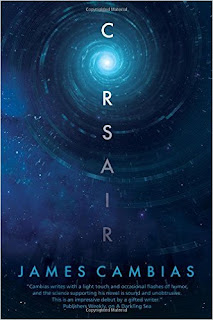 Corsair, by James Cambias (author of A Darkling Sea) offers a sci fi thriller – a near-future tale of
space pirates, computer hackers and terrorists. Nuclear fusion has, at last,
become a reality on Earth – powered by helium extracted by robots from the
lunar regolith. (Controversial if this will ever be economically feasible… but
I’m willing to go along for the ride.) The tricky part is returning the
shipments to Earth – the helium payloads an attractive target for pirates.
The amoral genius cyberhacker, David Schwartz (aka Captain Black), seeks to redirect the payload to international
waters where real pirates can claim it. The U.S. Orbital Command backs away from battle, but Air Force officer Elizabeth Santiago (with whom Schwartz had
a brief affair back at MIT) goes rogue, determined to foil his efforts. The
plot twists as Schwartz is double-crossed after he teams up with hard-core
terrorists.
Corsair, by James Cambias (author of A Darkling Sea) offers a sci fi thriller – a near-future tale of
space pirates, computer hackers and terrorists. Nuclear fusion has, at last,
become a reality on Earth – powered by helium extracted by robots from the
lunar regolith. (Controversial if this will ever be economically feasible… but
I’m willing to go along for the ride.) The tricky part is returning the
shipments to Earth – the helium payloads an attractive target for pirates.
The amoral genius cyberhacker, David Schwartz (aka Captain Black), seeks to redirect the payload to international
waters where real pirates can claim it. The U.S. Orbital Command backs away from battle, but Air Force officer Elizabeth Santiago (with whom Schwartz had
a brief affair back at MIT) goes rogue, determined to foil his efforts. The
plot twists as Schwartz is double-crossed after he teams up with hard-core
terrorists. Jeff Carlson, a rising star of SF, has published volume three of his Frozen Sky series — set under Europa's ice roof, an unusual tale of First Contact.
 In Frozen Sky 3: Blindsided, engineer Alexis Vonderach sets out to rescue an ESA biologist who has been kidnapped by ancient blind alien tribes, existing in secret deep below Europa's ice surface.
Meanwhile, in space the People's Supreme Society of China takes action against the ESA, launching thousands of drones and hunter-killers. Conflict above. Conflict below. Blindsided really moves. Try this science-rooted, fast-paced hard SF adventure!

The Long Way to a Small, Angry Planet, by
newcomer Becky Chambers has received a lot of press. Humans have abandoned their inhospitable homeworld,
and joined the Galactic Commons -- but they find themselves at the bottom of
the totem pole in this fragile alliance among sentient aliens. Seeking to
escape her family’s shame, Rosemary Harper joins the interspecies crew of the
Wayfarer, a tunneling starship on a mission to punch wormholes through
hyperspace to establish contact with a distant planet. On this long space-road
trip, the
story focuses on the backstories and relationships of
the crew, their solidarity tested by the stress of a long voyage through
galactic zones on the verge of war.
 If you enjoyed The Lifecycle of Software Objects by Ted Chiang, try his latest collection, Stories of Your Life and Others, speculations about the nature of man, machine and alien. In “Tower of Babylon”, one of my favorites and winner of the 1990 Nebula Award, Sumerian
workers labor to reach for the skies and shatter through the vault of the heavens…
only to find the unexpected. His novella, “Story of Your Life” won the 1999
Nebula for novella; it explores initial attempts to communicate with alien
minds who perceive reality and the flow of time very differently than humans.
“Understand” offers a dark take on a “Flowers for Algernon” – style
intelligence boost, as two hyper-enhanced minds work toward contrary purposes.
If you enjoyed The Lifecycle of Software Objects by Ted Chiang, try his latest collection, Stories of Your Life and Others, speculations about the nature of man, machine and alien. In “Tower of Babylon”, one of my favorites and winner of the 1990 Nebula Award, Sumerian
workers labor to reach for the skies and shatter through the vault of the heavens…
only to find the unexpected. His novella, “Story of Your Life” won the 1999
Nebula for novella; it explores initial attempts to communicate with alien
minds who perceive reality and the flow of time very differently than humans.
“Understand” offers a dark take on a “Flowers for Algernon” – style
intelligence boost, as two hyper-enhanced minds work toward contrary purposes.

ALSO: Have a look at Eliot Peper's latest novel, Neon Fever Dream. Sinister goings-on at Burning Man! In this fast-paced thriller, mystery, intrigue, espionage and dark conspiracies unfold during a pilgrimage to the incendiary desert festival.
A worthy follow-up to Peper's last book, Cumulus, a techno-thriller which envisioned a world of near-constant corporate surveillance.
If you enjoyed The Lifecycle of Software Objects by Ted Chiang, try his latest collection, Stories of Your Life and Others, speculations about the nature of man, machine and alien. In “Tower of Babylon”, one of my favorites and winner of the 1990 Nebula Award, Sumerian
workers labor to reach for the skies and shatter through the vault of the heavens…
only to find the unexpected. His novella, “Story of Your Life” won the 1999
Nebula for novella; it explores initial attempts to communicate with alien
minds who perceive reality and the flow of time very differently than humans.
“Understand” offers a dark take on a “Flowers for Algernon” – style
intelligence boost, as two hyper-enhanced minds work toward contrary purposes.ALSO: Have a look at Eliot Peper's latest novel, Neon Fever Dream. Sinister goings-on at Burning Man! In this fast-paced thriller, mystery, intrigue, espionage and dark conspiracies unfold during a pilgrimage to the incendiary desert festival.
A worthy follow-up to Peper's last book, Cumulus, a techno-thriller which envisioned a world of near-constant corporate surveillance.


