Showing posts with label accomplishments in space. Show all posts

Saturday, May 18, 2019

Space: where the rewards really are


Before getting into real life space adventures...

The lavish blockbuster - Wandering Earth - based on Liu Cixin’s novel - was released (quietly) on Netflix. “The Wandering Earth doesn’t yet appear under “New Releases” or “Netflix Originals” section, though it shows up on the “Recently Added” list when you scroll down. It seems odd to bury this film after the incredible reception it’s received overseas (even worldwide, it’s cracked $700 million), and Netflix’s enthusiasm when the company first acquired it.” And yes, by elevated standards of "high" SF there are some... simplistic or "oh, my" aspects. Hey. They're learning the ropes, fast.


== Space advances! ==

Earth has two “extra moons.” Dangerous rocks! Gold in them thar space rocks! And Fool’s Gold!

First an announcement: NASA's Innovative & Advanced Concepts program (I’m on the External advisory Council) has announced its 2019 grant selections. Your comments are welcome here. 

News from the future! My headline from 2039 leads off a series by the XPrize Foundation! Theme of this round: The Moon 2039. As you might expect, my "headline" is a bit sardonic. (I’ll be at the June International Space Development Conference in DC, as a lonely voice skeptical of the “Back to Luna!” theme.)

NASA, FEMA, and other national and international agencies and other agencies joined to run a hypothetical asteroid impact preparedness scenario at the International Academy of Astronautics Planetary Defense Conference, hoping to learn the best strategies for responding to a potential strike, starting from the moment a threatening asteroid is first detected by astronomers.

You can be part of the solution via an NGO that will apply your membership to finding gaps in the way governments are doing Planetary Defense: the B612 Foundation.

And so, this time, let’s focus on those rocks out there!  Newly discovered “moons” of the Earth, an older dustpile, and prospectors’ delight…

== Where the rewards are ==

Okay, here’s some moon-madness. One day - (one!) - after I predicted it, the administration swished from eagerness for a flag-waving, U.S.-only moon-race junket to calling for a joint international effort. (In fact, I predicted it more than a year ago, on-blog.) To be fair, I deem it likely NASA Administrator Jim Bridenstine is honest and just trying to make the best of a truly awful situation. Still, it all boils down to the same thing. In order to help other nations get their rite-of-passage moon-selfie moment on a useless and utterly resource-barren plain of poison dust, the US will share every technology and skill, virtually for free. We could be joining with Japan to do things no one else can even approach (see below), things that would benefit all humanity and also make us rich. But not on Mike Pence's watch.

But for a pretty thorough update/appraisal plus vivid historical perspective on our gorgeous planetary satellite, see a soon-released book entitled The Moon: A History for the Future, by my friend Oliver Morton, author of The Planet Remade. Pre-order now! It pairs well with Robert Zubrin’s recently released The Case for Space: How the Revolution in Spaceflight Opens Up a Future of Limitless Possibility, portraying the visionary entrepreneurs who are forging a bold future of space exploration, developing reusable rockets, pushing ahead to Mars, the asteroids and beyond... even to the moons of the outer planets.

Just read skeptically in both places – and anywhere else – when folks wave at “lunar resources.” There’s plenty to love about lovely Luna, and even visit. But we’ll get rich elsewhere.

Oh, don’t get me wrong. Luna is important over the long run, and even now -- scientifically. And I might be wrong about its sterile, near term uselessness. Hence it’s good that humanity will be checking it out again. Worthwhile science will get done, each time desperately eager tourists land there in expensive rites-of-adulthood. May those preening tourists prove me wrong! (I do think NASA should send a robot to one of those lava tubes.)  But elsewhere I list a dozen reasons why all talk of “lunar resources” tends to amount to just hot air.

Speaking of moons… NASA's Curiosity rover on Mars got lucky last month and spotted not one but two cool eclipses — in less than two weeks, one for each of the Red Planet's moons. Which leads to this reminder: Phobos and Deimos should be mission targets! If one of them possesses usable volatiles, then ISRU (In-Situ Resource Utilization) could fill fuel and water tanks both in orbit and on the surface of Mars, making the economics of crewed landings (and return to Earth) vastly easier.  https://www.space.com/curiosity-rover-sees-solar-eclipses-on-mars.html

And so we get to a special kind of “moon.” It turns out that Earth has several other than big ol’ Luna. We know a class of asteroids that are locked into periodic dance orbits that return them to near-Earth space – the “nearest” of the NEOs (Near Earth Asteroids) and by-far easiest to reach, though none has yet been visited. And Dr. James Benford has pointed out that these could be perfect hosts fir the sort of “lurker” interstellar surveillance probes that I describe in EXISTENCE.

Benford argues for close study of co-orbitals like Cruithne (3753), a 5-kilometer object with closest approach to Earth of 0.080 AU, and 2010 TK7, which oscillates around the Sun-Earth Lagrangian point L4. A number of other such objects are known in a 1:1 orbital resonance with Earth The dancer that comes nearest – 2016HO3 – is just tens of meters across… also known as Kamoʻoalewa — a Hawaiian word for an oscillating object in the sky

Now comes news that China plans a sample return mission to this object. Simpler and easier to get to than the Hyabusa and OsirisRex missions (see below), it’s still a very ambitious step that proves the PRC is not just fixated on military endeavors out there or the Apollo wannabe landing of taikonauts. They must be aware (as Mike Pence is not) that the real riches are likely in asteroids. After dropping those samples for Earth recovery -- and getting a gravity assist -- their probe will continue to the main asteroid belt and orbit the comet 133P to characterize its accessible water and other resources. The whole mission will last about 10 years. So far, China has achieved five continuous successes in its lunar exploration program, and they plan to launch a probe to explore Mars in 2020, which is expected to arrive at the red planet in 2021.

Still a leader -- Japan’s Hayabusa mission to explore asteroid Ryugu just keeps doing more wonderful things. After deploying three varied sub-landers, then poking the asteroid for a sample to return, it just blasted the surface to make a new crater, to later sample more pristine matter!  Efficiently and boldly testing methods that may take humanity closer to accessing the vast troves of wealth out there. These are the partners the U.S. should team up with, if we outgrow the current literal Lunacy of joining an insipid “race” back to the Moon’s dusty waste.  Don’t underestimate Japan. They’d be glad to be our helpers in this. But if we drop the ball… they are capable of carrying it alone.

And the U.S. mission OsirisRex is zeroing in on Bennu. The Colorado School of Mines just became the first university to offer master’s and doctorate degrees in space resources, bringing together many fields, including mining, resource economics, robotics, advanced manufacturing, remote sensing, metals/metallurgy, solar and nuclear energy along wwith ISRU or in-situ resource utilization, or using what’s in place.  Colorado Reps. Scott Tipton, a Republican, and Ed Perlmutter, a Democrat, are sponsoring a bill that would establish the Space Resources Institute. 
https://space.mines.edu/

Confused about how we’ve managed to measure distances and times  across the universe? This animation is truly wonderfully made.  Explained in this article.

Humanity is advancing gloriously! Too bad large and stupid minorities of voters in western nations have let them selves be egged into hatred and all-out war against the very same fact-professions – many of them their own sons and daughters – who are pushing the envelopes of understanding of climate, environment, technology, biology, medicine and the fantastic realm of God’s universe.


Saturday, October 01, 2016

Our phenomenal (recent) accomplishments in space

I am trying... hard ... to keep politics down to half of my postings (or so) and not on weekends!  And hence... something to remind you what a great civilization you are proud of!  Do not let the gloom merchants poison your mood.

After a successful launch, the OSIRIS-REx mission sets off to explore and bring back samples from asteroid Bennu, whose size, orbit and possible carbonaceous makeup suggest real potential for riches... and if that dream comes true, then we can stop digging into Mother Earth. Fly well, Osiris-Rex!

Layered buttes on Mars / NASA Curiosity 
Wonderful latest images from our hardworking, loyal robot on Mars. The Curiosity rover recently sent back stunning detailed photos of jagged finely layered buttes in the Mount Sharp region. And they are beauts! (pictured to right).

A very cool (get it?) summary of mysteries revealed about Pluto-Charon by the New Horizons probe.   

A rare double eclipse: Kewl! NASA’S Solar Dynamics Observatory caught BOTH the Earth and the moon crossing the sun

The U.S. government has approved Florida-based Moon Express for a planned 2017 robotic lunar landing, hoping eventually to exploit its resources. And  I am rooting for em!  Though I am deeply skeptical – I see no evidence for anything usefully available from the bottom of the Lunar gravity well, in the immediate time horizon. (I much prefer what NASA and planetary scientists, industrial investors and this administration see as an obviously better prospect: asteroids.) But go ahead guys!  Prove me wrong.

NASA's Solar Probe Plus mission is moving ahead with its daring 2018 launch to study the sun's super-heated atmosphere. Now of course I have mixed feelings. First, I’m certainly glad to see this daring voyage-endeavor which, it turns out, will require seven Venus flyby maneuvers in order to get into a near solar trajectory. (Do not imagine heading toward the inner solar system, to be ‘easy because it’s downhill.’ It is excruciatingly difficult, dynamically. Much harder than - say - going to Mars.)

Still, one of the competing groups had enlisted me on its board of advisers - as both a planetary scientist who used to do solar astronomy and later a member of NIAC.  But also, I suppose, because they had planned to name their mission Project Sundiver, letting me serve as mascot.  Ah well.  I suppose the JHUAPL guys had a better mission plan. Good luck sundivers!

For up to two billion years, some investigators believe, Venus may have been a hospitable place for life. “Venus receives 40% more heat and light than Earth does. At first, that wasn’t a problem since the sun was 30% dimmer in the early days of the solar system, but its brightness—and heat—increased over time… if Venus ever had plate tectonics, the process would have begun grinding to a halt, due at least in part to the lack of water to keep the upper mantle viscous. Without tectonics, carbon in the atmosphere can’t be recirculated underground, worsening greenhouse conditions.” 

Channels on Titan/ NASA Cassini
NASA's Cassini spacecraft has probed the surface of Titan with microwaves, providing evidence of liquid hydrocarbon-filled channels and rivers on Titan.  Stunning!  This is where I'd go.

Some astronomers think that the oddly-extended and somewhat retrograde orbits of a small class of trans Neptunian objects amount to a ‘treasure’ map that will let them pinpoint and spot “Planet Nine.” It used to be Planet X, when “X” could also stand for Ten.  There have been a lot of wild goose chases in the search for new planets.

Read how sun watchers stopped World War III in 1967. Yep!  Solar astronomers save the world! BTW... I was the first to spot the Great Flare of 1972! That one, too, could have caused a war, but for solar astronomers. Learn about flares & such in… SUNDIVER!

A new study shows another unique connection between Jupiter and its innermost large moon Io: In addition to its raging sulfur volcanoes and sputtering ionic radiation storms, Io's atmosphere collapses every time it passes into Jupiter's shadow, and scientists just watched it happen for the first time. The newly arrived JUNO mission should be spectacular - its goal to analyze Jupiter's atmosphere and map the giant planet's magnetic and gravitational fields.  

Oh, did I mention that you are a member of a civilization that does stuff like this?  Shame on you for buying into the gloom! Statistics refute almost every negative thing that politicians and media are saying about this society and era. Do not let gloom merchants get (or stay) in power! And change channels.

On the other hand... we do need to be prepared...

== Space Tech ==

Orbital targets for hackers? Satellites are at significant risk of cyber-attacks, by individuals or state-sponsored terrorists. These vulnerabilities could interrupt communications, defense, weather monitoring and navigation. 

China confirms that its Space Station Tiangong-1 will fall to Earth sometime in 2017. Heads up.


A 'space train' concept that can get to Mars in two days? There are too many awful-dumb things about this article to even begin commenting on… and I hope it is the reporter’s fault.  Because the underlying concept – having a space station that transit loops from Earth to Mars and back again – is actually a pretty good one.  Trajectory options are very very very limited but possible and alluring, allowing passengers to torch their rendezvous with this space liner in teensy capsules. Only there’s no going into “orbit” at either planet. That… defeats… the… whole… notion.

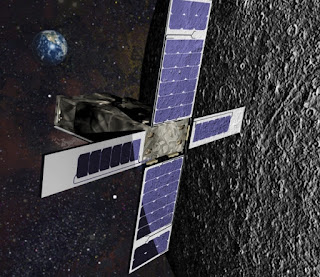
Lockheed SkyFire Cubesat
In 2018 the much maligned NASA Space Launch System will finally take off, delivering a test (unmanned) Orion capsule to lunar orbit and back, paving the way (one hopes) for an efficient dawn of the asteroid exploration (then mining) era.   Along the way, the Orion adaptor ring will deliver to lunar orbit 13 cube-sat  mini-satellites, opening a bold new era for miniaturized exploration, available to a far wider scientific and technical community.  Lockheed Martin announced a few details of its 6U CubeSat,called SkyFire. Lockheed's payload will capture high-quality images of the Moon. And in exchange for the ride into deep space, NASA will receive data from the mission. 

To be clear, I oppose the US taxpayers funding any near-term return to the (probably) sterile-useless lunar surface - for the time being.  But lunar orbit is extremely valuable! A space station there could do our asteroid mining experiments safely.  And that station could provide services to the European, Russian, Chinese, and billionaire-private efforts at landing on the moon. Charge the fools... I mean copycats... I mean brave explorers a nice fee.

Ever since the Obama Administration opened up launch services to competition, the United Launch Alliance’s monopoly on U.S. military and intelligence cargoes has been under threat, with Elon Musk’s SpaceX offering bids up to 75% discounted from ULA’s normal price. Oh but let's get those problems solved. Interesting times.

Aquila is Facebook’s solar-powered airplane designed to stay aloft weeks at a time and beam internet to remote parts of the world.

== Comets, Asteroids and more ==
  
Terrific! Hubble before and after images of Comet 332P breaking apart.

E-Glider concept, JPL
This promising concept from JPL: an E-Glider, or electrostatic glider that could maneuver around asteroids without expending fuel, in the electrically charged environment around an asteroid. Further research has been funded by NASA NIAC, where I'm on the advisory council.

NASA’s Asteroid Redirect Mission (ARM)  will demonstrate advanced, high-power, high-throughput solar electric propulsion; advanced autonomous high-speed proximity operations at a low-gravity planetary body.  Exactly what we should be trying to do. 

Rosetta’s mission to Comet 67P/Churyumov–Gerasimenko finally spotted the lost Philae lander. Pretty amazing photos reveal the lander tumbled on its side in a shadowed crevice, a fate long suspected suspected since it ran out of solar power soon after touch-down… or bounce-down. Ah well.  A lot of science got done anyway, verifying much of my doctoral thesis. (And some bits from Heart of the Comet!)  Thanks Europe!  Now onward into space!

And Rosetta's mission recently came to an end. After twelve years in space, and two years flying around Comet 67P, the orbiter crash took a final dive onto the surface of the comet on September 30.  Adieu, Rosetta! Mission Accomplished.

Like most sun-grazing comets, this comet was torn apart and vaporized by the intense forces near the sun.

Images from the Dawn mission provided evidence for a “fairly recent” salty water/mud volcano on Ceres. 

== Outside the Solar System ==

Interesting item. My comrade Stephen Baxter’s 2013 novel PROXIMA seems to have predicted almost every aspect of the newly discovered earthlike planet “Proxima b” orbiting our neighboring star, Proxima Centauri!  Lee Billings' writeup in Scientific American offers you a generous excerpt!  The James Webb space telescope, scheduled for launch in 2018, may provide more information. 

The mysterious dimming of “Tabby’s Star” – both periodic and secular, perhaps across the last 100 years – has both amateur and professional astronomers peering at old photographic plates and new Kepler data to seek possible explanations.  And yes, “alien constructions” are still on the table!  Though you have to make some assumptions…

Biggest galactic map may throw light on the nature of 'dark energy,' -- and fascinating echoes of the formation of our universe of galaxies with hints at the behavior of both dark matter and dark energy. All from the biggest and most detailed galactic mapping, ever.

The Future First series of brief online tech-shows is a credit to Popular Science, well edited, informative and on target. This one — “Where are all the aliens?” — starts with my description of the Fermi Paradox or SETI Question, then segues to Jason Crusan, director of NASA’s Advanced Exploration Systems. Such cogency, charisma and… science!

Directed Energy Comms and SETI/METI: UC Santa Barbara physics professor Philip Lubin — "The Search for Directed Intelligence" appears in the journal REACH - Lubin is a scientific advisor on Milner's Breakthrough Starshot, which is using his NASA research as a roadmap as it seeks to send tiny spacecraft to nearby star systems.

Of course mysteries remain... as explained in The Unknown Universe: A New Exploration of Time, Space and Modern Cosmology, by Stuart Clark. A look at how the latest discoveries are shedding light on the formation and evolution of the universe.

Send a fingernail sized digital archive containing human knowledge. Profs. Lubin and Bradshears, in this (unsuccessful) Kickstarter campaign, aim to create the world's first "Space Time Capsule" - a Humanity Chip, a custom semiconductor memory device that can be attached to the small, wafer-scale spacecraft that are part of DEEP-IN and other directed-energy concepts. This chip will contain volumes of data, including tweets, media files, and even the digital DNA records of all those who want to take part in the mission.

There, that was a lotta space stuff!  It oughta hold you across the weekend. And maybe convince you to tell every single grouch out there... and they are rife in the FAR left and the ENTIRE right... to get bent!  There is zero justification for gloom!  Every bad thing you hear is either exaggeration or else reason to step up in confident problem solving mode.

Because we are mighty beings, citizens of a spectacular civilization that can do a lot!  And the gloom merchants can go to hell.