Despite the War on Science and the War against Professionalism -- and the deliberate fomenting of struggle between professionals and amateurs -- it is still possible to see a civilization forging ahead in countless directions!
Read on for a list of fascinating items from the frontlines of science and technology...
First a brief puff. I’m told that the wonderful old Dreamcast game - Ecco the Dolphin -- has been re-issued as a downloadable for the Nintendo Wii. It happens I wrote that game! Or... at least, I wrote the storyline and scenario and introduction. I admit that the other stuff -- like graphics and game-play -- are also terrific. Under-rated as all get-out. (Somebody report back here if it still has the same, lengthy/lyrical introduction?)
The WorldChanging site has an offering by Alex Steffen appraising the harm done by our sprawling suburban lifestyle, and tabulating the argument for higher urban density, in cities where people simply don’t need cars, or anywhere near as much concrete. (Hint... don't raise this with your favorite "ostrich." Attacking suburbia is not a win-win issue, yet.)

From the same idea-generating program (run by my friend Tom Munnecke) see a fascinating “apology” by Mark Friesse to Tim Berners-Lee for having rejected TBL’s original paper on the potential of a URL-based Web.
More affordable solar energy? Energy from fusion? Reverse-engineer the brain? Those three are among the 14 "grand challenges" for the 21st century announced today by the U.S. National Academy of Engineering (NAE).
The NAE's web site has descriptions of all 14 challenges leaving it to the public to vote on which should be given top priority. Rather than focus on predictions or gee-whiz gadgets, the NAE said the goal was to identify what needs to be done to help people and the planet thrive. (Thanks Bandit)
-----
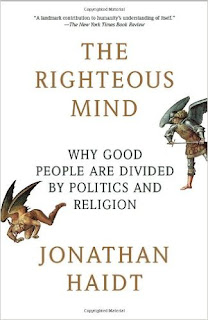
There is also much that Haidt misses! For example, I think Haidt underestimates the way older, solidarity-loyalty conformity-purity imperatives still influence liberals, and especially leftists (an important distinction!) Possibly because his research questions are biased toward older rather than newer forms of group identification. (If he'd asked questions about purity in terms of food rather than sex, the conservatives would have been impure, the liberals obsessed with purity! Likewise, liberals... and especially leftists... have their own “in-groups” and authority figures. Indeed, his oversimplifications abound and miss, I believe, a profound separation in personality between (on the one hand) indignation-junkies of the far right and left, and (on the other hand) the more frontal-lobe-driven variety of liberals and conservatives.
Recall Hillary Clinton’s book “It Takes a Village” (to raise a child)? That seems to be a “lattice world” statement and the right wing response “No, it takes parents!” was resoundingly atomistic.
Above all, what Haidt is missing is the perspective offered by looking at how liberals and conservatives differ over the matter of “horzions.” Horizons of danger, inclusion, opportunity and so on. I believe that it is just as likely that you can separate liberals and conservatives according to how they feel about the process of horizon expansion, with liberals pledging fealty to that general process -- often at the expense of older group loyalties (like the nation) -- while conservatives reacting with deep suspicion toward horizon expansion and fetishistic inclusion while touting reflexive loyalty to older in-groups.
Nevertheless, Haidt provides five extremely useful metaphors that help us grasp just how different the liberal enlightenment mentality is. Moreover, he is right that educated and thoughtful people in our civilization bear a responsibility to try harder, much harder, to understand the underpinnings of their own beliefs... and even their opponents. If we don’t try, then who will?
-----

----
John Kao believes the United States has an innovation crisis, and he’s calling on today’s corps of young technology professionals to sound the alarm. Citing technology pioneer Vannevar Bush’s assertion more than 60 years ago that “A nation that loses its science and technology will lose control of its destiny,” John Kao said the United States is in peril of becoming a technology laggard.
-----
...and an interesting... possiblyrelevant(?)... news item...
DVD in firefighter's coat blocks bullet: A South Carolina man is thankful for a DVD that ended up taking a bullet for him. Colleton County Fire and Rescue Director Barry McRoy says he was leaving a Waffle House restaurant in Walterboro on Saturday morning when two men ran in fighting over a gun. Police say a bullet hit one of the struggling men, shattered a window and then hit McRoy. The bullet hit a DVD McRoy was carrying in his pocket. He suffered a bruise but didn't realize he had been shot. As he told a police officer what happened he noticed a bullet hole in his jacket, the shattered DVD case and a piece of the bullet. The DVD was nicked. It was a gift from an employee who had recorded a TV show about fire extinguishers.
Um... any chance that it was my “Architechs” episode about future firefighting tools? Any conceivable way to find out?
-----
...and now a tech-news tsunami...
The demonstration site for the Implicit Association Test. (Someone try it & report!)
A space station astronaut does peculiar things with balls of floating water: (Thanks Stefan.)
A fascinating science blog entry about how rats use their whiskers to build accurate maps of their surroundings. A way-fun blog in-general!
When scientists found out that chimps had better memories than students, there were unkind comments about the caliber of the human competition they faced. But now an ape has gone one better, trouncing British memory champion Ben Pridmore. Ayumu, a seven-year-old male brought up in captivity in Japan, did three times as well as Mr Pridmore at a computer game which involved remembering the position of numbers on a screen. And that's no mean feat - the 30-year-old accountant is capable of memorizing the order of a shuffled pack of cards in under 30 seconds. The reason this is fascinating is that humans specialize in having a vast RANGE of abilities. The best human mimics can mimic other animal sounds better than any animal mimic, for example. For an average chimp to chomp a human champ into a memory chump, well... it indicates something deep and systematic.
In the race to perfect "regenerative medicine," stem cell therapy for animals is ahead of treatment for humans because it is not so strictly regulated. It's not experimental -- it's here.
Medicine’s dream of growing new human hearts and other organs to repair or replace damaged ones received a significant boost when University of Minnesota researchers reported success in creating a beating rat heart in a laboratory. But the researchers cautioned that the dream, if it is ever realized, is still at least 10 years away. The researchers removed all the cells from a dead rat heart, leaving the valves and outer structure as scaffolding for new heart cells injected from newborn rats. Within two weeks, the cells formed a new beating heart that conducted electrical impulses and pumped a small amount of blood.
Oy! Under the category of notions that attract dopes every generation... Bruce Bueno de Mesquita claims that mathematics can tell you the future. In fact, the professor says that a computer model he built and has perfected over the last 25 years can predict the outcome of virtually any international conflict, provided the basic input is accurate. What’s more, his predictions are alarmingly specific. His fans include at least one current presidential hopeful, a gaggle of Fortune 500 companies, the CIA, and the Department of Defense.
During an experiment originally intended to suppress the obese man's appetite, electrodes were pushed into the man's brain and stimulated with an electric current. Instead of losing appetite, the patient instead had an intense experience of déjà vu. He recalled, in intricate detail, a scene from 30 years earlier. More tests showed his ability to learn was dramatically improved.
The world's rush to embrace biofuels is causing a spike in the price of corn and other crops and could worsen water shortages and force poor communities off their land, according to a U.N. official.
But a biofuel startup in Illinois can make ethanol from just about anything organic for less than $1 per gallon, and it wouldn't interfere with food supplies...
...and bacteria into fuel uses 65% less energy than making ethanol.
The Toshiba Micro Nuclear Reactor mentioned in a previous posting does not exits! Apparently a hoax.
Just to show that all the liars out there aren't those we entrusted with power. There are scoundrels everywhere. And the only "disinfectant" - as Louis Brandeis said - is plenty of light.


109 comments:
A teacher writing a paper about moder education practice wanted to quote the following paragraph of mine, but had no citation point. I'll provide one here, even though I certainly posted it as part of a longer missive on education, some time ago.
"What had been the unsung glory of the American approach to education - something never measured in those international tests (on which U.S. youths score so badly) - is the way a tradition of open class discussion has fostered free thinking and rambunctious argumentativeness. And yes, confident creativity, to some degree. (At least among the upper half of students.)
"And here's a startling irony that illustrates the point. While we rush, rather thoughtlessly, to copy the rote memorization techniques that enable kids in in Asia and elsewhere to score so well on standardized tests, the education ministries in Japan, China and India are frantically dispatching minions into the field, exhorting teachers to "teach in a more American fashion," in order to stop squelching the creativity, imagination and argumentative confidence that we encourage (or used to encourage) so well.(1)"
Anyone know where this originally was posted? (I just tweaked it a bit.)
"The best human mimics can mimic other animal sounds better than any animal mimic"
I presume you are leaving out the lyrebird from this rather broad statement.
I originally ran into Haidt's "Five Pillars" theory not long after reading Altemeyer's The Authoritarians; I found the latter extremely compelling, and the former much less so (though still possibly a good starting point for further understanding). The theory that liberals actually have no sense of in-group loyalty, authority/respect, or purity/sanctity completely contradicts my experience of the many liberals I have known (bless their little furry hearts).
As for the atom vs. lattice model -- well, Dr.B poked a good hole in that one already, and I see a bunch more raising their hands and going "ooh, ooh, pick me!" but I'll leave them for another discussion if anyone really wants to hear about it.
I think Haidt was getting closer to the truth (albeit in a kind of euphemistic way) when he spoke about the belief that social structures contain embedded wisdom that you don't tinker with lightly.
In other words: we don't understand how it works, and if it stopped working we could be in deep trouble, so just leave it alone!
Once you break it down that way, the drivers seem obvious: ignorance (of how society works) and fear (that it is delicate and might collapse). {Fear of making mistakes} trumps {willingness to learn from error}.
Or, at any rate, that's *my* theory...
Yes, I was about to mention the lyrebird too.
Pentagon tells drunk-driving C student in Oval Office "climate change should be upgraded to a national security concern."
A secret report, suppressed by US defence chiefs and obtained by The Observer, warns that major European cities will be sunk beneath rising seas as Britain is plunged into a 'Siberian' climate by 2020. Nuclear conflict, mega-droughts, famine and widespread rioting will erupt across the world.
Latest polls show Obama up 57% to Hillary's 43% in Texas and 54% to 46% in Ohio.
Great news because the consensus now says Hillary must win both Texas and Ohio by at least 20% or she's history. I don't have the hate-on for Hillary some other folks do, but she's the wrong person for the Presidency right now. We need someone who doesn't practice politics as usual, and that means Obama.
(You may to register or use bugmenot.com to read this next one)
http://www.nytimes.com/2008/02/19/science/19carb.html?_r=2&ex=1361077200&en=d23ec5df5017adbc&ei=5088&partner=rssnyt&emc=rss&oref=slogin&oref=slogin
"If two scientists at Los Alamos National Laboratory are correct, people will still be driving gasoline-powered cars 50 years from now, churning out heat-trapping carbon dioxide into the atmosphere — and yet that carbon dioxide will not contribute to global warming.
"In a proposal by two scientists, vehicle emissions would no longer contribute to global warming. (..)
"The idea is simple. Air would be blown over a liquid solution of potassium carbonate, which would absorb the carbon dioxide. The carbon dioxide would then be extracted and subjected to chemical reactions that would turn it into fuel: methanol, gasoline or jet fuel.
"This process could transform carbon dioxide from an unwanted, climate-changing pollutant into a vast resource for renewable fuels. The closed cycle — equal amounts of carbon dioxide emitted and removed — would mean that cars, trucks and airplanes using the synthetic fuels would no longer be contributing to global warming."
Has anyone tried the Chimp-V-Human memory test with humans from non-literate societies?
That would be something worth testing, methinks.
Oh, BTW, I think Clinton is pulling an Edwards, and staying in to get donations to defray debt. In the last three days, we've had three comments from her about how the party would certainly be united before the convention.
I think we're looking at our first female VP, and the more I ponder, the better an idea it seems.
That paragraph on education reminds me of something you posted in 05 or 06. I'll dig in your archives and see if I can find anything.
Tintinaus: I would love to see a contest between a lyrebird and that mutant fellow who could mimic any bird -- or sound -- any time, anywhere.
Zorgon: Oh right, so let’s suck all the CO2 out of the air and make an ice age! ;-)
Jester: excellent point about non-literate humans, who had those bards... and also memorized detailed mental maps of hunting trails and water holes.
But save us from a Hillary Veep. Make her Ambassador to Londond and Bill to Paris (where they won’t notice shenanigens) and they can share a house weekends.
Wow, that trip into the archives brought back some memories. I saw everything from your fight with John Robert to the story about the teacher who wouldn't shave his beard until bin Laden was caught.
Oh yeah, and I found your posts about American style education.
From June 2005:
What had been the unsung glory of the American school system - something never measured in those international tests (on which Americans score so badly) - is the way open class discussion has fostered free thinking and rambunctious argumentativeness. And yes, confident creativity, to some degree. And here's a startling irony. While we run thoughtlessly to copy the rote memorization techniques that enable kids in Japan to score so well on standardized tests, the education ministries in Japan, China and India are exhorting teachers to "teach in a more American fashion," in order to stop squelching the creativity and imagination that we encourage (or used to encourage) so well.
Because science relies upon processes like imaginative hypotheses and laboratory experience that are hard to measure on tests, there has been a creeping de-emphasis on science across the board. My own kids see their science classes become the catch-all dumping ground, within which all the sex education, abstinence training, drug education, self-esteem, anti-bullying, and other remedial socialization topics are thrown. Even PE is spared this stuff, thus illustrating the way that sports have a vastly higher priority in American life than science.
From May 2006:
You cited this article (and the link still works): “Hong Kong’s South China Morning Post recently reported on South Koreans paying for U.S. couples to adopt their children so that they can gain access to Western education.” This illustrates a trend that I have spoken of for years. Unmentioned in the US press is the fact that - while we wring our hands and institute testing, in order to make American schools more like those in the Orient (e.g. No Child Left Behind) - similar handwringing takes place over there, yearning for education to be “more American.”
http://www.theglobalist.com/DBWeb/StoryId.aspx?StoryId=5265
Ecco the Dolphin, eh? So I guess the name must be a direct hat-tip to Lilly's off-the-deep-end Earth Coincidence Control Office stuff. I had always wondered.
Education -- my tuppence is that you need both the memorization and the disputation. You can't be usefully creative if you have to work from first principles or thin air.
Zorgon, good to see your logon working.
David, I haven't heard the man you are talking about, but since you are refering to him as a mutant it may be unfair to judge the whole of humanity based on this one indivdual. Oh can he do a chainsaw?
Well, the point of citing the Los Alamos CO2 proposal is to show that even though oceanic iron-dumping looks like a bust after detailed analysis, it's far from the only way of removing CO2 from the atmosphere.
Of course this new proposal may also fall apart under examination. They're talking about using nuclear power to get the energy to raise temperatures high enough to make this reaction work. That raises the question of the total carbon footprint for building nuclear power plants. We'd also want to use thorium breeder reators and those havevn't been fully tested yet. The there's the issue of toxic byproducts from the chemical reactions needed to turn the CO2-conatining postassium carbonate solution into usable fuels. There's also the issue of toxic byproducts from burning fossil fuels, which is something we really need to get away from entirely.
Carbon-composite fixed-body vacuum-enclosing dirigibles, electric light rail powered by electricity from nuclear plants, and electric cars represent a better solution long-term, along with redesigned cities and a slow (but sure) phasing-out of current suburbia in favor of either redesigned urban areas, distributed population in small towns connected by gigabit internet fiber, or (if we want to get visionary and all Paulo Soleri) some arcologies with hundreds of miles of parkland around 'em.
The point remains that the "Olduvai Cliff" Peak Oil doomsters, which predictably includes the Pentagon crowd, have a pessimistic view of human beings as stupid reflexive unimaginative creatures. Whereas the reality is that the human mind remains infinitely flexible, boundlessly imaginative and capable of the most astonishing feats of deduction and leaps of imaginative fancy building on previous discoveries, in an exponential progression which has few obvious limits other than the imperfectly understood laws of physics (as we know them right now).
My own take on the Peak Oil/gobal warming doom-and-gloom is that the solution is likely to arise from 15 different amazing new technological and scientific breakthroughs we can't yet imagine, because no one has thought of 'em yet. I suspect that looking back from 100 years in the future, generations to come will find themselves as amused by current worries about runaway global warming and Siberia in Britain and the mass collapse of civilization, as we find ourselves when perusing "expert" predictions from the 19th century that New York City would find itself hip deep in horse manure, and vast new surgical clinics would be needed to perform lung resections on all the tens of millions of new incurable tuberculosis patients by the year 2000.
Oh, and in case you thought I was being wildly overoptimistic and starry-eyed in the previous post, feast your eyes on this, buckaroos:
Yale lab engineers virus that can kill deadly brain tumors.
And you're telling me global warming or Peak Oil is going to wipe us out? Or even put a serious crimp in our style as a species?
Please. You think we've got technology and science and social enlightenment now, wait half a century. You ain't seen nothin' yet.
We're by no means finished, but "we'll come up with something, because we always come up with something" doesn't really cut it.
Humanity has been in the industrial revolution -yes, many peoples are just starting to experience it - for less time than the Viking colony on Greenland remained vibrant and thriving.
Many of us realize that hunting seals and fishing is a good idea, but we've got convince others rather than waiting for regular trade ships to start comming.
If they do, great, but let's learn to make decent harpoons from walrus Ivory while we wait, eh?
Jester, your pessimism is showing -- also the weakness of your straw man argument. Caricaturing my claims as "we'll come up with something because we always do" misrepresents what I said in 4 important ways:
[1] I provided at least 3 practical realistic ways of avoiding an Olduvai Cliff catastrophe, and suggested that there were potentially many more using current well-tested realistic technologies (which happens to be true);
[2] Our global warming problems are human-created, and, unlike the faulty analogy of the Vikings in Greenland, are therefore all potentially human-solvable;
[3] I explicitly acknowledged potential problems with the Los Alamos solution, but realistically pointed out that we seem able to generate hypothetical solutions faster than the problems get worse, unlike the case with the Vikings in Greenland;
[4] Lastly, I pointed out humans have always had this capacity, which does in fact set us apart from most other creatures on this planet. So in that sense, to take your challenge -- exactly, yes, quite right: we'll come up with something because we always do. That's what sets humans apart evolutionarily from other animals. We are uniquely adaptable. Change other animals' environment and they flounder or die. Plunge a uniquely adpatable human into an Ice Age, or toss us into the middle of the Sahara Desert...and we still survive. In fact, that aspect of our evolutionary heritage is precisely what has created our current climate problems -- there are so damn many of us humans, precisely because we're so good at adapting and surviving in an insane variety of climatic conditions and this population increase is what's mainly responsible for our current greenhouse gas problem. So the major premise of your defective syllogism actually contains its own self-destructing internal contradiction. Thanks for arguing in such a way as to prove me correct.
Secondly, and even more importantly, your facts are in error. The industrial revolution is not 200 years old. In reality, the current exponential takeoff of technological innovation began around the year 1050, and, in medieval Europe, included such innovations as the water-wheel-powered blast furnace, the water clock, the three-year fallow farming system, and astonishingly sophisticated mining and ore-extraction technologies pioneered by the medieval Germans (although they weren't really Germans, since the entity we call "Germany" today did not then exist).
See The Medieval Machine: The Industrial Revolution of the Middle Ages by Jean Gimpel, 1992, for more details.
Before you post these kinds of provably false claims that "Humanity has been in the industrial revolution...for less time than the Viking colony on Greenland remained vibrant and thriving" you'll want to brush up on your history.
Seems to me that (one or both of) the following two technologies will eventually solve the transportation problem:
1. AI-driven street vehicles (think "Johnny cab" from Total Recall, only less idiotic). Cost-of-entry is minimal, as no significant new infrastructure is required and they can be deployed one vehicle at a time to meet needs, so even small towns could have a few (perhaps starting with private entrepreneurship). Cities will deploy fleets of them, leaving individuals with all the freedom of personal vehicle ownership without the hassles. We don't even need to get rid of suburbs, though people may find it convenient to live closer to where the cabs hang out. Community parking lot acreage can be vastly reduced, as unused vehicles can be stacked in a garage/warehouse near the maintenance facility.
This eliminates the need for most people to have a "general purpose" personal vehicle capable of longer trips; some people will still want to have such, but they will be primarily "recreational use" and will constitute a much smaller footprint in terms of energy use and carbon emissions (for those still burning hydrocarbon fuel). The "cabs" can be specifically for shorter-range transportation, and hence can make use of battery power (even if there are no further improvements in the tech, which seems extremely unlikely).
2. I'm less certain of this one, but I keep coming back to the idea: automated tunneling and digging (some AI probably required so the machines can do "manual" tasks which currently require a worker's actual hands).
Why is it so expensive to dig subways and subterranean living spaces? I'm sure there's a lot of engineering involved to make sure the structure doesn't collapse or fill up with groundwater, probably a fair amount of energy (shovels and blasting and lifting/hauling debris) and of course the excavating equipment is expensive -- but it seems to me that the primary expense must be the human workers, who must be more skilled than average construction workers and are also in considerably more danger (hence hazard pay and higher insurance rates).
What happens to the cost of, say, digging a uniform-sized tunnel on a pre-set course when you can put (say) $1,000,000 worth of machinery down there to do the actual work, plus a shared supervisor off-site (keeping an eye on several projects), plus a group of engineers and other top experts on tap for helping with any really tricky problems that come up? You don't have to worry about cave-ins trapping/killing people, just equipment. Your cost is the interest on the equipment loan, insurance for the equipment, insurance against incidental damage (sinkholes? accidentally knocking out a buried pipe? not sure what the risks are), plus fuel and maintenance expenses, plus part of the supervisor's salary and the engineering group's consulting fee.
Now maybe this isn't feasible; I don't know. But what might happen if, via this scenario or any other, it became much, much cheaper to dig underground structures -- like, say, subway tunnels? Might smaller cities be able to afford subway networks corresponding to a substantial portion of their existing street networks, with a stop in every suburb and shopping center? Might we be able to run train tracks underneath all major highways, offering (at last) a true alternative to cars and planes for long-distance travel within the US? (Yeah, the scenery might be dull... but I'd still take 5-10 hours of being able to do light work, reading, or sleep, over driving the same distance. No worse than your typical cube-farm job. The trains would have free gigabit wifi, of course... and being largely underground, they could probably be extremely fast -- so a 5-hour car trip might be only 3 hours with station stops, or less for an express.)
Another significant point might come if it became cheaper per foot to build down than to build up or out.
This leads to some very SFnal scenarios, of course, where only the rich get to see the light of day much. Very Asimov (capital-d Doors, and Caves of Steel).
(And I've probably lifted both of these ideas from somewhere-or-other... but at least #1 seems like a very realistic likelihood for the near future, and not one that I see discussed much.)
Zorgon:
I think you’re equating technological innovation with the industrial revolution. Technological innovation has been going on a long time (the water clock, for example, goes back to ancient Egypt and ancient Mesopotamia), but the industrial revolution is surely a more recent and distinct event? While it is a product of technological innovation and remains connected with it, the industrial revolution refers more specifically to mass production and the replacement of manual labor with machines.
Now to something unrelated:
Here’s a piece on Russia from the Sunday Times. The writer Jonathan Dimbleby makes the argument that Russians do not share Western values of democracy and transparent government but prefer national strength and are ruled by paranoia. A point Dr. Brin made in one of his articles on his website I believe.
Thank you for mentioning my Star Wars critique, David! "Hilariously-scholarly" reminds me of humorist Sandra Boynton's self-definition as "warmly ridiculous" (*laughs*). There are a few more essays about science and culture along the same spirit here, in the Stories and Blog sections: Starship Reckless
Personally, I think that the optimum combination is thoughtful implementation of technological innovation interwoven with a lattice society (shorn of its tyranny of custom). Atomism violates a deep human biological need. We are fundamentally social, an attribute that has not changed since Homo sapiens first arose.
Google is your friend, people.
http://www.google.com/search?client=safari&rls=en-us&q=brin+%22teach+in+a+more+American+fashion%22&ie=UTF-8&oe=UTF-8
One thing that we as a species needs to focus on is on creating an inexpensive and efficient method of transforming seawater into potable (and decent-tasting) drinking water. The wars of the future may very well be fought over water... and water rights could eventually risk tearing the U.S. apart as coastal regions demand their fair share of water, while inland regions use more and more water to grow crops and help their own infrastructure.
Should a method of large-scale treatment of salt water be proven viable... then coastal cities will likely start using the world's largest source of water for its own drinking needs and in turn assist in food and other assorted needs... indeed, with viable irrigation for the interior and water purification on the coasts, the green footprint of countries will grow and carbon consumption will increase. This in turn will help in lowering the amount of carbon dioxide in the atmosphere.
------
Google has created a contest to encourage private industry to send a probe to the moon. I must admit I've been putting my own mind to the issue. The primary problem is that the prize money will not defray the traditional costs of sending a probe to the moon. So I've been considering methods of breaking Earth orbit... and in turn pushing outward to lunar orbit.
One possibility is using one of the new materials that I recall hearing about that was being bandied about for use in weather balloons because it was far stronger than traditional materials, and could make it to the uppermost levels of the atmosphere without bursting. From there, far less fuel is needed to break to a low Earth orbit, which significantly reduces the cost to get into orbit to probably a couple million dollars (though don't quote me on this, I'm just brainstorming and don't have precise details available).
From there, the use of a solar sail could be used to push a probe slowly into a larger orbit, eventually using the sun's own energy to propel the probe to the moon. It would be tricky and needs precision calculation to ensure the probe reaches the Moon at the right time... but it would cost far less than traditional chemical engine propulsion.
The final problem would be in landing the lunar probe. In that, a possibility would be in using a page from NASA's landing probes on Mars... in essence, airbags to "bounce" the probe, lessening the amount of fuel needed to soft-land the probe. In addition, it may be possible to try and use the solar sail in tacking the probe around the Moon, using the Moon's gravity to encourage landing, but solar radiation as a boost to help slow descent onto the Moon's surface. In short... a landing that utilizes minimal fuel.
I've not considered the probe itself, but considering the number of universities that work on robotics and the like, once the calculations are done on getting a probe to the Moon are complete, gaining access to a probe would be undoubtedly far easier.
But I'm just the idea man. The actual viability of this scenario is probably low.
Robert A. Howard, Tangents Reviews
Thanks Kelsey.
Steve said "Education -- my tuppence is that you need both the memorization and the disputation. You can't be usefully creative if you have to work from first principles or thin air."
Have you ever heard american teens argue? We have bred a generation of lawyers, who can win any argument... based on zero knowledge.
Z: welcome back to the land of modernist-optimism! Now to cheer up that grouch, Jared Diamond.
Dig this. I've been touting Periclean Athens as the one candle in a long darkness before our Enlightenment and industrial revolution. And a weak candle at that. Oh, and I guess the Renaissance. But ponder this. In 2700 BCE, the entire Egyptian civilization built only with mud brick and straw. By 2500, the pyramids had been completed, all of them.
W: Right on. Tunnel-digging is a huge item. I fantacized tuning microwaves (masers) to bust the SiO2 bond like a scalpel, instead of brute force heating....
Athena! Thanks for dropping by! You are welcome here any time.
Robert, solar sails don't work till you get beyond mid-earth-orbit or MEO because of the Van Allen radiation belts and residual atmosphere.
What DOES work very well in there is the electrodynamic tether I describe in Tank Farm Dynamo. See:
http://www.davidbrin.com/tankfarm1.html
It's not intuitive. But solar power panels plus a long conducting tether, plus a simple cathode emitter... and you can cruise around MEO at will!
Above which, THEN a sail could unfurl. My rare collection PROJECT SOLAR SAIL tried to raise funds for a lunar "sail regatta" to commemorate Columbus, in 1992. Didn't happen.
Separate matter: You may have heard that Sky Horizon is up for a Hal Clement Award. I feel deeply honored to be in such company.
> > Sky Horizon, David Brin, ISBN 978-1-59606-109-5
> > Reap the Wild Wind, Julie E. Czerneda, ISBN> 978-0-7564-0456-7
> > A War of Gifts, Orson Scott Card, ISBN> 978-0-7653-1282-2
> > True Talents, David Lubar, ISBN 978-0-765-30977-8>
> Righteous Anger, Lynda Williams, ISBN> 978-1-894063-38-8
Of course Sky Horizon is at a disadvantage being a special, limited edition. I should seek some way to let the voters know how to get copies. If necessary, I could supply PDF copies... Anybody know any of the voters?
David's been touting magnetic tethers for years. I noted it was being proposed for future space probes to Jupiter, where they've got plenty to push against!
RH: attach a large weight at each end of your tether and the gravity gradient will do the rest.
Nice to see Zorgon's firing on all cylinders (or should that be solar panels?). I agree we muddle on through (civilisation being an emergent property of the system called h. sap), but we still have to do the muddling.
200 years eh? Interesting what putting the fear of God(s) into the population can achieve! Snark aside, what happened to give the Egyptians the resources to do all that ?
Alfred might be considered another weak flicker in the gloaming. Burning the cakes was just the entree. He then went on to halt the Danes, overhauled the saxon legal system, and raised the general standard of learning and literacy.
But, you know, kings: they come and go.
Speaking of candles, sorry to light the murky wick. In a proportional voting system I would laud Nader's recent candidacy announcement. As it is (and considering I think his popularity is left of centre), I have four questions:
1. Why didn't he run in 2004?
2. Given his rant about big business interests, why does he wait until 'grass roots' Obama is looking increasingly likely to win dem nomination?
3. What has he got against the dems, anyway?
4. What have the puppet masters got against him?
(Of course, it might just be a case of those with predictable reactions attracting predictable stimuli...)
@ Tony
To answer your questions about Nader.
1: He did, but didn't get as much attention that time.
2: He usually announces that he's running once the candidate for either party is pretty much decided. In 2004 he announced that he was running in February too.
3: He has said that Republican party and Democratic party are the same in that they are both corrupt and don't represent the people. Plus he blames Democrats for not stopping the Iraq War
4: He only runs for president and has no chance of winning. If he actually wanted to change the way government was run, he'd try to get elected as a representative or a senator, or he'd offer to be one of Obama's advisors (Obama thought of him as an heroic figure). He's egotistical and uncompromising.
There are also Democrats who think he gave the election to Bush in 2000, but I consider that point irrelevant now. The Democratic Party should be able to win this election in a landslide with or without Nader. And if they want to prevent a repeat of 2000, they'll fix the winner-take-all system.
Since we are listing candles in the dark, it may do to remember the almost-always-forgotten Byzantium, that held the gates for one thousand years, introduced much knowledge to both East and West (its own as well as that of ancient Greece and Rome) and brought alphabets to the Slavs.
According to Senator Obama, Nader contacted him several times and stormed off in a fit when his policy advice was taken with a polite "Thank you for your input". Senator Obama of course said all of that much more politely.
Nader won't sap squat from Obama if he's the nominee. He could probably take about 1-2% from Clinton.
At this point, I think Kucinich could do more damage as a third party candidate.
Nader really ought to chill and take a position as a Consumer Protection czar, but he likes peeing into the tent too much.
___________
Zorgon, the Antikythera mechanism dates to 100BC, and I know all about Babbage, but the "computer age" still starts in the 60's.
We'll always come up with something, untill we don't. Then a couple billion people - at least - will die. Nothing short of a massive comet is going to wipe us all out, we're a resourcefull and adaptable breed to be sure, but excessive confidence in the idea that "someone or something will save us" is a path to destruction on a grand scale.
We're going to have to make some hard choices, and change the way we live, or we're going to be in a world of shit for a couple of hundred years. The longer we delay making those choices, the worse it's going to be.
Tinkering on a grand scale with a life support system we don't really understand makes a lot less sense than giving up our habit of pooping in the air vents.
We've got the technology we need to massively reduce our CO2 out put.
We know how we need to change our lifestyles.
Some genius farm boy might invent sustainable cold fusion tomorrow while out riding a tractor. After all, that's basically how we got television.
It's sure not something to bank the lives of a few billion on, though.
Calling an attorney! Dave Wright points to a toy company offering one of my Traeki for sale!
http://www.courant.com/business/custom/consumer/hc-toyprices0224.artfeb24,0,6107840.story
Look, I know there were many periods of progress in history. Much was done in the Hellenistic period, including batteries. The Song Dynasty was China's best. Hadrian had his good points. But these weren't systematically seismic. They did not reverberate changes in the very way that humanity looked at itself and the universe. They are impressive, but second-order.
Nader could have one benefit. With him screeching the dems and goppers are the same, it might be harder for Bloomberg to attempt a silly-ass run for the center, crying out that the two parties are "too polarized. Especially with the electorate already having chosen the least biliously partisan in each party.
Still, big money may push Bloomberg, as a way to bleed the dems. (Remember months ago, when it looked as if November would feature THREE NEW YORKERS going head to head?)
Has anybody done a full investigation of how much money Nader gets from goppers, whenever he runs? There have been a few news stories.
Then there is the third type of 3rd party run. The George Wallace wing. McCain may feel he has to pick a rightist veep (not the uncontrollable Huckabee) in order to forestall such an insurrection. But that would be a terrible mistake, even so far as possibly endangering his own life.
For his sake, and ours, I hope he chooses a moderate statesman, instead. (1) because it's responsible, (2) because it would make him no longer a prime "martyr candidate", (3) because it would let him go for the center and draw back the moderates who are fleeing to Obama, actually reducing Obama's overall vote count (though not his margin), (4) because he would thus lay a seed crystal for a new Republican consensus that rejects neoconservatism madness.
And (5) because it WOULD cause a far right secession, doing the country (and the reborn GOP) great good, but dooming his chance of election. (It is doomed anyway.)
It is my dream happenstance, since at that point, McCain could enter the American pantheon as a Weldell Wilkie type, who mattered far more than most of his fellow citizens would ever know. Deserving our honor and gratitude.
It could also keep him alive.
Alas, fear of that insurrection, plus fantasies of the White House, will make him pick some awful person. And while GOP unity will reduce Obama's margin a bit, it will vastly increase his vote total.
The effect, either way, will be a blow-out... unless a convenient national disaster happens. Or Obama slips back into smoking or some other filthy habit. On stage.
Of course, all of the above is moot. One of you convinced me. It will be Condi.
Shudders.
Hola Athena, your article on Star Wars was excellent. It makes me want to keep my children from watching it. Well, that and all the other appalling things Star Wars offers.
Do you keep a blog yourself?
"The best human mimics can mimic other animal sounds better than any animal mimic"
I presume you are leaving out the lyrebird from this rather broad statement.
Depends... Do the Humans get to use the tools they were able to build with their huge, succulent brains?
------------------------
Have you guys heard of the Launch Loop, a proposed alternative to space-elevators that requires no revolutions in material science or physics to build?
A steel cable stretches 2000 KM across the equator, 80 KM high and touching the ground at the endpoints. The whole thing is held aloft because the steel cable is circulating (it doubles back along the same path) at 14 KM per second within a vacuum-sealed sheath, and the two are prevented from touching by magnetic levitation. The upward force is provided by momentum transfer as the sheath curves earthward during its ascent. Payloads (with almost entirely plywood/plastic launch vehicles!) are accelerated to an appropriate velocity using magnetic forces on the circulating cable.
There are some introduction slides here (PDF).
#1 Oops! (Check the facts, Fisk!)
#2 OK. It still looks suspiciously like Nader doesn't check his facts either (to see what it is he's railing against).
#3 A rhetorical point, but thanks for answering.
#4 ie the 'spoiler' label sticks (Huckabee likes him!). Being egotistical and uncompromising suggests he's easily manipulated, primed and pointed. I hope it doesn't matter, Still...
Lyrebirds make pretty good camera motors, too (In the days we had such things)
Nope, Alfred wasn't seismic. He was part of a gradual, progressive shift, however, which set the scene for such punctuations as 'the enlightenment'.
Launchloop: on first (brief) look, I'm afraid I'm too thick to see it! I don't even see how it stays up! (centripetal force? If so, what about the effect of the return section of the cable moving counter to the Earth's rotation?)
I do like the buffers on the trolleys, though! Quaint, at those speeds!
The Launch loop appears almost at a throwaway in some 25-year old papers from the JBIS on "Orbital Ring Systems and Jacob's Ladders".
And, David, note my qualifying adverb "usefully" -- when it comes to engineering, facts beat rhetoric.
A launch loop of a sort also appears in Robert L. Forward's novel Starquake.
Meanwhile, the original post contains the phrase "Had enough about Star Wars? Or want more? Here’s an essay" where it seems it should instead say "Had enough about Star Wars? Or want more? Here’s a 404". :P
Another launch loop appeared in the anime series "Bubblegum Crisis 2040" though the anime's English dub billed it as a space elevator. Looking back at the anime and at these schematics, and it seems likely it was a launch loop.
Rob H.
Dr. Rice doesn't want to run for elected office. She's done everything short of lighting her hair on fire and running through the halls screaming "No"!
I'm sure she has her own reasons, and I suspect there are things in her past that would make her a greater liability than any of us realize.
David, thank you for the warm welcome!
Derek, I'm glad you liked the Star Wars critique. I do keep a blog at www.starshipnivan.com/blog/. You can find more of my essays at www.starshipnivan.com/stories/ and www.toseekoutnewlife.com/portfolio.html.
Athena,
Another perfect example for your Snatchismo essay - Rob Roy in the 1995 film, played by Liam Neeson.
You've got some great stuff there.
Brief foray into politics: Is Senator Clinton's allegations that Senator Obama would be another Bush in terms of foreign affairs going to torpedo any hope of reconciliation within the Democratic party? I mean, it seems lately that evoking comparisons of the Shrub is much like invoking Hitler and/or Nazis in internet arguments. In addition, Clinton's allegations are off the mark, considering that Obama was on the Senate's Committee on Foreign Relations, whereas I cannot recall any foreign relations experience with the Shrub.
It seems like the Clinton campaign is starting to flail about and causing damage to itself and to Obama without considering the ultimate consequences. I halfway suspect that we'll be seeing some of the Democratic leadership taking Clinton aside and quietly telling her that she's lost their approval and that they're backing Obama.
Indeed... if the vast majority of the Superdelegates swung their vote over to Obama right now, then once the March primaries are done, Obama would likely wrap up the nomination. While the Superdelegates stated they wanted to wait it out and do the will of the people... it might be necessary to rally behind Obama now to minimize what damage Clinton does rather than wait to see if the will of the people for the rest of the country lies with Obama.
Rob H.
Jester said:
"Another perfect example for your Snatchismo essay - Rob Roy in the 1995 film, played by Liam Neeson."
You are absolutely right! How could I have forgotten him? I must revise my essay!
Here is an interesting article on Obama's advisers that should make David feel good: The Audacity of Data
Barack Obama's surprisingly non-ideological policy shop.
...
Cutler told me Obama is adamant about consulting bona fide experts. "The staff kept saying, 'What he wants to know is that he's really talking to experts in the field. When you go see him, you know, make it clear that you're an expert.'" When it comes to economics, it's very difficult to achieve expertise without an academic background. It's a field that prizes rigorous results, supported by reams of painstakingly sifted data.
...
In economics, it's the academics who are first-rate engineers and the nonacademics who are either dreamers or technicians. In foreign policy, it's often the practitioners whose engineering prowess stands out. And so it's no surprise that Obama would attract the latter.
...
I have been indulging in a guilty pleasure lately and I thought I would share:
Tell a republican friend that Barak has made a deal with Hillary, if she bows out, she gets nominated to the Supreme Court. Their heads explode shortly after ;-)
occam's comic
Take a look at the Norwegian Doomsday Vault!
http://green.yahoo.com/news/afp/20080224/sc_afp/norwayarcticenvironmentwarmingcrops.html
It a series of three crypt-like structures intended to store samples from all varieties of all earths crops. It was carved into the limestone under the permafrost, a mere 600 miles from the north pole. It is kept safe by airtight seals, armed guards, and polar bears.
Sorry, reading it really brought out the DnD player in me.
The problem with the launch loop as shown in the slides something not mentioned in detail. Before you can get a payload on the "West Station" end of the track you have to get your cargo up 80km(270,000ft)! A lot of energy will be needed to get things that initial distance.
It may be simpler and more efficient in the end to build the space elevators (ala Vanilla Needle in Sun Diver or Arther C Clark's Tower of Kalidasa's in Fountains of Paradise).
Occam please!!!
You just canceled out ALL of my "arguments to rouse an ostrich"! Just tell an ostrich that scenario and bang! Head will explode and the new one they grow back (a la Men in Black) will be more troglodytic than ever.
Yes, I know it's satisfying. But please DON'T SAY THAT!
(In fact, she's smart and would probably not do badly. But no. Keep her in the Senate. Send Bill to Paris. Everybody's happy.
tintinaus: Actually, my Vanilla Needle is EXACTLY what would made the launch loop work. It can get cargo balloons up to near that altitude!
You know, one of the things that bugged me the whole time about episodes I-III was the complete lack of a Han Solo character.
That, and Anakin just got really annoying.
The whole "chosen one" character in so much fantasy (and I count Star Wars as fantasy) just made me feel left out as a kid. I liked the movies, but I couldn't identify with the hero.
Now, Indiana Jones on the other hand... not only is a regular guy with no special powers (and, if you've seen the trailer for the new movie, he gets old) but, hey, he's a friggin' scientist !
Oh, I don't know... young Obi Wan had a certain level of swashbuckling to him.
('This.. is not good!')
Jar Jar Binks was a pretty decent pilot... of submarines
As for whip wielding scientists... 'cracking tongue, Jar Jar!'
(No! This is *not* good!)
(Admit it , Matt! You're just another Harrison Ford fan ;-)
Harry's the man, I hope I'm half as cool when I'm 60 something.
I grew up on MacGuyver too, between Indy and Mac there was always hope that us geeky guys could grow up to be cool action heros. Of course, it didn't work, but I can dream.
Matt, you're MY hero... for saying dat stuff.
See, I could never believe Indy as a scientist. He never treats any of his finds the way a respectable archaeologist would. Even when he isn't on the run from nazis and cultists he just wants to run in and get the treasure.
For a laugh, read BACK FROM YET ANOTHER GLOBETROTTING
ADVENTURE, INDIANA JONES CHECKS HIS MAIL AND DISCOVERS THAT HIS BID FOR TENURE HAS BEEN DENIED.
http://www.mcsweeneys.net/2006/10/10bryan.html
McGyver was cool, but eventually I learned that most of his stuff didn't work, and my dreams were crushed.
Dr Brin I was never sure how your tower operated. I don't remember there being any mention of the mechanics in Sun Diver and if you wrote about it somewhere else I must have missed it.
Doing a search on the space elevator I found the LiftPort Group who state their goal is to provide the world a mass transportation system to open up the vast market opportunities that exist in space, many of which haven't even been imagined yet, to even the smallest entrepreneur. These new markets can only become viable through safe, inexpensive, routine access to space. Our motto is, "Change the world or go home," and we strive each day to make that change a reality.
Here is the link to their disertation about the Space Elevator
@tintinaus
On page 18 in the overview, it mentions the west-station has an elevator to hoist up the cargo. (I don't know if this is the 'detail' you wanted, though). I can't imagine it being more or less efficient than a space-elevator.
Honestly I wish there was a brinopedia out there somewhere, so our host could explain some of his ideas outside of prose. "The Vanilla Needle worked by . . . "
Another example was Kiln People. To this day I'm fuzzy on how civil liens worked. Or what national boundaries existed. Stuff like that.
Well, now, Z... I like to leave lots to the imagination. In any well-textured universe, the more interesting stuff you reveal... the more threads lead off in fresh directions!
But the Needles are pretty simple. In Equador and Kenya, the Vanilla and Chocolate Needles are hollow spires held up by internal air pressure, kept pumped by atomic power plants at the base. High pressure not only keeps them rigid and tall, but lets cargo balloons rise upward very high and efficiently.
At the top you can meet a launch loop... or send out rockets. Or meet a whirl-tether that swoops down to snatch cargos. (Best method. The Launch loop really is quite silly. Fun, but silly.)
Still...a better wiki-brin wouldn't be a bad thing when it comes to trying to remember who was who in the vast Uplift Universe.
Of course, I could just gather then all up again and read through them in one swoop. I read them as they originaly hit paperback, a few years apart.
Also, while I know this isn't the "Stroke Dr.Brins Ego" site, thanks for not going all David Eddings and just pumping out an Uplift book every year to pay the mortage.
On tunneling, IANA geologist, but --
The price of tunneling depends *drastically* on local geology. For instance, the Chunnel was practical because the boring machines were passing through the Dover chalk layer the entire distance (and thus hardness, hydrological properties, etc.) were assured.
Contrast this to Boston's Big Dig, which cost about the same amount to tunnel a mere mile and a half... because that mile and a half was composed of swamp loam and garbage fill from 17th century Boston, about the worst possible material to tunnel through. $15B and engineering marvels galore... but the thing *still* leaks, and probably always will.
The inconsistency of the Earth's surface means your tunnel engineering must adapt constantly to local conditions. I suspect tunneling is much easier in those rare places where the parent material is soft, waterproof, above the water table, and identical for hundreds of meters in all six directions. Such places are not common.
To give just a taste of why it seems to ridiculous to me to be pessimistic about the near human future right now, let me blue-sky it with five technologies which right now are well under development, and not "lab tests" or "theories," but at present solid and workable and practical:
[1] Biotechnology. Freeman Dyson has suggested that very soon we'll simply bioengineer plants to generate fuel as we need it. Want electricity? Bioengineer organisms to generate that too. Need super-strong composite nano-materials? Bioengineer a critter to produce it.
[2] Fabricators. Both Bruce Sterling and Cory Doctorow have recently written stories about what happens when we get cheap mass-produced washing-machine-sized widgets that take in cabron nanofibers and fabricate...well, anything you want. Need a laptop? Fabricate it. Want food? Print it out. Need a new heart for a trasplant? Print it out. Captitalism goes away when fabricators become widespread and factories disappear. This sounds like wild science fiction, but fabricators exist now, albeit using cheap plastic. Printers are now being used to print out human cell cultures, laying down the basis of new organs. Look ahead a few years, and when we move from plastic to something more durable, and then add dopants for room-temp superdonducting pathways, you'll soon do away with factories entirely. Everybody becomes wealthy. Want something? Fabricate it. Hungry? Print out dinner.That changes the game entirely.
[3] Radical new living arrangements like arcologies. The first mini-arcologies are being built right now, in Moscow. 10,000 people will live and work in Crystal Island. Scale those up, and you eliminate a lot of he problems with suburbs, transportation, etc. Paolo Soleri and Bucky Fuller both foresaw this long ago, and proposed truly huge arcologies. Once genetic engineering gets cranked up, why couldn't we grow our houses? Bioneingeer in the waste reclamation facilities and thermoelectic and photoelectric comopnents, plus organic insulation and air conditioning.
[4] New materials. We don't now have materials strong & light enough to produce a space elevator, but we will eventually. Materials science continues to advance at a breakneck pace. Soon, we'll be able to create much higher-compression car engines that are much lighter because they'll be made out of composites, not steel or aluminum, and the shells of cars may be harvested from plants bioengineered to produce super-strong ultra-lightweight "smart" materials that change their properties drastically in response to the environment. A sufficiently streamlined vehcile, something like Buky Fuller's Dymaxion car, could easily attain 90 mph using today's technology and transport one or two people, but use less than 1% of the energy currently burned up on hauling around heavy steel and cutting through huge wind resistance.
[5] Radical new air and sea transportation technologies. The most ingenious idea I've seen for air travel (can't find the original URL) was proposed by a NASA scientist who suggested pumping air out of a lifting body to increase its buoyancy, then when it reaches altitude, harvest the kinetic energy to recharge the pumps which in turn pump the air out (rinse, wash, repeat). Only a small amount of forward motive power would produce amazingly efficient air travel, much faster than a dirigible, and far more energy-inexpensive. For sea transportation, it's not obvious why we couldn't bionegineer living creatures able to transport cargo yet which only need to feed on krill.
These remain only the most obvious and crude well-worn ideas reiterated by many others, as long as 60 years ago. The really
radical new technologies are the ones we can't foresee, and which will have a much greater impact on improving energy efficiency and enhancing peoples' lives. As just one example, Woozle's idea of AI cars is great -- what about super-energy-efficient smart bicycles built from near-indestructible composites (including tires), with brakes that reclaim energy, and a tiny induction motor that gives you a boost travelling up hills, then reclaims the energy when coasting down the other side.
For tunnels, the obvious end goal remains the gravity train, a totally efficient method of long-range transportation.
There's just so much right around the corner, in develompent now, that it's impossible to be pessimistic about the near future.
I can remain pessimistic. Research has shown (via ice cores in Greenland) that we have been in a weather lull for the last ten thousand years. Earlier? Our weather underwent drastic changes. Why did it stabilize? It may very well be due partly to the Himalaya mountains disrupting air patterns and slowing the upper air winds as a result.
Should we increase our temperature sufficiently, our weather patterns will alter and truly nasty weather patterns may emerge. Air travel may become a thing of the past. Sea travel will likely be fraught with peril, even with high technology. It may be almost impossible to send anything into orbit and materials that might be strong enough in twenty years to build a space elevator for today's weather systems may prove unable to cope with the drastic alterations in weather systems (though the equator may remain fairly static). Land travel will likewise be more perilous due to rapid storms rushing across the country, ripping apart regions with tornadoes and unstructured wind storms.
We need to get a handle on carbon emissions now, before it's too late and we bump our planet's weather systems into a new pattern that is far more disruptive. Indeed, we need to get off planet to truly stand a chance. We need viable space habitats and to expand outward and colonize asteroids and the like. Because if we don't do it in the next hundred or so years... I suspect we won't have the capability to do so once the Earth's weather goes south.
Side note: has there been any consideration of building the space elevator at the Southern polar axis? I'd think that this would reduce stresses on the elevator, though you'd have to be careful to make sure the structure didn't wobble too much or it would turn into a whip and tear itself apart. Though I admit I'm not a mathematician and don't have the physics behind it... I understand the outlying concepts but calculus kind of killed me when I was younger.
Rob H.
Whoa! Zorgon, I love the optimism, but it is definitely CITOKATE time.
[i][1] Biotechnology. Freeman Dyson has suggested that very soon we'll simply bioengineer plants to generate fuel as we need it.[/i]
CITOKATE: such critters still have to be [i]fed[/i]. I've worked in biotech; making batches of bugs big enough for production, and keeping them happy enough for high yield, is a decidedly nontrivial task.
[i][2] Fabricators....Need a laptop? Fabricate it. Want food? Print it out. Need a new heart for a trasplant? Print it out. Captitalism goes away when fabricators become widespread and factories disappear. [/i]
No, it doesn't, because you still need three very important things for your fabricator to work:
a) plans
b) material feedstocks
c) energy.
Capitalism simply shifts its basis once again as the 'means of production' are altered. A fabricator makes for a somewhat simpler economy, as it reduces commodities more clearly to their physical basis --
a) negative entropy
b) matter
c) energy
-- but it doesn't take them away at all. Nor would I want it to -- there has to be some way to maintain CITOKATE. Charles Stross' [i]Singularity Sky[/i] and [i]Iron Sunrise[/i] posit a galaxy where a thousand cultures are dropped on a thousand planets with fabricators. Some make farms and factories, and live well. Others make nukes and tailored viruses, and don't live well... or even live.
[i][3] Radical new living arrangements like arcologies.[/i]
Humans are not meant to live in hives. Growing our own houses is likely, but unless there are compelling [i]economic and social[/i] reasons to do so, people spread out. Megacities exist because of trade, manfacturing, and high culture. An arcology must have a truly profound and attractive living arrangement, or it will rapidly fail. That said, I think growing our own houses will be likely in the mid-21st. Living things are so much better at maintenance, after all.
[i][4] New materials. We don't now have materials strong & light enough to produce a space elevator, but we will eventually.[/i]
In another 10-20 years we will know enough nanotech to start spinning space elevator cable. Earthly applications in bridgebuilding and such will likely be the test applications.
[i]...but use less than 1% of the energy currently burned up on hauling around heavy steel and cutting through huge wind resistance.[/i]
Please, be reasonable. As long as we are using heat engines, thermodynamics constrains us to something on the order of 70% efficiency, and you can't evade the basic kinetic energy requirements for the human body. Reducing our energy use per car by one order of magnitude is probably doable; two is unlikely.
[i]There's just so much right around the corner, in develompent now, that it's impossible to be pessimistic about the near future.[/i]
Now that I agree with; you just have to be realistic and know that only a fraction of the mud thrown at the wall will stick.
I'm just waiting for the open source people to try and get in on the Google 'send something to the moon' prize. [edit: team frednet is planning on employing free talent, but... I am hoping for something more ... ambitious].
You know how many geeks have an extra 1k lying around? Say it's a million (that's less than one percent of America, btw). A stake, and good plans (endorsed by independent scientists) -- it's investment from the people, not the government.
Heck. $100 shares. Each share is entitled to part of the prize money. Develop a low-cost method of getting to orbit, hand-build the craft, maybe get a robotics team to volunteer their robot to be the probe (I suspect several groups would be willing to do so for just the publicity factor to attract new bright minds to their colleges)... and you could have a hundred thousand people offering to be in on it.
So. Dr. Brin. Do you think we could manage to send a spacecraft and probe to the moon for $10 million? Utilizing scientific principles to allow a slower journey to the moon and then land on it? Sure, the final payoff (if successful) would be $50 each after taxes (because I'm sure they'd tax the $30 mil, not the $300 per person), but to be in on something like that... might be fun. And if the craft could be built for less... then the payoff would be greater.
Heh. I truly am a starry-eyed dreamer at times.
Rob H.
Robert, see my story :"Aficionado" at http://www.davidbrin.com/shortstories.html (it's also in my new novel.)
Z: Now THAT’s entertainment... and worth a lengthy post. Cool stuff!
I do think some of these wondrous things will have longer time frames... and our neo-lords will try to suppress as many of them as they can, thus calling for BIGTIME whistle-blower subsidies as the #1 need in civilization.
Long ago both Fred Pohl and Heinlein wrestled with the possibilities of a society that is materially fecud and satiated. Result? “Economics” changes. Material needs are socialistic “Food is, of course, free.” (Heinlein). But anyithing having to do with the arts is, was, and always should be ferociously competitive and capitalistic! Food may be free, but RESTAURANTS will proliferate like mad.
Robert, sorry, but you committed a groaner. (Everybody, throw fish at him, now! ;-)
Space elevators can only be above the equator because they stay up BECAUSE they are connected to a counterweight far beyond geosynchronous orbit. The beanstalk is kept up by centrifugal force! And there ain’t none of that available at the south pole.
So in other words, what would be needed at the South Pole is some sort of supported pyramid, probably utilizing a microscopic honeycomb structure? Though the thought of "driving" into low earth orbit by going up the side of the pyramid would be rather intriguing. Seeing that it would require the mass of a mountain at least, it's not likely anytime soon. Still, I can almost envision it as a new Tower of Babel, reaching for the stars.
And hey, thanks for all the fish!
Rob H.
About the U.S. - Canadian military Civil Assistance Plan:
http://www.worldnetdaily.com/index.php?fa=PAGE.view&pageId=57228
I've been pondering the notion of evacuated dirigibles for a while. Who needs tricksy hydrogen or pricey helium, when you can get by with nothing at all but a light and rigid envelope? A 'vubble' maintained at 1/15th atmosphere provides the same lift as hydrogen! (Of course, there is the minor issue of a lightweight, rigid envelope capable of withstanding ~ 10 tonnes/m2)
I must confess that I hadn't thought of that means of propulsion, though (mind you, an envelope that size has plenty of solar panel real estate)
Robert, you can throw a couple of those fish back! A space elevator could deviate a little from the equator, but it certainly wouldn't alleviate any of the stresses involved.
(On a related note, there have been proposals to hoist satellites into pseudo-geocentric orbits above and below the equator by providing them with solar spinnakers)
To address the pessimism about wild weather destroying elevators, there is no reason why an elevator needs a ground floor: just a heavy enough anchor to maintain tension.
A base station floating in the stratosphere would avoid all those inclement tropospherical zephyrs.
It could also be moved out of the way of derelict satellites, large rocks and beer bottles.
And fish!
Best place for space elevators: Mars! Lighter loads = easier materials. Diemos nearby to mine. Less atmospheric loads or debris in space. See KS Robinson's Green Mars.
Actually, I'm rather intrigued by the idea of a hovering Space Elevator. One of the greatest problems with the Elevator is dealing with the stresses of having an elevator going all the way to the ground. But if the bottom were half a mile up, located in the middle of the Pacific, then you could have a landing pad, send aircraft to it to exchange astronauts or cargo and the like, and if something goes FUBAR and it breaks, it'll land in the ocean and cause less damage. Well, I suppose a possible tsunami isn't trivial, but compared to what could happen?
Actually, something similar to that could be used to transmit power to the Earth... running solar energy down the line to the Earth. It would have little of the potential hazard that microwave transmission of electricity is said to possess. Though I'm sure the hardcore environmentalists would still be against it (which is why I consider myself a conservationist and have for over a decade... I believe in preserving and protecting the environment, but I also believe in using it when necessary).
Meh. Just more musings.
Rob H.
Oil may hit $4 a gallon by spring.
http://www.nytimes.com/2008/02/26/business/26gas-web.html?exprod=myyahoo
Yes, I am torn, between anger over having to pay it... and the likely reason...
...and schaedenfreude that, at least this time, the right people will catch the blame...
...and two deeper, more reflective parts of me, pointing out that:
1) this will sure prime the nation for the next president's energy push... and...
2) this is exactly the pattern you'd expect, if the Saudis have given up any hope of a new GOP presidency, and are now anxious to squeeze everything they can get, in a year-long end-game.
How many blatant red-flags must there be? If none of our professionals have the balls to overcome the bullying of political appointees, and actually form the pattern analysis teams to investigate the possibility of top-level subornation... then might a few of those political appointees actually love their country enough to notice what they've done?
You CIA and NSA guys reading this. Have you no imagination or paranoia at all? No, not the just-s-story paranoia about Al Qaeda boogeymen, but the kind we pay you for! The worst case scenario paranoia, with a touch of pattern analysis and a willingness even to consider a Hollywood thriller plot, if it happens to fit all the facts.
The kind of pattern-recognizing paranoia that would lead anybody, with half a brain, to see...
Oh, I give up.
Mars is not so great for space tethers, alas! (no magnetosphere to push against)
There's also the little issue of getting to Mars in the first place.
Isn't Phobos below geocentric orbit? Deimos is above geocentric, but would probably still play chicken with the counterweight occasionally... oh, wait! It could *be* the counterweight!
(I guess you could see them coming, and take evasive action)
Still, definitely a better prospect than Venus!
----
It's always struck me as a little ironic that LiftPort's business plan was to initially get funding from supplying communication stations tethered 20 miles up. That's where I figure you want to start from.
Oh well...
----
For interest, a local transparency alert:
Armed - and above the law
Who needs light when you've got cockroaches probing the dark spaces?
David, the most concrete evidence I am aware of regarding r'oil conspiracies came to light a couple of weeks ago here
A British high court corruption inquiry into arms deals involving British Aerospace and Saudi Arabia was informed that, in December 2006, Prince Bandar made direct threats to Tony Blair to pull a serious fraud squad investigation, or face renewed terrorist threats since information would be withheld.
Not exactly a smoking gun wrt the shrubbery, but it certainly shows where the Saudi royal family's true loyalties lie!
It also hints at a few leashes being held.
Obama's hit one million distinct donors. Pretty damn impressive, that. And maybe even proof that we the people can buy our politicians for ourselves, which is an outcome I'm happy to see.
Re David's lack of detail about stuff in his books: Yeah. I still want the story of Demwa saving the Needle. What happens to Stratos after the death of Renna Aarons.
The Democrats might get some money from me, unless they pull a stupid and leverage superdelegates against a majority choice for presidential nominee. See my blog, where I find a hint of that plan in Geraldine Ferarro's NY Times commentary.
Since our national guard units are in Iraq, Bush wants the Canadian military to put down rebellions in the U.S.:
http://www.worldnetdaily.com/index.php?fa=PAGE.view&pageId=57228
Argh. Are the redstate dittoheads SO stupid they cannot imagine that someday a democrat may get these powers that Bush is augmenting?
Worse, are they so, deep-down, reliant on democrats to be oh-so-prim-and-mature that they won't abuse these powers, but leave the precedents in place for the NEXT rightist to pick up again?
There are no explanations that do not come across as nasty. But what about those decent ostriches? OMG, can ANY of them wake up to this BS?
Bill Buckley died (today) without once raising his head, at the moment when his country needed him most. Way-to-go-Bill. It's okay. Colin Powell and George HW Bush are heading for the same place you've just gone. (Hint, you won't find Barry Goldwater there. He spoke up before he died!
He was an American.
Off to LA to speak about space & robotics! Oh, to be able to go back to those niches again. If America stands up, bigtime.
What do you want America to do, David? Protest voter disenfranchisement by shutting down a highway and marching seven miles so they can vote?
Oh, wait
Does that count as an insurrection requiring the proclamation of USPD 51, Kelsey?
(The scary thing is... in someone's backyard, it might!)
Here's another scary thing (to some. *Now* what we gunna whip?)
To be honest, I don't know what USPD 51 is.
I like the poll though. Wish I could convince my family of the results. One thing that interested me was that some of the Muslims considered radicals (the ones who condoned the 9/11 attacks) said that they admired Western democracy. Most Muslims just don't want American-imposed democracy.
Th article should have added, imposed democracy isn't democracy.
'USPD51' was a minor misquote, sorry.
How about NSPD-51, or HSPD-20, wherein the president grants himself (aka 'a National Continuity Coordinator') the power to assume complete executive control in the event of a national 'catastrophic emergency' without congressional approval.
As of May 2007.
(Hmmm! Numerological trivia: what else has 51 in it?)
Catfish N Cod offered some constructive criticism on those "blue sky" ideas about future tech. If you would, permit me to demur with several of those well-reasoned crtiques:
[1] Catfish mentioned "such critters still have to be fed. I've worked in biotech; making batches of bugs big enough for production, and keeping them happy enough for high yield, is a decidedly nontrivial task.
Good point for bacteria. Freeman Dyson and I are thinking more along the lines of bioengineered plants. Plant seeds in, say, tar sands soil. Harvest the JP4 jet fuel when the trees grow.
To my knowledge, no forest ever died because humans failed to water or fertilize it. That's what I'm talking about here.
[2] On my mention of fabricators and the putative end of capitalism as we know it, Catfish remarked
[Capitalism] it doesn't [go away], because you still need three very important things for your fabricator to work:
a) plans
b) material feedstocks
c) energy.
You download the free open source plans into your fabricator via the internet. The nanofiber particles come from the bioengineered plants you grow in your backyard. The energy comes from the bionengineered solar cells that grow on the roof of your house as shingles.
A stretch, I agree, but the basic principle here remains "If you can't show me a law of physics that prohibits this, I don't see why we couldn't do it."
[3] Regarding arcologies, Catfish allowed as how
Humans are not meant to live in hives.
You may want to tell New Yorkers that. Also the inhabitants of Cairo, Rome, New Delhi, Tokyo, Seoul, Bombay, et al.
Humans are much more flexible than most people think and human "nature" turns out to be quite malleable in many instances. I think the "people like to live spread out" reflects a distinctly rural American prejudice. Many people elsewhere in the world don't prefer to live that way.
As evidence, consider that over the past 50 years, rural populations worldwide have continually moved into urban areas, and the trend has accelerated in the last few years.
In fact, I would argue that humans are already living in hives, we're just doing so inefficiently and in unnecessarily ugly hives. Let's make the hives beautiful and efficient!
Of course, people can still live in rural areas if they want to. It's all a matter of choice.
Lastly, Catfish pointed out that heat engines have a limit on their thermodynamic efficiency, in a rebuttal about my claims on the eventual efficiency of cars.
Catfish, who said anything about heat engines? Myself, I'd prefer a superconducting ring battery feeding a magnetohydrodynamic induction engine with no moving parts except the axles of the car...but that's just one possibility. There exist many others. My point is that the current internal combustion engine dominates transportation solely because oil has heretofore been so cheap and plentiful. Many vastly more efficient types of engines exist on the drawing boards -- we just haven't implemented 'em because cheap plentiful oil made it uneconomic. Peak OIl will change that, and we'll move to radically more efficient power plants.
The situation here is similar to the current widespread use of the grossly inefficient ammonia-pump refrigerators. The Szilard-Einstein magnetic refrrigerator, patented in 1939, proves much more thermodynamically effiicient. When energy becomes a crucial issue, we'll move to the Einstein-Szilard technology. This offers an example of the positive side of capitalism: when inefficient tech gets too expensive, economics forces us to adopt less wasteful technologies.
I think Catfish is contemplating retrofitting conventional cars. I agree we'll never get very far in that direction. However, most cars have only one driver, and most people don't need much storage in their cars. So completely redesigning personal transportation seems like the way to go. Eiminate piston-driven internal combustion engines, get rid of the wasteful gear train and technaical transmission insofar as is possible, radically reduce the mass of the car (one person vehicles) and radically streamline the vehicle (think something shaped more like a composite-shell 8-foot-long teardrop at most 3 feet high than a conventional car) would have a huge impact on fuel efficiency. People would recline in such vehicles and use HUD for navigation. MHD or other designs that eliminate moving parts, except for axles, would have a big effect. A much more efficient method than current gear trains for changing speed involves temporarily storing energy in a flywheel or using back-EMF with superconducting ring batteries. In those designs, kinetic energy gets transferred but not lost during braking, and can then be tapped for acceleration.
Can't find the URL, but last year there was a news article about an X-car with solar augmentation that got over 7000 km per gallon of gasoline. True, it travelled at only 15 mph, but once again that's an extreme example. Scaling it up somewhat to faster speeds should be possible, with corresponding efficiency loss...which still makes it several orders of magnitude more efficeint than current cars. BTW, did you know that today's SUV weighs more than a U.S. army truck used to supply the First Infantry during WW II? Talk about gross inefficiency--!
One thing I think we're going to have get used to is slower transportation speeds. In the movie "The Postman Always Rings Twice" from 1946, Barbara Stanwyck quips to Fred McCmurray, "You're travelling pretty fast, buster. The speed limit in this city is 45 miles per hour." That was in 1946. If people accepted that kind of speed limit in HelL.A. in 1946, I see no reason why we can't adapt ourselves to slower speeds today. The idea of rushing around at 70 mph is crazy and highly energy-inefficient. If we limit vehicles to 30 or 40 mph, we can achieve tremendous energy efficiencies.
Travel in the future is likely to be more leisurely than today. Subsonic air travel, oceangoing ships powered by wind, and induction-motor land vehicles with a top speed of 35 mph on a straightaway seem more likely than supersonic maglev trains or that old silly Heinlein standby, the suborital rocket transport, given the realities of Peak Oil.
Personally, I don't care. Leisurely travel is fine for me, as long as we've got net access on the train or ship or aerostat.
Much more potent objections to my "blue sky" notions involve the reluctance of humans to completely re-organize their lives. Habit remains powerful. People resist change. Comletely uprooting and transforming so much infrastructure, including suburbs, conventional freeways, the gasoline-distribution infrastructure, etc., etc., will take a lot of time and effort. But in the end this remains a political and social issue which can in principle be solved. Once again, I see no fundamental laws of physics that would prohibit such radical reorganization of our current transportation and energy-generation infrastructure. The best guide here is history. Pre WW II, Americans lived in much smaller houses, yet were quite happy. Pre WW II, Americans travelled much less, but weren't miserable AFAICT. Pre WW II, Americans travelled more slowly, with a distinct bias toward collective modes of transport like trolleys and trains, yet no one complained about that. If people in the 1910s or 1920s lived happily travelling mostly on trolleys and trains, I don't see why we couldn't do so in the proximate future.
Incidentally, this is probably silly and will likely never become a real issue. But, boy, talk about a game-changer, huh?
McCain was born in the canal zone which is not a part of the United States, and this may make him legally ineligible to become president.
He's eligible.
"The children of citizens of the United States that may be born beyond sea, or outside the limits of the United States, shall be considered as natural-born citizens of the United States." Passed by the first Congress, in 1790.
From Article Two
"No Person except a natural born Citizen, or a Citizen of the United States, at the time of the Adoption of this Constitution, shall be eligible to the Office of President; neither shall any person be eligible to that Office who shall not have attained to the Age of thirty five Years, and been fourteen Years a Resident within the United States."
So, the Constitution left the defination of "Natural Born" open, but the congress clarified it immediately. McCain, being born to two U.S. Citizens, is "Natural Born".
Zorgon, I only use my car when I go home for the holidays. Right now the trip takes 14 hours. If I have to drive at 30 mph, it would turn into a two-day trip, just to go the other end of the State.
Screw. That.
I've been toying around with writing a book about the economic aspects of speeding. It came about when I started contemplating doubling/halving times when it came to how fast cars drive. For instance: It takes four hours to drive 60 miles when driving 15 miles per hour. By doubling your speed to 30 miles per hour, you cut your time in half (to 2 hours). Double your speed again, you cut your time in half again (60 MPH and 1 Hour). Double it again? 120 MPH and 30 minutes. It shows that doubling times become increasingly inefficient because higher speeds become more and more difficult to use.
Now, if you're traveling 20 miles and going the normal speed limit, it takes almost 18.5 minutes to get to your destination (assuming instant acceleration and deceleration). If you decide to speed and go 75 MPH, it takes 16 minutes, which is a savings of only 2.5 minutes. Want to push it further, and go 85 miles per hour? It takes just over 14 minutes... a savings of 4.6 minutes from the original speed, and 2 minutes from the revised. The average traffic stop from a police officer that nabs you for speeding? Takes at least 10 minutes, and often longer. Thus you lose time. That's not taking into account the money lost from increased engine inefficiency from speeding.
Why do we speed? The illusion that we're saving time. Yet what can you honestly do with 9 minutes of time saved for a round-trip? (Mind you, this is also a major reason why fewer people take mass transit. Sure, it travels faster than cars can. But you have to wait for the transportation to arrive and shift your schedule to match it. Of course, now that some mass transit systems are piping in free internet, more people may decide to utilize it as they can use their time more constructively (or even for leisure) while riding to work or wherever they want to go.)
And yes, it's amusing what your brain can come up with when you're driving to and from work each day. I've been calculating out driving time and time saved by speeding for a couple months now. My personal calculations were close to what the calculator pumped out for numbers.
------
Zorgon: there was a study about the effects crowding has on rats oh, some thirty years ago? It showed that if you gave rats all the food they could eat and all the water they needed, but constrain the space (they start out with sufficient space but then through overpopulation crowded themselves). It showed rats became increasingly sociopathic the tighter space became. Rats started killing their young, abusing each other, and so forth. Once disease wiped out a significant portion of them, their behavior patterns returned to normal. It reflected what was already happening with humanity. It is why we're drifting out to the suburbs: we want space, but need our jobs. People go to cities to get employment and because living on farms is almost impossible these days. It's not human nature to live in a crammed space with lots of other people.
Rob H.
[3] Regarding arcologies, Catfish allowed as how
Humans are not meant to live in hives.
You may want to tell New Yorkers that.
You miss the point. Humans are certainly adaptable enough; the question is of the incentive. Half of humanity is in an urban environment; that's mainly because it's superior to being a peasant farmer. For a denser population, you need
(a) an attractor sufficient to resist the innate human desire for space and nature, and/or
(b) a repellor sufficient to drive humans away from countryside, farms, and cities.
I think Catfish is contemplating retrofitting conventional cars. I agree we'll never get very far in that direction.
Infrastructure turnover is costly. It took over 70 years to develop the roads of the United States to the peak status they now enjoy, with freeways from sea to shining sea. IC engine vehicles (unlike wagons) are expensive, nonsubstitutable (horses can pull threshers, race, or be made into glue; cars are just scrap) and have lots and lots of resources in them; they also are critical to the economy. You can't replace them fast, and a complete transport overhaul is just too damned expensive and troublesome.
I sorta liked the descriptor from the new Knight Rider pilot:
"The supercar runs on gas?"
"I have a hybrid solar-electric-gasoline design, 93% efficient. I can go 147 miles on one gallon of gas."
"OK, the supercar runs on gas!"
OK, I think 147 mpg is a bit skivvy scifi, but 70 or 100 is totally doable -- and should be done.
Rob H.:
"Why do we speed? The illusion that we're saving time."
Actually, I speed because it is safer to do so. Staying at the speed of traffic is much safer than going slower than the speed of traffic. Plus, the cops don't pull you over for doing seven miles over a 60mph speed limit.
I walked to work today, as I do every day. This enables me to save over five thousand dollars a year, because I live without a permanent car. Instead, I use ZipCar, where I only need to pay for a car when I'm using it (the free gas and insurance is a bonus).
Most people can't take the inconvenience of public transportation, which is sad.
Zorgon, while I'm sure that there are some (by no means ALL) SUV's that can match/beat the typical US Army 2.5 ton truck used in 1944, none are matching the 6 ton truck used by the supply units (Red Ball Express).
For those interested in the 'Ultimate SUV', look into the US Army's DUK/W 'Duck', a Ford 6 wheel drive truck built into a boat frame.
Re: innovation crisis
One reason the United States is in peril of becoming a technology laggard might be because of increasing religious fundamentalism.
I found some charts that suggests that there is an inverse correlation between a country's religiosity and its per capita GDP.
Is this a hoax?
Electronic tatoo display runs on blood.
http://www.physorg.com/news122819670.html
I recall a recent report stating that a larger portion of the U.S. population is switching religious affiliations, with the largest denomination becoming "nondenominational Christian."
Rob H.
wrt population density: it may seem counterintuitive to the rustic idyll we all cherish, but urban centres are actually a greener way of living than everyone reverting to the country (cost of stretched infrastructure, transport etc.).
However, as Catfish notes, there's a lot more to high density dwelling than throwing a mass of concrete prefabs together and doling out the soylent green. As Melbourne's 2030 plan is discovering, people have to want to live in such places, and town planners need to recognise and incorporate the factors that make compact communities work. One important factor appears to be layout and connectivity. Indeed, a network analysis of a town's roads and pathways can identify its potential slum areas without cribbing off the police reports and property prices.
----
anon who uses ZipCar, have you seen the little flurry over at WorldChanging on the topic of service?
"How about NSPD-51, or HSPD-20, wherein the president grants himself (aka 'a National Continuity Coordinator') the power to assume complete executive control in the event of a national 'catastrophic emergency' without congressional approval."
Got it, I know what you're talking about now.
I've been following that story for awhile. I'm bothered no Democratic candidate has made an issue of that yet.
Hmm! A whistleblower:
Chief Guantanamo prosecutor turns critic
Meanwhile, mad King George seeks ongoing immunity from prosecution for telecommunication companies assisting in wiretapping operations:
"The law expired, the threat to America has not expired," Mr Bush said.
If you think about the 'expiry of law' (and accountability), and recall Sir Thomas Moore's views on the chopping down of sheltering trees, you will realise he speaks the truth, but not as he knows it.
Back from giving a dinner speech in LA for a JPL robotics conference. Saw the IMAX film on the Mars Rovers. You folks have got to see this one!
Zorgon, very clever, but jester wins a big prze for rapid citokate research!
Robert, speeding comes up in discussions of The Transparent Society . What if you were caught every time you exceeded the speed limit. One guy said “I’dd pay thousands in $200 fines and lose my license, just for keeping up with traffic!”
Dolt. The REASON we have $200 fines is because people are rarely caught. If people were universally caught we’d either (1) put in automatic speed governors, or (2) vote in reasonable laws that treated the first 15mph of excess speed as a metered chargeable, like a long distance call, that you’d pay if in a justified hurry, but that’d make you slow down if you had no urgent need.
Yes, robert, but the fundies are fast becoming a self-degregated caste of hate-drenched know-nothings. We may be forced to spin off several hundred rural-southern counties and let them finally be the Confederacy, just to keep our nation.
I appear on several episodes of the new History Channel show "The Universe" starting with one on March 11.
Makes me almost wish I had cable. Except, you know, the fact that 99% of cable programs are worthless trash and it's not worth the money they want to extort out of you for the few decent programs out there.
Now all we need is a decent competitor for iTunes that isn't proprietary, works with other computer video programs, and has a decent quality level. Though I suppose that would also require a decent broadband system...
What we need is a nationalized broadband system. Have the U.S. government put up the broadband lines across the country. Then they license it out to companies to use. The companies don't have to set up their own broadband networks and can specialize on other services. So basically the government is responsible for the broadband infrastructure and Comcast, AT&T, Verizon, and the others support the government network and act as middlemen for the consumer.
Really, when you think of it, it's the best method of ensuring this country has broadband access comparable with the rest of the world.
Rob H.
Ironically, I am MUCh more capitalistic on this matter.
Simple law: The boundaries between all cable and network companies get hazy. Each may build into their neighbor's territory by a mile a year. Any that refuse to be aggressive instead LOSE territory by a mile a year.
Watch how fast they invest. And compete. No taxpayer expense.
Completely OT and has been around for a while, but why not?
Proposed Solution To Global Warming
David, your simple law would not enable small municipalities and outlying suburbs with any innovation or broadband; the telcos and cablecos would simple chew on each other in six or seven large cities for a year or two before engaging in a stock swap.
The suggestion is innovative but the route around it for the "free market" is easy to spot, which complicates the law.
Provo, Utah once had a fantastic "innovation". It simply awarded two cable franchises and ordered them not to interfere with one another's lines in some kind of arrangement. I think it's since long gone, though; one of the franchisees managed business worse than the other and didn't renew or something, or couldn't win the rapacious most-favored-nation bundle contracts which Viacom, TW, Scripps, and all the others foist on the cablecos.
Reforming this will be far from simple. I might prefer a more local approach. If a cableco wants a franchise renewal from, say, a city of 200,000 or larger, it must also seek out and win non-exclusive franchises, with commitments to build infrastructure if needed, from surrounding municipalities. Or, no two neighboring cities may be served by the same cableco, unless both are served by both cablecos.
Even that idea is fraught with complexity.
Bah, the system deleted some of my citokate comments.
Good point for bacteria. Freeman Dyson and I are thinking more along the lines of bioengineered plants. Plant seeds in, say, tar sands soil. Harvest the JP4 jet fuel when the trees grow.
The problem is that domestication often causes decreased evolutionary fitness -- resources are diverted to production instead.
This doesn't happen if the product is evolutionarily useful -- fragrances for flowers, antibiotics for yeast -- but wild wheat and maize don't need irrigation, and the domesticated high-yield strains do.
To my knowledge, no forest ever died because humans failed to water or fertilize it.
That's because xylem is evolutionarily advantageous. If you can find a way to make JP4 advantageous for the tree, it probably won't need tending; but if it can't use it, then you probably will.
You download the free open source plans into your fabricator via the internet.
Only works for common, simple items, most likely. Medium-level items by barter or market. High-level items by barter or purchase.
The nanofiber particles come from the bioengineered plants you grow in your backyard. The energy comes from the bionengineered solar cells that grow on the roof of your house as shingles.
I doubt you will have the capacity, especially early on as there will be efficiency problems.
Rob: The problem is that you risk having the haves and the have-nots differ from town to town. I'll use as an example a town I lived in once. The inhabitants of this town are (outside of the lucky few who live close to the town borders) unable to get DSL, which costs a mere $20 (along with telephone, which most people have). If you want cable internet, you either spend $60 plus taxes or get a $15 rebate and get cable television and cable internet for I think around $70 plus taxes. For those people who hate the cable companies and who would welcome the competition of DSL? Sorry, they can't because of the exclusivity contract that the big-name cable company has with the town... an exclusivity contract that offers the inhabitants of the town no discounts as to costs of internet.
When a telephone company asked if they could expand their fiber optic services through the town, they were told in no uncertain terms they would be charged per pole so to be able to expand their infrastructure. The phone company told the town to go jump in a lake and built the fiber optic network around the town. I'm unsure if that was related to the exclusivity contract or not.
Mind you, said town also went without high speed internet for several years because of an exclusivity contract with a cable provider that was not offering internet services but was considering maybe doing so in a few years or so. Until of course they were bought out.
The people who have suffered from all of this politicking and idiocy over the Internet? The inhabitants of the town.
Dr. Brin: By having a federal mandate to build a country-wide high speed internet system and then having the providers be middlemen to the people, this level of idiocy would be ended. Towns and cities wouldn't be able to insist on fees and charges to expand infrastructure (because the Federal Government already dealt with that), local politics would take back seat to much of the process, and the people and industries served by high speed internet would be able to get the job done.
The problem with expanding the internet infrastructure is a combination of local and state politics and corporate greed. High speed internet is an important aspect for the continuance of industry and education in this country. As such, the federal government has a responsibility to get involved and cut through the red tape that has strangled the process (as well as tax breaks that the MiniBells and Cable Companies got to expand the infrastructure in the first place and then failed to do).
Corporate America had its chance. It squandered it. It's time for the government to build the information superhighways to match the physical superhighways across the nation, uniting every state and every city, and in doing so expanding the potential of our country's economic, educational, and scientific power.
Robert A. Howard, Tangents Reviews
Regarding broadband, I must side most strongly with Dr. Brin. If we look at Japan, which has one of the most spectacularly sucecssful broadband infrastructures in the world, it came about because the japanese goernment made a conscious decision to foster competition.
In 1996, Japan was actually far behind America in internet speed and accessibility. Since then, Japan forced enough competition among ISPs that now even rurual areas of Japan get 100 megabit fiber to the home. So the claims that (A) Japan only has great broadband because it has dense urban areas, and (B) Japan has better broadband than we because they started later and got hte advatage of higher tech, are both provably false. If (A) were true, Chicago and New York city would have great 100 megabit fiberoptic broaband...but they don't. If (B) were true Japan would've been far ahead of us since the 80s in internet access, and the reverse was true. Japan has only pulled dramatically ahead int he last 10 years.
The last thing we need in America is some command-and-control system with gigantic bureaucratic waste delivering our broadband. Remember that the intenret infrastructure is very different from muni water or sewage systems, because a muni internet system would have to constantly upgrade to higher and higher speeds, better switches and routers, and new tech we can't imagine yet. Gov't bureaucracies are rotten at this kind of continual imaginative upgrading in which newer technologies eat older ones. Markets are ideal for that.
The thing is, in America we talk a lot about free markets, but in practice we hate free markets. America since Reagan has become the Land of the Monopoly. In 1996 there were 15 big ntaionwide ISPS; today, there are 5. After the AT&T breakup, the bell system has mostly reassembled itself. There are only 3 big cable companies nationwide. It's gotten so bad that cable TV providers have started to negotiate statewide instead of by individual community with regulators.
It's just grotesque. If we actually had a free market for cable TV or telecom or internet providers, things would be viable. But right now, we've only got a "choice" between a duopoly in most areas.
Did you know that none of the cable TV providers now make much money off providing cable TV? The vast lion's share of their profits now comes from grotesquetly overcharging customers for broadband, and from the even more usurious cellphone charges. The difference is that you don't usually need a cellphone unless you're a doctor on call, or a lineman, or in some other specialized profession. Everyone else can make do with a regular phone. But there is no substittue for broaband -- if you're on dialup, as I am, you're locked out of streaming audio, streaming video, flash, pretty much everything.
Catfish N Cod makes various points about efficiency with bioengineered critters. The chagneover to a different infrastructure would also requires lots of work. Yes. So? IF we'd spend out time and money on those kinds of issues instea dof pissing away half a trillion bucks per year on a military designed to defeat a Japanese Imperial Navy that no longer exists and a Soviet Army in Europe that no longer presents a threat, we could go a long ways toward solving the problems Catfish N Cod adduces.
A couple of things re Zorgon's last post --
First: do you happen to know of any sources for the Japan vs. US internet situation? I'd love to post something about this on Issuepedia (it relates on several levels, especially with regard to what you said about our faux love of competition), and while I've certainly heard this story before it would be more convincing with some hard data.
I'd absolutely love to be able to thorougly demolish the whole "well, why *shouldn't* we let ISPs charge more for access to some services? They need to make money somehow, right?" argument, not to mention the "Hey, it's their wires -- they should be able to charge whatever they want!" argument and of course the "You're always free to take your business somewhere else!" argument (already looking rather wilted around the edges even to the staunchest free market believers, I should think).
Second, re cellphones: From personal observational data, cellphones seem to be very popular with poor and possibly even homeless people. This makes a great deal of sense: combine the fact that it's nearly impossible to get any kind of job without a phone and the fact that you can have a cellphone without having a permanent address or even a bank account, it's a perfect match.
Also, as a co-parent of three high-maintenance children, one of which is autistic, I can safely say that the cellphone helps a great deal with not being tied down to the household. I wouldn't say that it's absolutely vital, but this situation would have been a lot more difficult to manage in the pre-cellphone era.
So, no, it's not just doctors -- but I'll concede that most people probably don't need a cellphone that desperately. (On the other hand, we only pay about $7/month to keep our prepaid phones active, so it's hardly a huge dent in the budget.)
Oh, believe me, I feel the Internet thing quite completely. Between the single telco and single cableco, the market is essentially divided so that the telco takes in most or all of the lower-speed broadband service, with the cableco at higher speed tiers.
Effectively there is no choice. And frankly, unless I agree to a bundle arrangement the telco offering even that looks mighty unpalatable.
And I hate bundled services. I just don't *need* call waiting, for example, because I think it's rude to use it on people.
All this doesn't stop Qwest from sending me advertisements for their 7 Mbit service, of course. It comes in the phone bill, online, on TV, and in direct mailings, only to have them tell me that I can't get it when I inquire.
Lightning internet on way
Time for a bit of hollow laughter i think.
Source data about broadband internet speeds, pricing, and penetration by country:
"America's Broadband Disconnect" Washington Post, Nov. 2006
"As the Congressional Research Service puts it, U.S. consumers face a `cable and telephone broadband duopoly.' (..)
"The telecom merger spree has left many office buildings with a single provider -- leading to annual estimated overcharges of $8 billion."
op. cit.
"Broadband Reality Check II: The Truth Behind America's Digital Decline"
"The U.S. broadband market is dominated by regional duopolies of cable and telephone companies that face little competition.
• Despite claims of “fierce competition,” Cable modem and DSL platforms account for 98 percent of the residential broadband market.
• The top 10 broadband providers, each a regional monopoly in cable or DSL, made up over 83 percent of the entire U.S. broadband market.
• A recent Government Accounting Office (GAO) report on broadband shows that the median U.S. household has only two terrestrial broadband services providers available.
• According to the GAO, nearly 1 in 10 consumers don’t have access to any broadband providers.
• FCC data show that over 40 percent of U.S. ZIP codes have one or zero DSL and/or cable
modem provider reporting service."
op. cit.
(1 kilometer = approximately 0.6 mile, so 1 square mile = about 2.56 square kilometers)
DENMARK - 128 people per square kilometer
AUSTRALIA - 2.6 people per square kilometer
NORWAY - 12 people per square kilometer
NETHERLANDS - 1023 people per square kilometer
ENGLAND - 383 people per square kilometer
NY CITY - 23700 people per square mile
SAN FRANCISCO - 15500
CHICAGO - 12300
BOSTOM - 11900
PHILADELPHIA - 11700
WASHINGTON DC - 9900
BALTIMORE - 9100
DETROIT - 7400
LOS ANGELES - 7400
MILWAUKEE - 6500
Chart of average advertised broadband speed by country in megabits, October 2007.
Note that New York City, with 24,000 people per square miles, maxes out at 7 megabits, while Norway, with around 4 people per square mile, has an average 12 megabit broadband connection. Clearly the reason for these broadband speed differences isn't population density.
Robert X. Cringely sums it up in his column "Game Over":
One caveat: because of geography, we should discount stats from Australia and Canada. These countries have populations that cluster mostly around the edges. In Australia, almost all the population clusters around the coast with virtually no one living in the desert interior, and in Canada almost all the population clusters around the U.S. border. For this reason, population density figures in these two countries prove deceptive. For the rest of the countries cited, however, viz., France, Norway, the Netherlands, etc., the population density figures are reasonable and representative.
The conclusions drawn by all these studies match Dr. Brin's and my suggestions -- the monopoly/duopoly regional broadband internet markets in America need to be forced open to competition, which can be done at the regulatory level by the FCC without any need for new legislation. Market forces should take care of the rest.
"What if you were caught every time you exceeded the speed limit."
The latest development seems to be that people are getting multiple tickets for one speedy drive along a stretch of highway with multiple cameras. And I think the real answer to the above question is "people would mostly stop speeding".
On the topic of space elevators - there *is* a variety of tethered launcher for the poles - the idea being to spin the tether horizontally fast enough to keep the ends up. The tether wouldn't need to be nearly as long as a conventional space elevator, but air drag has to be avoided or dealt with somehow. I came across an artist's conception once, but can't find it now.
The article that tintinaus pointed to states the Aust govt wants to get broadband to 25Mb/s rates for 98% of the country(still slower than the top three in Zorgon's links) and it will not be too hard to do because ~90% of Australians live in our capital citys and a further 8% are in other urban centers. So even though we only have a population of 21 mil(less than 1/10 of the US with a similar sized land mass), we mostly aren't all that spread out.
Large 3 x 5 foot sheets of carbon nanotubes created.
Startup predicts 100 square foot sheets by summer. Applications include airplane wings, ship hulls, car bodies, etc. Tensile strength 200 to 500 megapascals; if the tubes are aligned, it jumps to 1200 megapascals. Aluminum sheets of the same thickness rate at 500 megapascals but nanotube sheets are inestimably lighter. That superefficient car looking any more likely now, kiddies?
Robots increasingly entering daily life in Japan.
Because of the country's emographic crisis, this has become a top priority, since there aren't enough young people to work as caretakers for all the elderly Japanese over 65.
Molecular biologists discover gene that blocks HIV.
Drug resistant TB "at new highs," virtually incurable using any known antibiotic.
Dr Mario Raviglione, director of the WHO Stop TB Department, said:
"TB drug resistance needs a frontal assault.
"If countries and the international community fail to address it aggressively now we will lose this battle.
"In addition to specifically confronting drug-resistant TB and saving lives, programmes worldwide must immediately improve their performance in diagnosing all TB cases rapidly and treating them until cured, which is the best way to prevent the development of drug resistance."
Some countries, including former parts of the Soviet Union, have drug-resistant TB rates as high as 22% of their total population.
Researchers unravel key step in apoptosis (self-programmed cell death), hope to prevent cell death in major injuries and diseases, viz., heart tissue dying due to heart attacks, etc.
Astronomers detect giant sheets of dark matter spanning 270 million light years.
NOTA BENE: you really want to avoid launching spacecraft at the poles. All the high-energy particles get funneled down by the earth's magnetic field and hit the atmosphere, causing pretty aurora borealis light shows. Alas, once you get out of the earth's atmosphere, those super-high-energy particles will fry the folks in the spacecraft without a lotta extra shielding. Launching for low or near earth orbit should be avoided at the poles. Of course, if you're launching for interplanetary transit, you still face the problem of getting bombarded with enough high-energy particles during the trip to develop some pretty serious health problems. No one appears to have solved that problem yet.
Zorgon: thanks for the broadband links. Here's the wiki page if anyone wants to add anything.
Post a Comment